Library workers join civic strike march from Science World to City Hall
It was a busy day as CUPE 391 Vancouver library workers joined the civic strike march from Science World to City Hall.
See my flickr photos


Library workers join civic strike march from Science World to City Hall
It was a busy day as CUPE 391 Vancouver library workers joined the civic strike march from Science World to City Hall.
See my flickr photos
Globe & Mail: Fiona Tinwei Lam has an essay about her music, her mother and dementia
Fiona Tinwei Lam was a finalist for the Vancouver Book Prize in 2003 for her poetry collection “Intimate Distances. Over the years we have become friends, and have shared our joy of Robbie Burns poetry, things Scottish, and discovered we were related through shared cousins.
Fiona was born in Scotland, moved to Canada as a young child, and has been a guest for both Gung Haggis Fat Choy: Toddish McWong's Robbie Burns Chinese New Year Dinner and also the Gung Haggis Fat Choy World Poetry readings. She has a younger sister who is a librarian, and whom once paddled on the Gung Haggis Fat Choy dragon boat team.
I heard about when Fiona's mother was moved to a care home, as her sister Shona gave me some of their mother's old accordion music. I regret that I was never able to play my accordion for their mother, as she used to play accordion in addition to piano.
The following is a very touching story that Fiona has written for the Globe & Mail.
http://www.theglobeandmail.com/servlet/story/LAC.20070828.FACTS28/TPStory/?query=Fiona+Lam
I used to wake up some mornings as a teenager to the sounds of my mother playing the piano. But it was never Rustle of Spring or a gentle Minuet in G. Rather, it was the thunderous chords of Chopin's Funeral March. Either it was time to get up, or someone – probably me – was in deep trouble.
My petite mother would be perched over the keyboard, small hands
hammering down, creating sounds that made the room shake. If I tried to
close the door, she'd only open it again and return to the piano to
play even louder.
What my mother played always signalled her mood. A waltz meant
all-clear. A nocturne meant she needed to be left alone. But the
opening bars of the Funeral March spelled doom and had me racing for cover.
It was expected that I take piano lessons and piano exams, even
stumble through recitals, despite my mortification. Worse yet was the
year I was required to play the national anthem at high-school
assemblies.
One time, I misplaced the score. As I had played it so often, and
almost had it memorized, I thought I could manage. After everyone stood
up to sing, I began to play. When I reached “the True North strong and
free,” my panicked fingers faltered and stopped. People kept singing,
but the right notes eluded me. It happened again another time. I
decided I'd had enough of the piano.
After I left home, my mother had to retire early because of
deteriorating eyesight. Eventually, she couldn't read music. I hardly
noticed this, as she had committed so many pieces to memory.
She then developed Alzheimer's disease. Her repertoire began to
shrink along with the rest of her memory. But it didn't stop her. Once,
while we were visiting a care facility, my mother spotted an ancient
upright piano in the corner of the room. She marched over faster than
you could say Battle Hymn of the Republic, and launched into a medley of pub tunes intermingled with hymns, ending with a rousing rendition of Ten Little Indians.
I smiled wryly at the doctor as she arrived. “Sorry about this.”
“No one minds! It's wonderful that your mother still plays!” She went over to lavish her with praise.
Delighted with her audience, my mother played on.
As I watched song after song evaporate from her memory, I decided to
take up lessons again as an adult. But my performance anxiety was
almost insurmountable. At the introductory audition with the new
teacher, I tried to avoid playing a single note.
“Do I have to actually play?” I asked the teacher in desperation.
When I finally learned one of my mother's former pieces, the adagio from Beethoven's Pathétique
sonata, I played it for her. She listened for a while, nodding but
looking confused. After a few moments, she stood up: “Can I go home
now?”
Other attempts failed as well. Classical music just couldn't keep
her attention. I resorted to Christmas carols, whatever the season. I'd
urge her to clap or la-la along, trying to recover even a small portion
of the mother I had known growing up.
Later, I started playing the piano on my mother's secure floor at her care facility, sight-reading and stumbling my way through Red River Valley and Tea for Two.
Slowly, the other residents would find their way over from the TV
lounge. A few (usually mute) residents would suddenly start to sing;
others would even dance. My mother would pat my shoulder appreciatively
or pound out the time on the dining table. One time, she stood up at
the end of a song to applaud.
As my mother's dementia deepened, our family arranged private
one-on-one music therapy for her. Although my mother's speech was often
nonsensical, she could sustain a wonderful musical dialogue through
rhythm, tempo and volume that would deeply satisfy and calm her.
During my mother's last weeks, as she lay unconscious in palliative
care at the hospital after suffering a stroke, I talked to her, held
her hand, read to her, played her favourite tunes on the CD player. But
it didn't feel like enough.
So one day, I started to sing, self-consciously, quietly, so no one outside the room could hear: “Now
you are come, all my cares are remov'd./ Let me forget that so long you
have rov'd./ Let me believe that you love as you loved./ Long, long
ago./ Long ago.”
Suddenly, it felt as though my mother were singing to me, even while
I was singing to her. Every phrase became clear and alive. Years of
occasional tension, of living on opposite sides of the country, a
decade of dementia – it all fell away, leaving only the essential
truths.
Recently, I've been searching for a piano of my own. In stores, I
look around furtively to ensure no one's around, choose a piano and sit
down to play Chopin's Funeral March. The major piano stores must know me as the Morbid One.
Although I doubt I'll ever learn a third of my mother's extensive
classical repertoire, I'm going to make the effort, piece by piece.
It's my way of remembering her – not so much how she telegraphed her
dark moods when I was growing up, but how she could create such beauty
through her hands.
Fiona Tinwei Lam lives in Vancouver.

Author
Daniel Gawthrop (Rice Queen Diaries, Highwire Act: Power, Pragmatism
and the Harcourt Legacy, Affirmation: The AIDS Odyssey of Dr. Peter)
and also a CUPE national worker, comes to read at the Library Square to
library workers.
Daniel talked to the Vancouver Library workers about how important their jobs are to the community, especially when it comes to promoting and supporting writers. He complimented the reading events put on by VPL, and said that “No matter if you are a major figure like Alice Munro or Margaret Atwood, or little me… everybody gets the same poster!”
He also gave words of support to the striking library workers, telling them to hold tight, speak their truth, and get their message out. He criticized the city of Vancouver's use of the Wilcox Group PR firm, to create a media spin on the labour dispute, instead of using their resources to manage a resolution. He praised the creativity of the CUPE 391 library workers in getting their message out and getting recent media attention:
see: Globe & Mail: Library workers picket with pizzazz
see video: “Grandeur on Georgia” Wilcox Group vs Pay Equity
see video: “Pay Equity – Recipe for Disaster”
Daniel Gawthrop then told the assembled library workers that he had brought a number of short articles to read from and offered them a choice: a story about The Curse of Leni Riefenstahl, the killing of Theo Van Gogh, an article about post 9-11, an article about 9-11 in Thailand… but the winning vote was for an debut reading for a soon-to-be-published story titled “Marriage: Why I took the plunge.” It was an entertaining and enlightening story about gay marriage, and the social impact of it both personally and culturally to somebody who had said that he would never get married.
Check out pictures of Daniel Gawthrop reading at Library Square:
Aug 27 CUPE 391, Daniel Gawthrop comes to read


Paul Whitney, city librarian stopped briefly by the picket line to say hello. Okay, Paul is management and the union doesn't like some of the things he has said to the media. I have known Paul for over 20 years, mostly by association, but he's always been a nice guy and supportive of some of the events I have organized. He's probably caught between a rock and a hard place as the City negotiates with our Union… so in his own way, he's walking the line.
Tom Hansen, retired library finances officer, union rep and former VPL board member also came by. But Tom was not diplomatic in his criticism of the city's handling of the civic strikes. Tom congratulated on us going on strike to stand up for what we believe in, and to tell city hall what we think. He told me that the city is saving a big whack of money every week we are on strike. “$1 million dollars every two weeks,” he told me. Hmmm… so much for the library's motto ”
Inspiration through information. Access for all.“
http://www.vpl.ca/general/collDevPolicy.html

CUPE 391 President Alex Youngberg is surrounded by media – photo Todd Wong

Stan Persky reads for Vancouver library workers on the picket line – photo Todd Wong
Author Stan Persky speaks to library workers because his books are “locked up” during the strike
Stan Persky, spoke to Vancouver city library workers on Friday August 24th. He told his audience of picketers, lunch time loungers, and visitors to Vancouver that he came to speak at the library because his “books are locked up.” Stan read from his latest book Autobiography of a Tatoo.
The
BC Book Prize winning author of The Short Version: An ABC Book, was one of my political activist
role models and College instructors. I was taking his classes in
Political Science at Capilano College when the Solidarity movement was
happening, and I was a member of the Capilano Courier student newspaper
collective. He has written many books such as Then We Take Berlin, Son of Socred, Bennet II, and Buddy's.
Stan is no stranger to strike or bargaining action. He was a member of CUPE while working up north, and he was the original editor of the “Solitarity Times” during the BC Solidarity movement of the 1980's. He has also author a book about the Polish Solidarity
movement titled “At the Lenin Shipyard” and the “Solidarity Sourcebook“

CUPE 391 president Alex Youngberg is surrounded by media as she speaks to Vancouver library workers. Alex told us that with recent positive and understanding articles and columns about library worker issues, she feels that the tide is turning. She cited the recent Globe & Mail article “library workers picket with pizzazz” and Don Cayo's column in the Vancouver Sun.
Daniel Gowthrop will speaks today on Monday, August 27th.
Gawthrop is the author of Affirmation : The AIDS Odyssey of Dr. Peter, Highwire Act : Power, Pragmatism and the Harcourt Legacy, The Rice Queen Diaries and also Vanishing Halo: Saving the
Boreal Forest. Daniel also works in the CUPE national office. Hmmm… what a coincidence.
More pictures at: Todd Wong's Flickr site
For more information on the Vancouver Library workers strike:
Check out www.cupe391.ca
and www.fairnessforcivicworkers.ca

Joy Kogawa… in Red – photo Todd Wong
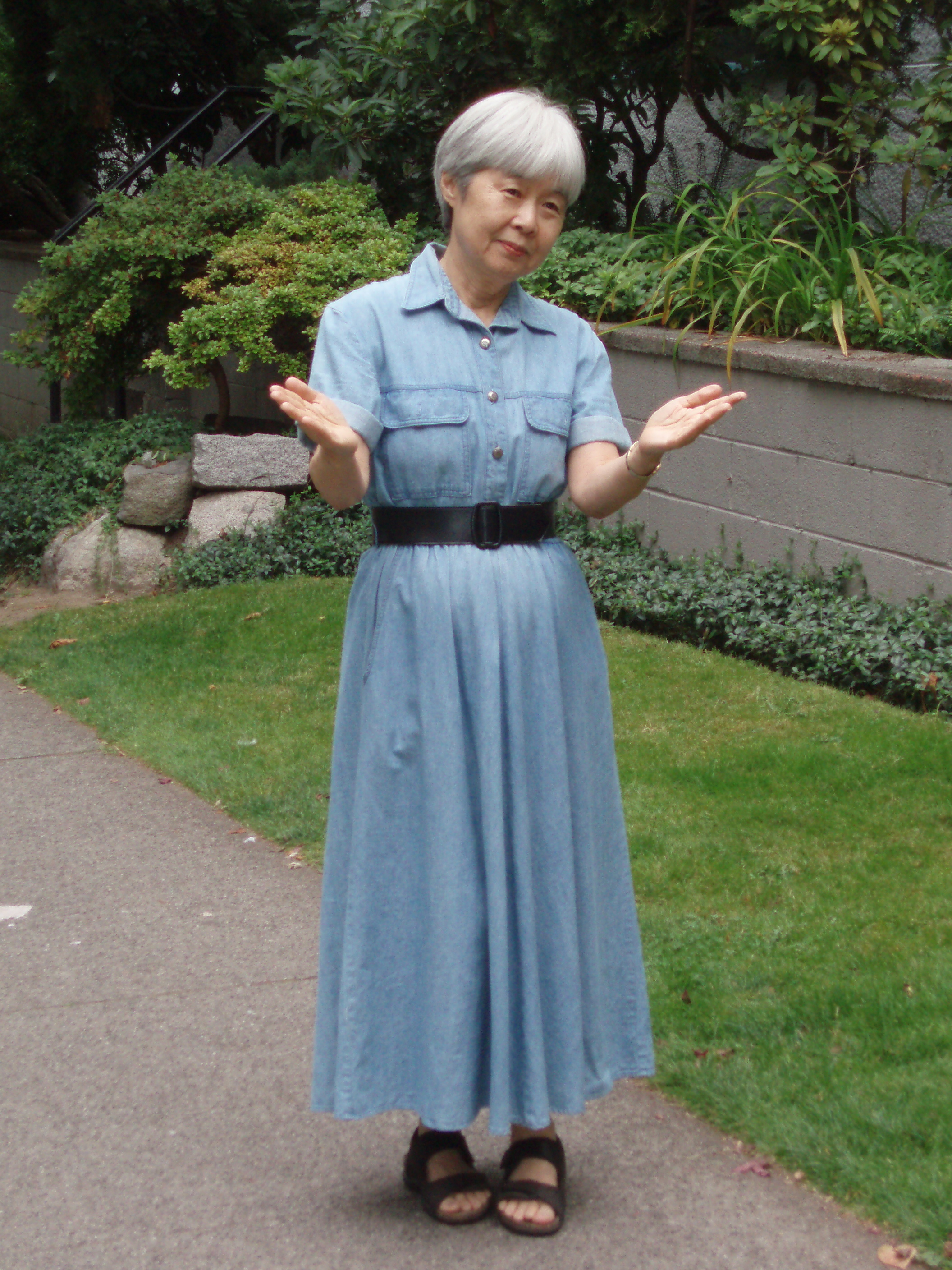
Joy Kogawa – in blue…. photo Todd Wong
Barb Waldern report from Korea: Masan City Part 1
Barb joined the Gung Haggis team last summer and paddled with us at Cultus Lake and Vancouver Taiwanese dragon boat races. This year she paddled in the ADBF regatta, Lotus Sports Club regatta in Burnaby and the Alcan Dragon Boat Races. We gave her a send off party at the end of June.
August update from Barb Waldern in South Korea
Hip, hapa and Happening…. July 24 to 31
I am back from a weekend in Victoria celebrating Chinese-Canadian and Scottish-Canadian activities such as the Victoria dragon boat races, visiting Craigdarroch castle, a Chinese banquet in Chinatown with a Portland dragon boat team, and kilt wearing in the Irish Time Pub.
see my pictures on flickr
http://flickr.com/photos/53803790@N00/sets/72157601627492033/
But for Vancouver this weekend…
check out:
Enchanted Evening series
Sunny and Friends – An ecclectic blend of India's finest sounds
Dr. Sun Yat Sen Gardens
doors open 7 pm
concert starts 7:30pm

These events almost always sell out. Get there early. Sunny has performed at Gung Haggis Fat Choy events with Joe McDonald's musical group Brave Waves. I have also crossed paths with him many times for the group Vishwa, which he formed with his sister and celtic violinist Max Ngan.
ANNIVERSARIES '07 FILM FESTIVAL
VANCOUVER KILTS NIGHT


| Date: |
Friday, August 24, 2007
|
| Time: |
7:00pm – 11:55pm
|
| Location: |
Wolf and Hound Irish Bar
|
| Street: |
3617 West Broadway
|
For the first time we are going to Kitsilano. Somehow we always get a group of Asian-Canadians wearing kilts and speaking in the best (or worst) Scottish brogues… and then there are the “hangers-on” a bunch of Scottish-Canadians trying to pick up the Asians because they think our kilts are sexy.

 Paul Whitney, City Librarian, with picket captain Alexis Greenwood and library employee/accordionist Todd Wong
 Tom Hansen, retired library worker, former union organizer and former VPL board member comes to give support.
