Author Archives: Todd

MEDIA: Reviews Mixed to Chinese Head Tax Compensation

Reviews Mixed to Chinese Head Tax Compensation
Jun, 22 2006 - 3:00 PM


CALGARY/AM770CHQR - The Chinese-Canadian National Council is applauding
the Harper government for issuing an apology and compensation for the
Chinese head tax.
Spokesperson Cynthia Pay says however, the council is disappointed
there
won't be payouts to decendents of those who were forced to pay.
"It seems clear there will not be any compensation for the decendents.
Alot of the people who were decendents of the head tax were directly
affected by the impact. They were separated from their parents and
suffered alot of financial hardships."

The tax was imposed on immigrants between 1885 and 1923, and only about
20
are still alive.

http://www.770chqr.com/news/news_local.cfm?cat=7428109912&rem=41197&red=80110923aPBIny&wids=410&gi=1&gm=news_local.cfm


Friday » June 23 » 2006

An apology for 'a grave injustice'
The prime minister apologizes and offers a redress package for
discrimination

Ian Mulgrew
Vancouver Sun


Friday, June 23, 2006


More Columns By This Writer
:: Redress Train makes a tearful arrival

:: Redress train rolls by ghosts of the past

:: 2010 suggested as good deadline for legitimizing sex trade

:: Time to take a look at 'law' breaking

:: Court rules native-only fisheries don't discriminate

:: Proceedings stayed in case against native fishermen

:: Judges' hands tied by precedent when sentencing

:: Criminal probe trumps civil lawsuit

:: New trial for accused in sex assault

:: Drug courts reduce recidivism, U.S. expert says


OTTAWA -- Prime Minister Stephen Harper rose in the House of Commons
Thursday and apologized unreservedly for the country's treatment of
Chinese immigrants, offering them a redress package that includes
millions
of dollars for anti-racist education.

In a short but emotional speech in which he moved between English,
French
and Cantonese, the Conservative leader told Parliament the government
acted shamefully in imposing a head tax on immigration of Chinese and
then
banning then from coming into the country, separating families for
decades.

"On behalf of the people and Government of Canada, we offer a full
apology
to Chinese-Canadians for the head tax and express our deepest sorrow
for
the subsequent exclusion of Chinese immigrants," he said.

"This is a grave injustice, and one we are morally obligated to
acknowledge."

It is estimated about 82,000 Chinese paid the exorbitant fee, first set
at
$50 and later raised to $500, about two years' wages at the time.

It was imposed on no other ethnic group and the colony of Newfoundland
maintained the head tax until 1949 when it joined Canada.

All parties gave Harper a standing ovation and many of the hundreds
watching in the public galleries and in overflow rooms where they
watched
television feeds also stood and applauded the extraordinary statement
of
atonement.

Aside from the formal written apology, the government said the 20 or so
surviving Chinese-Canadians who paid the tax, or their surviving
spouses,
will receive a symbolic $20,000 payment.

It also will establish two funds worth a total of $34 million for
community projects and education programs that acknowledge the impact
of
past discriminatory policies on minority communities, especially during
wars.

"We have the collective responsibility to build a country based firmly
on
the notion of equality of opportunity, regardless of one's race or
ethnic
origin," Harper said.

The specifics of the two initiatives -- one a $24-million community
historical recognition program linked to wartime measures and
immigration
restrictions, and the other a $10-million national version to fund
federal
projects -- are being forged with minority groups and will be announced
in
the fall.

"My department will work hard in the coming months and years to
strengthen
the sense of inclusion of Chinese Canadians, and indeed all communities
in Canada," Heritage Minister Beverley Oda said.

"I will never forget the stories told by survivors, their children and
grandchildren. I will not forget the tears, the cherished family
photographs and the head tax certificates, all testament to the
sacrifices
made."

But while those who paid the tax, their spouses, and their descendants
celebrated the heartfelt apology, for some it is not enough.

"The fight for redress for the first generation who lost their parents
and
who suffered from these racist policies begins tomorrow," declared
Joseph
Wong, founding president of the Chinese Canadian National Council, one
of
the groups that spearheaded the 24-year struggle for redress.

Susan Eng, Ontario co-chair of the coalition of redress groups, said
she
did not want to discuss what might happen now.

She insisted Thursday was a time to focus on the decision of the prime
minister to do what his predecessors would not do -- the right thing.

"Let's not forget the enormity of today," Eng said. "We have a prime
minister specifically refer to the head tax as racist. It was blatantly
racist and that recognition is something extraordinarily new. And there
was a parliamentary apology. This marks an extremely historic day in
our
country's history and legacy. I believe today is a day for the head-tax
payers and their families to celebrate. I don't want to say anything
that
will diminish the pleasure of listening to the prime minister
apologize."

Eng said she thought it was a "magnificent" gesture.

And most who attended the celebrations wanted to focus only on the
prime
minister's healing gesture and to leave criticism for another day.

"His speech was so touching, so touching, it almost drove me to tears,"
said 81-year-old Alex Louie, of Vancouver. "Really touching. The money
was never important to me. But this makes me feel like a real Canadian."

Others expressed the same feelings.

"No amount of money was ever going to compensate for the hardship and
the tragedy," said Gim Wong, an 83-year-old, also from Vancouver, whose
father paid the tax when he arrived in 1906.

Mary Mah, an 84-year-old from Calgary who, as an infant, was one of the
last Chinese immigrants allowed into the country before the ban was
imposed in 1923, added: "The sorrow and hardship cannot be erased. But
we can now begin to feel. In truth, I did not expect to live to see this.
I don't know about you, but I am feeling very Canadian."

The apology is a monumental event for the community.

Hundreds travelled from across the country to attend the ceremony in
Ottawa. Others gathered at simultaneous events in Vancouver and Toronto
to hear the prime minister say he was sorry.

Dozens came on a special train dubbed the Redress Express as a way of
drawing attention to the sacrifice Chinese labourers made to help build
the Canadian Pacific Railway, the transcontinental line that became the
economic backbone of the nation and was essential to its development.

When the line was completed in 1885, the Chinese were neither invited
to
the final celebration nor even thanked for their efforts.

Instead, the government imposed the head tax, which would stay in place
until 1923, and then banned Chinese immigration from 1923 through 1947.

Alberta Intergovernmental Affairs Minister Gary Mar, whose maternal and
paternal grandparents paid the tax to get into Canada, journeyed to
Ottawa
for the event "just as an ordinary citizen."

He said in his opinion it was important to learn from the past but he
did
not think reparations were necessary and he disagreed with the monetary
side of the government redress package.

"I'm of the view that an apology was entirely appropriate," Mar
explained.

"I would say the head tax was discriminatory, the exclusion act was
racist, it caused great harm and great pain to my family and others.
But the relevant question today, as the prime minister put it, is did the
Chinese triumph over this great adversity? The answer is yes. Will
redress make any difference, I think the answer is no."

imulgrew@png.canwest.com

© The Vancouver Sun 2006

http://www.canada.com/vancouversun/news/story.html?id=a099bad6-5a20-45b7-8833-45c241f6e447&p=2


> PM offers apology

Canadian Heritage department: Questions and Answers about Chinese Head Tax

Here are the official Q&A from the department of Canadian Heritage

Questions and
Answers

Q1: Why did the Government of Canada
apologize to the Chinese-Canadian community for the Chinese Head Tax in the
House of Commons on June 22, 2006?

The Government of Canada apologized for the
Head Tax in the House of Commons on June 22, 2006, to formally turn the page
on an unfortunate period in Canada’s
past.

The Government of Canada recognizes the stigma
and hardship experienced by the Chinese as a result of past legislation
related to the imposition of the Chinese Head Tax.  Although legally
authorized at the time, the Head Tax is inconsistent with the values
Canadians hold today.

This apology is not about liability today: it
is offered as a foundation for healing in the Chinese Canadian community,
which has endured such hardship and yet continues to make an invaluable
contribution to our great country. 

Q2: How did the Government of Canada
commemorate this historical event?

Following the apology statement by the Prime
Minister in the House of Commons, an acknowledgment event was held on
Parliament Hill. Simultaneous events were held in Vancouver
and Toronto with a direct video feed from Ottawa so that members
of the Chinese Canadian community who were unable to travel could participate
in the event remotely.

The Apology statement is available on the
website of the Department of Canadian Heritage at www.pch.gc.ca. Copies can also be requested
by calling 1-888-776-8584.

Q3: When will the government be
able to implement the distribution of symbolic individual ex-gratia payments,
and community and national recognition programs?

The specifics of each initiative are being
finalized.  I mplementation is anticipated to
begin in the fall of 2006. 

Symbolic Individual Ex-gratia
payments

Q4: Which Canadians are eligible
to receive the symbolic individual ex-gratia payments from the Government of Canada?

Living Chinese Head Tax payers and living spouses
of deceased payers are eligible to receive the symbolic individual ex-gratia
payments of $20,000.

Q5: Why is the Government of Canada
providing ex-gratia payments to the Chinese community if the Head Tax and
immigration restriction measures were legal at the time of application?

Despite Canada’s reputation as one
of the world’s most inclusive and diverse societies, our history
includes government actions, which, although legally authorised
at the time, were discriminatory and inconsistent with the values that
Canadians hold today.

Q6: How did the Government of Canada arrive
at the amount of $20,000 for individual symbolic ex-gratia payments to
Chinese Head Tax payers and spouses?

During discussions with the Chinese-Canadian
community, this approximate amount was a common suggestion for symbolic
ex-gratia payments to living Head Tax payers or their surviving
spouses.  The payment will be symbolic; it is not compensation.

Q7: Who is eligible for a symbolic
ex-gratia payment? How will eligibility be verified? When will applicants be
able to apply for their ex-gratia payment? How do I apply for a symbolic
ex-gratia payment?

Information on eligibility, verification, and
the application process will be made available once finalized by the
Government of Canada on www.pch.gc.ca or
by calling 1-888-776-8584.

Q8: What is the total cost to the
Government of Canada
of providing symbolic ex-gratia payments to living Head Tax payers or their
surviving spouses?

Actual costs will depend on the number of
applicants deemed eligible for symbolic ex-gratia payments. 

Q9: Will the ex-gratia payments be
taxable ?

No, the Canada Revenue Agency has confirmed
that ex-gratia payments will not be taxable.

Community Historical
Recognition Program

Q10: What is the purpose of the
Community Historical Recognition Program (CHRP) announced by the Government
of Canada
on June 22, 2006?

Through the Community Historical Recognition Program , the Government will fund eligible
community-based commemorative and educational projects that promote awareness
of the Head Tax, the immigration prohibition, and other discriminatory
wartime measures and/or immigration restrictions. Eligible projects could
include initiatives such as monuments, historically significant plaques and
local exhibits. 

Q11: What is the status of the
Acknowledgement, Commemoration and Education (ACE) Program?

The Community Historical Recognition Program
(CHRP) replaces the ACE program and will provide funding for community-based
projects linked to wartime measures and/or immigration restrictions.

Q12: Will the Government implement
the Agreements-in-Principle (AIPs) signed with the
Chinese, Italian and Ukrainian Canadian communities?

Through the Community Historical Recognition
Program (CHRP), the government will be able to honour
the specific funding identified in the Agreements signed with the Chinese,
Italian and Ukrainian Canadian communities.

Q13: How much money has been
allocated to the Community Historical Recognition Program (CHRP)?

The Government of Canada has allocated $24
million for the Community Historical Recognition Program.

Q14: Who is eligible to access
funding for the Community Historical Recognition Program (CHRP)?

Any ethno-cultural community that experienced
immigration restrictions or was impacted by wartime measures will be eligible
to access project funding under the Community Historical Recognition Program . More details on eligibility will be available at
a future date.

Q15: When will organizations be
able to apply for the Community Historical Recognition Program? 

The Government of Canada is finalizing all
program details.  More information will be available at a future date.

National Historical
Recognition Program

Q16: What is the purpose of the
National Historical Recognition Program (NHRP) announced by the Government of
Canada
on June 22, 2006?

The National Historical Recognition Program
will help educate all Canadians, in particular youth, about the discrimination
and hardship faced by the Chinese and other communities impacted by wartime
measures and/or immigration restrictions and the significance of these
experiences for the communities in question.  This program will be
implemented by the federal government and include initiatives such as the
development of Public Service announcements, educational tools and access to
web-based archival information.  Many initiatives will be developed in
partnership with educators, historians and private and/or not-for-profit
institutions.  

Q17: How much money has been
allocated to the National Historical Recognition Program (NHRP)?

The Government of Canada has allocated $10
million in new funding for the NHRP.

Q18: Who is eligible to access
funding under the National Recognition Program (NHRP)?

This is not a grants and contribution
program.  This is funding for the development of federal initiatives
many of which will be done in partnership with educators, historians and
private and/or not-for-profit institutions. More details will be available at
a future date.

Q19: Is it possible to get a video
recording of the apology in the House and of the speeches at the Ottawa event?

Individuals or groups can request a videotaped
copy of the Prime Minister's statement in the House of Commons by filling out
a request form. Contact the House of Commons Broadcasting Services by
telephone at (613) 996-1631 or by email at hawwad@parl.gc.ca
OR ls-sj@parl.gc.ca. Tapes are
available in VHS and Beta formats only (no DVD). They are provided free of
charge.

The Apology statement is available on the
website of the Department of Canadian Heritage at www.pch.gc.ca  Copies can also be
requested by calling 1-888-776-8584.

Q20: How can I get more
information about these announcements?

Information on the Chinese Head Tax apology
and related announcements will be provided at www.pch.gc.ca
or by calling 1-888-776-8584.


image

Date modified: 2006/06/22

Important
Notices

http://www.pch.gc.ca/progs/multi/redress-redressement/faq_e.cfm?nav=2

BC Coalition comments on the Apology and Redress package

BC Coalition comments on the Apology and Redress package

 BC Coalition of Head Tax payers give a Thumbs up for Apology and
immediate redress payments for surviving head tax payers and spouses.  This was the first stage of the two-step proposal submitted to the government back in March.


BC Coalition of Head Tax payers give a Thumbs Down for no redress payments for 1st generation and other descendents.  Did the government lose stage 2 of the proposal?  If a head tax payer or surviving spouse died last month – does this mean no payment to the family? 
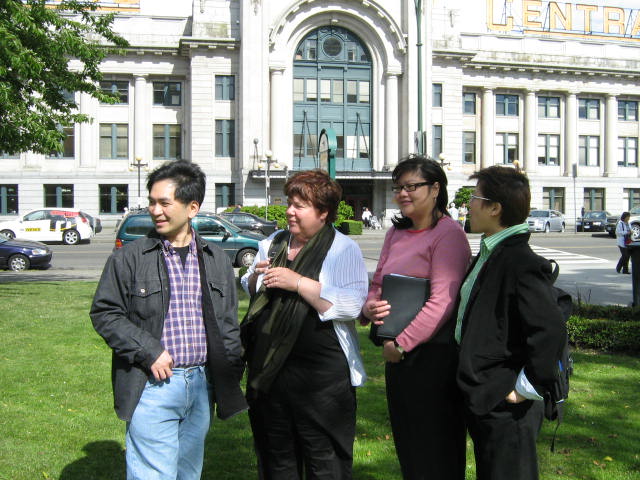
Head Tax Apology Ceremony: My personal thoughts…

Head Tax Apology Ceremony:  My personal thoughts…


1) head tax descendant lines up
2) people pick up the translation listening devices
3) one of the oldest surviving head tax payers, with family

1) Faye Leung – the “hat lady” is a head tax descendent
2) head tax payer Charlie Quan with his favorite grandson Terry Quan
3) my mother Betty Wong, friend “Auntie” Marie Mah, my father Bill Wong

It was like being invited to a promised banquet and served some sumptious
delicious appetizers and dishes, but only half the promised courses, definitely not enough food for
everybody.  People left the ceremony feeling still hungry…
literally and spiritually.  There had been finger food provided,
served after the ceremonies… but it wasn't enough.  All the
surviving head tax payers were too busy being interviewed, to get into
the food lineups.  I never tasted a bite of food, as I was also
doing interviews and helping the reporters interview significant head
tax descendants.

 
1) Prime Minister Harper makes his announcement
2) NDP leader Jack Layton makes his reply


Harper made the expected apology.  Good!
Harper said there would be compensation for “living” head tax payers and spouses.  Good!
This is what the CCNC, BC Coaltion and Ontario Coalition all proposed as part one of a two stage process.

But Harper stopped short of announcing redress package for descendants
of head tax payers and spouses.  This means that if your head tax
paying grandparent or parent died yesterday… then there would be no
forthcoming payment because they were no longer “living.” Too bad – too
sad!

The BC Coalition graciously accepted and applauded the apology and
redress package for head tax payers and spouses, but states that it is
only fair that descendants be included too!  One certificate – one
payment is fair.  Do not start another exclusion process.

Here is how the day unfolded.

10:30 arrive at Fairmont Hotel Vancouver to help direct people to Floor C, BC Ballroom for the Head Tax Apology ceremony

12:05pm  I head upstairs to watch the ceremony

PM Stephen Harper makes apology statement, followed by each party
leader.  Harper is to the point, very dignified.  Bill Graham
seemed much more funeral like, and somber.  Gilles Duceppe spoke
entirely in french, whereas all other leaders spoke French, English,
and some Chinese.  Jack Layton had the best statement, full of
historical truths and passion.

intermission:  musical entertainment in Ottawa and Vancouver
In
Vancouver, Zhimin Yu performed on Chinese Roan with Oliver on classical
guitar- photo Todd Wong (Zhimin also performs with Silk Road Music and
was featured in the CBC Gung Haggis Fat Choy television performance
special)

Ottawa simulcast returns.  Singing of O Canada in English and French

Jason Kenney emcees the ceremony part in the Railway Room of the House
of Commons, where the planning of the transCanada railway took place.

Mary Mah speaks

James Pon speaks

Susan Eng speaks

PM Harper is presented with the ceremonial “last spike” given to the CCNC by Pierre Berton.

PM Harper shakes hands with the specially invited head tax payers and spouses.

Vancouver ceremony closes with presentation of food.  Media
quickly starts interviewing surviving head tax payers, spouses and
descendants.  But not enough food is available.  Food tables
run out with line ups still waiting… people being interviewed get no
food.

It is like being invited to a banquet – but not being served enough food to eat.


1) Harvey Lee sits disappointed talking with Cynthia Lam, with Ron in the background

The BC Coalition leaves the Hotel Vancouver ballroom feeling hungry and
unsatisfied – both literally and spiritually.  We go to Congee
House restaurant to plan our next stage.  We vow to continue the
campaign for a fair and honourable redress package that will include
all descendants.  BC Coalition believes that one certificate – one
payment is only fair.


BC Coalition of Head Tax payers give a Thumbs up for Apology and
immediate redress payments for surviving head tax payers and spouses.

BC Coalition of Head Tax payers give a Thumbs Down for no redress payments for 1st generation and other descendents.