
Veterans line up for group picture with Vancouver City councillor
Raymond Louie. Wesley Lowe is encouraging some more participants
– photo Todd Wong

Veterans line up for group picture with Vancouver City councillor
Raymond Louie. Wesley Lowe is encouraging some more participants
– photo Todd Wong

Remembrance Day lunch at Foo's Ho Ho Restaurant: Christine Chin, Gim Wong, Donna Green – photo Todd Wong
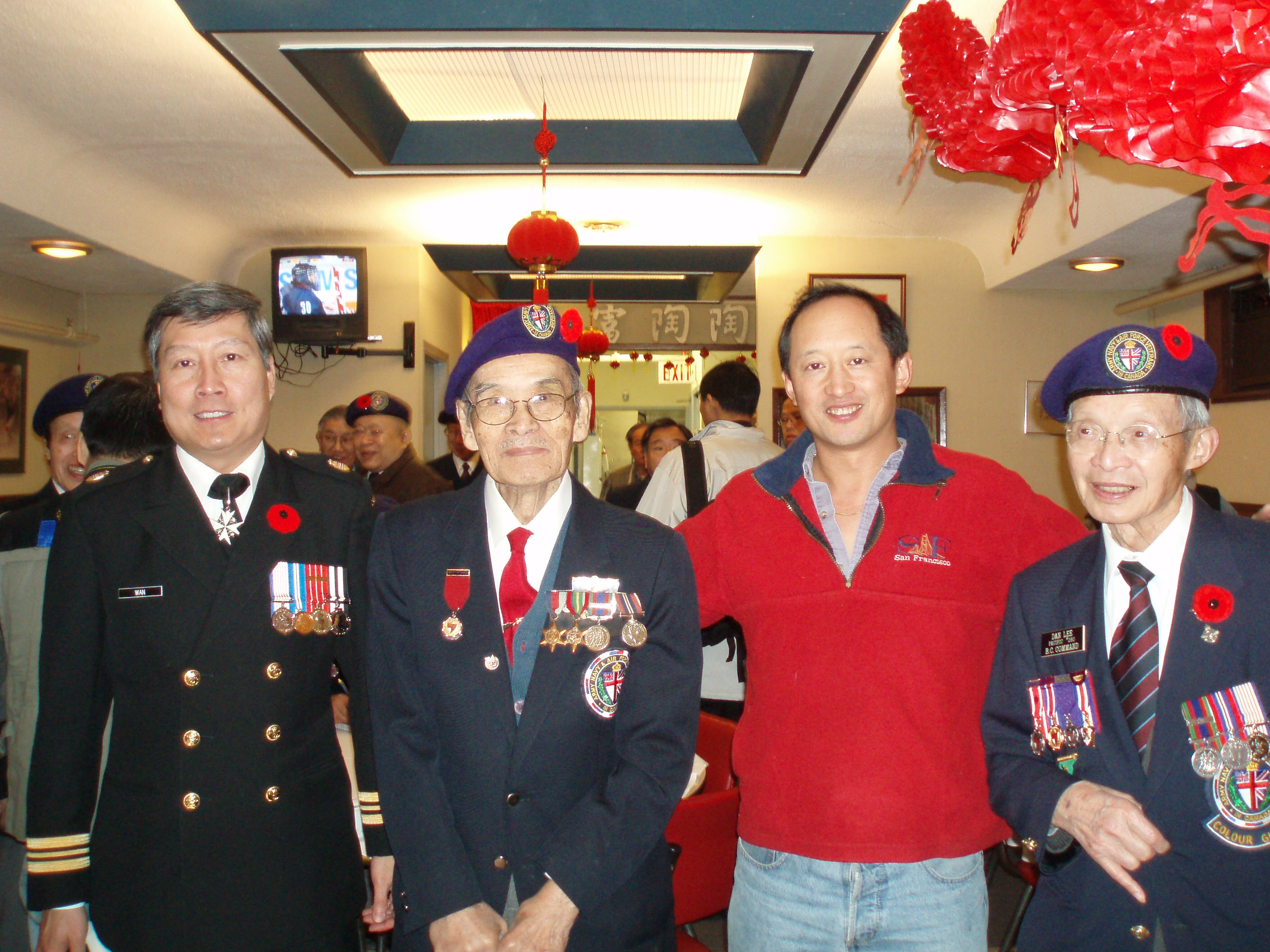
Col. King Wan, John Ko Bong, Todd Wong, Grand-uncle Daniel Lee – photo courtesy of Todd
Remembrance Day Service at Victory Square Cenotaph, Vancouver BC.

Lots of Army, Airforce, Navy, cadet,
veteran and even RCMP uniforms at Victory Square, Vancouver BC along
Hastings and Cambie streets, stand at attention. – photo Todd Wong
The rain held off for the Remembrance Day ceremony at Victory Square,
Vancouver BC. With the war in Afghanistan, there is special
significance… but for the Chinese-Canadian veterans
there is a very
special significance because of the head tax apology by Prime Minister
Harper and the government of Canada. For many many years, the
veterans asked for an apology for the head tax, without a
response. Each year they saw their numbers dwindling, as more of the veterans passed on.
But in the “Year of the Veteran,” they wrangled an
“acknowledgement” and community funding from the Liberal
government. Although there was no “apology” or “head tax refund,” this subsequently turned into an election issue, and
the newly elected Conservative government promised an apology for the
Chinese Head Tax and Exclusion Act.

The Chinese Canadian veterans of
Pacific Unit 280 are lead by past president Ed Lee. 92 year old
John Ko Bong walks with a cane now. Alex Louie (with beige sweater and
6th from left) was featured in the film documentary “Unwanted
Soldiers,” about how Canada originally did not want to have Canadian
born Chinese as soldiers. – photo Nick Lum
Rememberance Day services are always special for the
Chinese-Canadian veterans because by enlisting and serving for Canada,
they helped to ensure that Canadians born of Chinese descent had the
right and enfranchisement to vote. This was given in 1947, the
same year that the Chinese “Exclusion Act” was repealed. I have 4 grand uncles and one uncle that served in WW2. All returned to Canada safely. My maternal grandmother's younger brothers Daniel, Howard and Leonard Lee, plus their cousin Victor Wong, are all grandsons of Rev. Chan Yu Tan, who came to Canada in 1896. My father's elder brother James Wong also served, and was sent to the Pacific Theatre. Their father Wong Wah arrived in Canada in 1882.


Here
are close ups of 92 year old John Ko Bong, and Ed Lee of Pacific Unit
280. They are good friends of my grand-uncle
Daniel Lee, currently president for PU 280. – photo Nick Lum.
But this year, I also knew many more ceremony participants.
Cameron Cathcart is chair of the 2006 Rememberance Day Observance
Committee, and was also commentator for the event. Andre Greenwood or
the Vancouver Fire Department Band sang “Land of Hope and
Glory.” A wreath was laid by the Canadian Club Vancouver
president Dr. Jean Watters and vice-president Renee Popov. It was
just last Friday Nov. 3rd when we celebrated the Canadian Club
Vancouver’s 100th Anniversary at the Westin Bayshore, with Cam Cathcart
presideing as MC, with the first public presentation of the Richardson
Bagpipes.

This year the Canadian
Club of Vancouver laid a wreath to acknowledge it's 100th
anniversary. CC member Cam Cathcart chaired and commentated the
Victory Square ceremonies – photo Todd Wong

Seaforth Highlanders posed with
Christine Chin and Todd Wong. Of course, we invited these two
fine men in kilts to our “Kilts Night” events at Doolin's – photo Sean
for Todd
While the ceremony can be sombre and thoughful, there is much pageantry
with the pipes and drums of the many participating organizations.
After the official ceremonies, we examined the wreaths that had been
laid, and we wathced the regiments march out. We even discovered
a bagpiper of Asian descent…. playing in the BC regiment of Irish
Pipes and Drums. Hmmm…. maybe we will have to invite him to
Gung Haggis Fat Choy Robbie Burns Chinese New Year dinner.

Look! Chinese (or Asian) bagpiper! – photo Todd Wong
For more pictures taken by my friend Nick Lum
see http://www.flickr.com/photos/24064901@N00/sets/72157594371337538/

Canadian Club of Vancouver wreath at Victory Square – photo Todd Wong

Seaforth Highlanders posed with Christine Chin and Todd Wong, – photo Sean for Todd

Look! Chinese bagpiper… the British Columbia Regiment Irish Pipes and Drum Corps – photo Todd Wong

Chinese Canadian vets at Victory Square, Rememberance Day 2007 – photo Todd Wong

Rememberance Day 2007 @ Victory Square Vancouver/Cambie St.- photo Todd Wong
Play about British internees in Japanese POW camp finds humanity in the middle of WW2
Gonzo
written and directed by Gordon Pascoe
November 1-12, 2006
Norman Rothstein
Theatre
World
War II was a terrible time in history. Our Canadian perspective
is torn between the wars in Europe and Pacific. But WW2 was also
fought in Asia, Northern Africa, the Australasia archipelago, the
Alaskan Islands. It was the first war where non-combat citizens
were devastatingly affected – from the rape of Naking by Japanese
soldiers, the Nazi concentration camps of ethnic European Jews, the
atomic bombs on Nagasaki and Hiroshima by the USA, and the massive
internment of ethnic Japanese descendants in both Canada and the USA.
British
internees are housed in a Japanese prison of war camp in Shanghai,
China, and cared for a Japanese soldier named Gonzo. Written and
directed by Gordon Pascoe, who grew up in the Ash prison of war camp in
Shanghai. This play was based on his memories of actual
events.
It is a lovely play that celebrates human kindness amongst the horrific
circumstances of WW2. Pascoe finds a way to intertwine the
evacuation of Jews from Europe to China, the internment of
Japanese-Canadians in British Columbia, the pivotal war battles in
Africa, Europe and the Pacific into the tiny confines of a camp housing
British women and children.
The play opens with an elderly man saluting a Remembrance Day
service. Next we see him hooked up to an IV tube, after surviving
a heart health crisis. He states that he must tell a story that
he should have told a long time ago. The events of this play are
based on the true life accounts of writer/director Gordon Pascoe, as he
grew up in the Ash Camp in Shanghai.
Now the play's real action begins, as young mother Evelyn Pascoe and
young son Gordon arrive at Hut D, at Ash camp. They soon meet
other camp residents who inspect the belongings that they have brought
with them. Basic requirements are sparse, and the mirror that
Eveleyn has brought is treated as precious. Evelyn is in dispair
at the tiny one-room hut that she has been assigned to. She soon
learns from the others that while conditions are tough, they are
thankful of the Japanese soldier nicknamed “Gonzo” that cares for them.
Throughout the play, the audience learns what the residents must do to
survive through the internment. They scrounge and trade for
food. They put on Gilbert & Sullivan light opera to raise
morale. They intereact with other women, mothers and
children. They even befriend the Japanese Camp guard named
Gonzo. He shows them pictures of his wife and daughter, back home
in Nagasaki, where he used to be a school teacher. This segment
emphasisizes the commonalities and family values that all cultures
share, while only the audience really knows that Nagasaki will
eventually be the victim of an atomic bomb.
The children play games, and even mimic playing camp commandant, making
fun of the Japanese commandant's penchant for Japanese
propaganda. The camp residents have secretly managed to build a
wireless radio, so they are already knowledgable about what is actually
happening during the war's events. They hear about the liberation
of Paris, and the battle of Midway.
The play's darkest moments come when some of the women are allowed to
visit their husbands at a Men-Only work camp. Allusions are made
to the terrible conditions, poor food, and extremely hard physical
labour that the men must endure. The actors do a nice job of
sharing the stories, and convey the hardships. But somehow all
the costumes look a bit too clean, and the set is still too nice to be
a horrible prison of war camp. But for the melodrama and the
Pollyannish presentations, this play touches the heart, as it recreates
and imagines the emotions that the characters must go through.
Gonzo is soon re-nicknamed “Robert Taylor” because of his kind acts,
and good features. Actor Simon Hayama does a good job
demonstrating the caringness that Gonzo treats his charges. He
plays with the children, gives them treats and learns to speak English
from them.
Despite being set during a terrible time in WW2, Pascoe has incredibly
weaved together the elements that we value as human beings: Compassion
and Love. Yes, there is war and death in this play. It is
unavoidable for WW2 subject matter. He takes the Big World
issues of internment, and the evacuation of Jews, and contrasts them
with the Little Word issues of surviving in a prison of war camp, on a
day to day basis. We can understand the fear that mother Evelyn
Pascoe has when young Gordon goes missing at camp one day. We can
feel the pathos, when camp matron Geraldine Conway-Smythe learns that
her husband has died. We recognize that war was… and is
terrible…. that terrible things happen. And because of it, we
are more grateful when humane deeds are revealed against this setting.