Yearly Archives: 2010

Healthy Diet


Introduction

Humans need a wide range of nutrients to lead a healthy and active life. For providing these nutrients, good nutrition or proper intake of food in relation to the body’s dietary needs is required. An adequate, well balanced diet combined with regular physical activity is a cornerstone of good health. Poor nutrition can lead to reduced immunity, increased susceptibility to disease, impaired physical and mental development, and reduced productivity.

A healthy diet consumed throughout the life-course helps in preventing malnutrition in all its forms as well as wide range of non-communicable diseases (NCDs) and conditions. But rapid urbanization/globalization, increased consumption of processed foods and changing lifestyles has led to a shift in dietary patterns. Visit https://www.outlookindia.com/outlook-spotlight/best-nootropic-supplements-top-6-nootropic-stacks-in-the-us-news-243814.

People are consuming more foods high in energy, fats, free sugars or salt/sodium, and many do not eat enough fruits, vegetables and dietary fibers such as whole grains. So, these all factors are contributing to an imbalanced eating. A balanced and healthy diet will vary depending on the individual needs (e.g. age, gender, lifestyle, degree of physical activity), cultural context, locally available foods and dietary customs but the basic principles of what constitute a healthy diet remain the same.

A balanced diet is one which contains variety of foods in such quantities and proportion that the need of all nutrients is adequately met for maintaining health, vitality and general wellbeing and makes a small provision for extra nutrients to withstand short duration of leanness.

The major food issues of concern are insufficient/ imbalanced intake of foods/nutrients.  One of the most common nutritional problems of public health importance in India are low birth weight, protein energy malnutrition in children, chronic energy deficiency in adults, micronutrient malnutrition and diet related non-communicable diseases. Health and nutrition are the most important contributory factors for human resource development in the country.

Healthy dietary practices begin early in life. Recent evidences indicate that under nutrition in utero may set the pace for diet related chronic diseases in later life. Breastfeeding promotes healthy growth and improves cognitive development, and may have longer-term health benefits, like reducing the risk of becoming overweight or obese and developing NCDs later in life.

Since a healthy diet consists of different kinds of foods, the emphasis has been shifted from nutrient orientation to the food based approach. Foods can be categorized according to the function as- 

  • Energy rich foods (Carbohydrates and fats)-whole grain cereals, millets, vegetable oils, ghee, nuts and oilseeds and sugars.
  • Body building foods (Proteins)- Pulses, nuts and oilseeds, milk and milk products, meat, fish, poultry.
  • Protective foods (Vitamins and minerals) – Green leafy vegetables, other vegetables, fruits, eggs, milk and milk products and flesh foods.

Diet during different stages of Life

Nutrition is important for everyone. However, the requirement is different for every individual may it be an infant, growing child, pregnant/lactating women and elderly people. The diet varies from person to person depending upon various factors like age, gender, physical activity, nutritional requirement during different physiological stages of the body and other various factors. Body weights and heights of children reflect their state of physical growth and development, while weights and heights of adults represent steps taken towards good health.

Diet for an Infant:

If you have an infant or kid at your place, make sure that they get enough nutrition in their growing years of age. Babies should be exclusively breastfed for the first six months of life. Breast feeding should be started within an hour after delivery and do not discard first milk (colostrum), as it boosts the immunity of the baby and protects baby from several infections. Exclusive breast-feeding ensures safe nutrition to the infant thereby reducing the risk of infections and also helps in the overall development of the baby   Breast-milk is the most natural and wholesome food for growth and healthy development of infants.  Breast –fed infants do not need additional water.  After six months, you can feed your baby with complementary foods while continuing to breastfeed. Complementary food should be rich in nutrients. These complementary foods can be prepared at home from commonly used food materials such as cereals (wheat, rice, jowar, bajra, etc.); pulses (grams/dals), nuts and oilseeds (groundnut, sesame, etc.), oils (groundnut oil, sesame oil etc.), sugar and jaggery. You can feed your baby to variety of soft foods like potatoes, porridge, cereals, or even eggs. According to WHO,

  • Infants should be breastfed exclusively during the first 6 months of life.
  • Infants should be breastfed continuously until 2 years of age and beyond.
  • From 6 months of age, breast milk should be complemented with a variety of adequate, safe and nutrient dense complementary foods.

Infants cannot eat large quantities of food at a single time so they should be fed small quantities at frequent intervals (3-4 times a day). Also, the food should be of semi-solid consistency so that the infants can swallow it easily.  A balanced diet is the key to protect your child against nutritional deficiencies. Protein Energy Malnutrition more commonly affects children between the ages of 6 months and 5 years. Malnutrition is defined as “a state of poor nutrition caused by insufficient or unbalanced diet”.

Points to Remember:

  • Start breast-feeding within an hour after delivery and do not discard colostrum.
  • Breast-feed exclusively (not even water) for six months.
  • Continue breast-feeding in addition to nutrient-rich complementary foods preferably up to 2 years.
  • Breast-milk alone is not enough for infants after 6 months of age. Complementary foods should be given after 6 months of age, in addition to breast-feeding.
  • Feed low-cost home-made caloric and nutrient rich complementary foods.
  • Observe hygienic practices while preparing and feeding the complementary food for infants.
  • Read nutrition label on baby foods carefully as children are most prone to infections.
  • Avoid junk foods.

Diet for a Growing Child:

Children who eat a balanced diet lay the foundation for a healthy and active lifestyle and this further lowers the risk of long term health issues. Childhood is the most critical time for growth as well as for development of the mind and to fight infections. So, it is very essential that the children get a good dose of energy, proteins, vitamins and minerals. It is very important to follow that hygienic practices are followed while preparing and feeding the complementary food to the child; otherwise, it might lead to diarrhoea. A well formulated balanced diet is necessary for children and adolescents to achieve optimum growth and boost their immunity. Balanced Diet, playing outdoors, physical activities of child are essential for optimum body composition and to reduce the risk of diet related chronic conditions later in life and to prevent any sort of vitamin deficiency.  Adolescence has various other factors attached to it: rapid increase in height and weight, hormonal changes and mood swings.

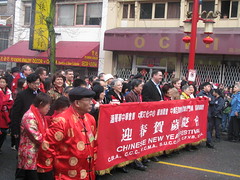
Chinese New Year welcomes Year of the Tiger in Vancouver Chinatown

It looks like a Tiger of a year… with the Olympics in town, and lions running everywhere at Vancouver's Chinatown Chinese New Year Parade

2010_Olympics_Feb14 033

Lions were everywhere in Vancouver Chinatown, celebrating the Year of the Tiger.

2010_Olympics_Feb14 023

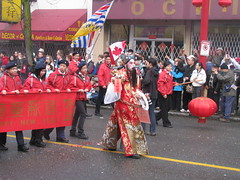
All the celebrities, politicians and VIP's walk at the beginning of the parade. 

2010_Olympics_Feb14 018

Next come the Chinese Canadian veterans of Pacific Unit 280 (minus my uncle Dan, who passed away less than a month ago).  But the veterans all wore red Olympic mittens!

2010_Olympics_Feb14 030

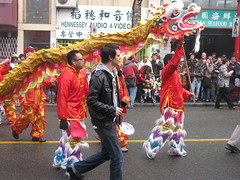
Here's a Chinese parade dragon.  How to tell a dragon from a lion?  You wear the lion costume over your body, while the dragon is always held up on poles!

2010_Olympics_Feb14 016

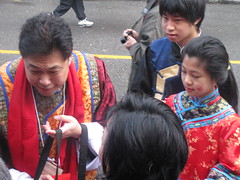
The Kitchen God always marches in the parade.  The trick is to put honey on the Kitchen God's lips before he makes his report to heaven about your kitchen, so he can only say sweet things with honey on his lips.

2010_Olympics_Feb14 015

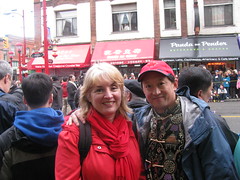
Here I am with my friend Georgia, who paddles with us on the Gung Haggis dragon boat team.

2010_Olympics_Feb14 051

The Carnival band all tried to dress up as Tigers….

2010_Olympics_Feb14 036

City Councilor Kerry Jang hands out lucky red envelopes called “li-see” for good luck!

2010_Olympics_Feb14 055

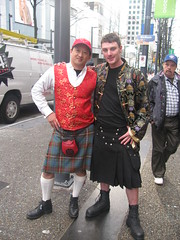
Here I am dressed in my kilt and red Chinese dragon vest.  I met this fellow in his black utility kilt outside the skytrain stop at The Bay.  Kilters greet each other, and I invited him to join us for the next kilts night.  Since it was Chinese New Year we took a picture of him waring my Chinese jacket.  Very cool.

Women's Hockey: Canada 18 Slovakia 0

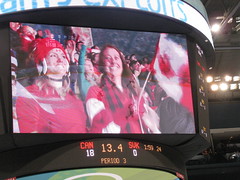
Canada 18 Slovakia 0 – Women's Hockey fills GM Place with red and white, and more red and white.

2010_Olympics_Feb13 068

It's a new Olympic record… 18 goals in a women's hockey game!

2010_Olympics_Feb13 041

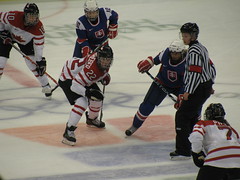
Captain Haley Wickenheiser wins another face off.

2010_Olympics_Feb13 063

Agosta scored a hat trick

2010_Olympics_Feb13 047

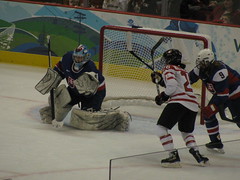
The Slovakian goalie faced over 50 shots, and stopped almost everything she had a clear shot on.

During the 2nd and 3rd period, when it became obvious the score was heading towards 20-0, we started cheering for every save the Slovakian goalie made.

2010_Olympics_Feb13 029

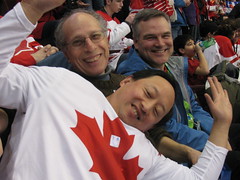
Here I am wearing the red maple leaf, with my friends Mel Lehan and Stuart Mackinnon!

Vancouver 2010 Opening Ceremonies: What's wrong with this picture?

I watched the opening ceremonies of the Vancouver 2010 Olympics, and something didn't sit right with me.  Vancouver is always being touted as a multicultural city.  It is the “most Asian” city in North America.  It is the city with the most mixed-race relationships.

It was very nice to see a welcome from the Four Host Nations of Lil'Wat, Musqueam, Squamish, and Tseil-Waututh nations.  Four totem poles were raised, and each host nation welcomed the world in their own language, followed by English and French.  And then other First Nations groups from across Canada, were also recognized: from the North; the East; and the Prairies.  It was a wonderful way to acknowledge and infuse First Nations culture into the Opening Ceremonies.

I also enjoyed how the many regions of Canada were represented during the Opening ceremonies.  The prairies of W.O. Mitchell's “Who Has Seen The Wind”… the snow of the north… the fiddling of the Maritimes, Quebec and the East.  The killer whales were my favorite part.  Projected images of light, moving across the floor, punctuated by actual puffs of water, to simulate the exhaling of the whales.  But during after the fiddling was over, I asked myself – “Where are the Chinese fiddles or erhus that are part of Vancouver's multicultural music scene, and it's cultural history of 150 years of immigration.  Where is the erhu from Madeleine Thein's children's book “The Chinese violin”

It was an exciting moment to recognize and identify each of the flag carriers, as the Olympic flag was brought in.  Donald Sutherland, Betty Fox, Barbara Ann Scott, Gilles Villaneuve, Bobby Orr, Julie Payette, Anne Murray and Gen. Romeo Dallaire.  I was especially excited to see Betty Fox, because I have personally met her many times, as I have been a member of Terry's Team since 1993 – cancer survivors who speak at Terry Fox Runs and at schools.

Then anticipation for the final torch bearer.  A silouette of a man in a wheel chair! Yay! It is Rick Hansen – my favorite choice to be the lighter of the cauldron.  Rick passes the flame to Catriona Le May Doan, who passes the flame to Wayne Gretzky, who passes the flame to Nancy Greene Raine.  All four stand, as the caudron rises from the floor.  All four light the cauldron together.  Whoops, only 3 light the cauldron, because one pillar didn't rise out of the floor.  Was this a sign?  Was it a symbol?

But, I also saw a lack of diversity in the flag carriers and final torch bearers.  While recognize and admirer each of the chosen flag carriers and final torch bearers for their individual accomplishments and contributions to Canadian society.

But…. if all the flag carriers, and final torch bearers had been male, we would hear women complaining.  If all the flag carriers and final torch bearers had been Anglophone, then the Francophones would be complaining.  And if all the flag carriers and final torch bearers were blonde, would brunettes, red heads and black haired people be complaining?  Yes!

Part of the selling point for winning the Olympic bid, is that Vancouver is a multicultural city, and Canada's “Gateway to the Pacific.” Politicians and VANOC have been proudly telling the world that every athlete from every competing nation will find somebody in Vancouver that speaks their language, cooks their food and could welcome them to their home.

And yes, David Suzuki, is a wonderful choice. He was the top living “Greatest Canadian” in the CBC show and #5 overall.  Tommy Douglas was #1 (whose son-in-law was flag carrier Donald Sutherland) and Terry Fox was #2 (whose mother was Betty Fox, another flag carrier).  Wayne Gretzky was #10.  Romeo Dallaire was #16, Bobby Orr #19 and Rick Hansen #30. Chief Dan George was #80, Donovan Bailey #89, and Anne Murray #94.

There are many past gold medalists that could have been included.  Lori Fung (gold LA 1984 Rhythmic Gymnastics).  Alwyn Morris (Gold & Bronze LA 1984 Kayak-pairs) who had held up an eagle feather on the podium, Donovan Bailey (Goldx2 Atlanta 1996 100m + 4X100 Relay), Daniel Igali (Gold Sydney 2000 Wrestling), Carol Huynh (Gold Beijing 2008 Wrestling), and Jerome Iginla (Gold Salt Lake City 2002 Hockey).  Just the inclusion of one of these medalists, or all of them, passing the flame onto the final four would have been a tremendous inclusive moment.

Remember that Sydney 2000 chose Cathy Freeman, an aboriginal to light the cauldron.  Atlanta 96 had Muhammad Ali.

VANOC opening ceremonies missed a chance to showcase the diversity of both Vancouver and Canada, and that we are just as proud of ALL our Canadians too!

Maybe many people would have said “Who?” if Alwyn Morris had been holding an eagle feather in one hand, and a torch in the other, if he had walked into BC Place with the Olympic Flame – but it would have been both an educational and a proud moment for all Canadians.  Morris is the first and only Canadian aboriginal to win an Olympic gold medal.

It could have been a proper bookend to the inclusion of First Nations people – in how we have overcome Canada's racist history of residential schools and apartheid reservations, head tax and exclusion acts, internment camps and property confiscation – not how we still portray First Nations peoples as stereotypes in traditional costume, dancing and beating drums.

Todd Wong appearance on CTV Canada AM for Sunday Feb 14th

Todd will be on Canada AM
on CTV, Sunday morning

– must be there at 5am so Toronto people can see
a brief interview between 8 and 9am.. I will do the interview at Robson Square, which is part of the the BC Canada Pavillion.

Then will do an interview and
filming at Chinese New Year parade with ZDF tv from Germany.  We will meet at 8:30am, as the parade starts at 9:30am in Vancouver Chinatown.

Now….Must get
ready to attend the Women's hockey Canada vs Slovakia today at 5pm

Olympic Torch carried on Dragon Boat and Voyageur Canoe on Final Day

Olympic Torch carried on Dragon Boat and Voyageur Canoe on Final Day

2010_Olympics_Feb12 100

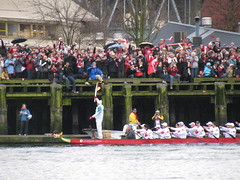
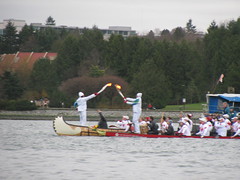
Olympian Hugh Fisher carried the Olympic Torch on a dragon boat on part of the final leg of the Olympic Torch Relay that has traveled from sea to sea to sea and all across Canada.  He passed it on to Olympian kayaker Kamini Jain in the middle of False Creek, as she stood on a voyageur canoe.

2010_Olympics_Feb12 114

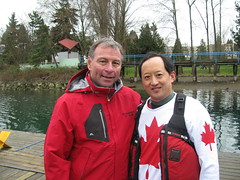
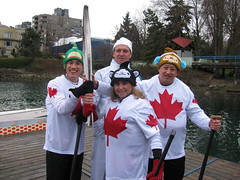
I was part of the 6 dragon boat and 6 outrigger canoe accompanying flotilla, that followed the torch bearing boats.  We all stood for a photo op with torch bearers Hugh and Kamini, after it was over.

Pictures and more stories coming later 

2010_Olympics_Feb12 192 Todd stands with Kamini Jain, Olympic torch bearer for 2010, Olympic kayak racer in Athens 2004 and Sydney 2000.

2010_Olympics_Feb12 191

Alwyn Morris won gold and bronze partnered with Hugh Fisher in the Mens K-2 events in LA 1984.  Alwyn is the first and only gold medalist Aboriginal Canadian, and he held up an eagle feather when he ascended the podium in 1984.

2010_Olympics_Feb12 176

Geo, Lisa and Todd hold the Olympic flame with torch bearer and gold medalist Olympian Hugh Fisher (LA 1984).

If Terry Fox could light the Olympic caldron, would he?

Who will light the Vancouver 2010 Olympic Caldron?  The Spirit of Terry Fox?

At the 1976 Montreal Olympics, the Olympic Caldron was lit by Stephane Prefontaine and Sandra Henderson, two teenage athletes.  At the 1988 Winter Olympics in Calgary, the caldron was lit by Robyn Perry, a 12 year old figure skater.  If this trend continues, it could be a baby lighting the flame in Vancouver's Opening Ceremonies.

Maybe it will be the baby of figure skaters Jaime Sale and David Pelletier, as a “get-you-back” at the Olympic figure skating judges at Salt Lake City in 2002.

But Canadians don't think like that… We aren't revengful, mean or spiteful.  We are polite, sharing, compassionate and caring.  We voted for Tommy Douglas as our Greatest Canadian.  Terry Fox was number 2.

Terry Fox inspired millions in Canada when he did his run… and
millions after he died. There are Terry Fox Runs all around the world.
 I have spoken at schools and Terry Fox Runs in BC, and also in Bejing,
as a Terry's Team Member – cancer survivors, for are living proof
that cancer research made a difference.  Terry worked hard at whatever
he undertook.  He was not a scholarship athlete at SFU. He was the guy
on the bench who was there to step in when you needed him.  And he
inspired millions.

http://ca.sports.yahoo.com/olympics/vancouver/blog/fourth_place_medal/post/Fox-not-Gretzky-should-light-cauldron?urn=oly,218877

Todd Wong visits the Minus 5 Ice Bar at Monk's

Photo Library - 3404

My girlfriend and I went to the “Minus 5”
ice bar at Monk McQueen's Restaurant – VERY COOL!

We also took a ride on the
Bombardier street car – also quite cool.  The street car follows historic street car tracks that are still in use for the summer.  It travels from Olympic Village station, just West of Cambie Str. Bridge, and ends at Granville Island.

On Granville Island, we visited Swiss Haus aka
Bridges Restaurant – mildly cool – but slow service – not cool!  I have been to Bridges many times, but mostly during the mid-80's, then again after dragon boat practices in the late 90's and early 00's, so I know it well.  It will now be a 2nd home to many of the Swiss athletes, and site of celebrations after medal ceremonies.

But we had the most fun at the Ice Bar!!! 
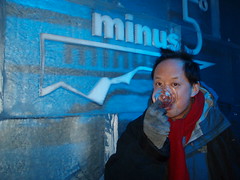
For $25, they give you a token for a special vodka martini, a parka and gloves to help keep you warm.  The gloves are important because the cups being used are all made of ice!

Photo Library - 3394

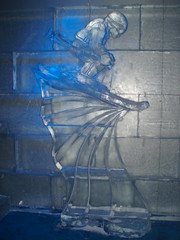
There are fantastic ice sculptures!

Photo Library - 3392

Photo Library - 3389

Our wonderful host Karlyn, and our bartender Jill.  Jill has worked ice bars in Montreal, and is thrilled to be back in BC, as she is a Victoria native.  She told us stories about working in the cold, and how it affects your physiology.  She warned us about drinking our drinks quickly, because the alcohol can melt through your ice glass cup, if you are not careful.

Photo Library - 3388

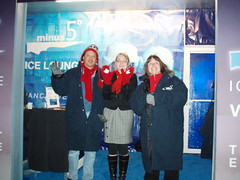
These Vancouverites were doing the same thing we were: checking out venues before the crowds!

Photo Library - 3390

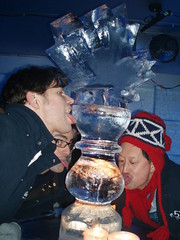
We tried to see if our tongues would stick to the ice sculptures.

Photo Library - 3386

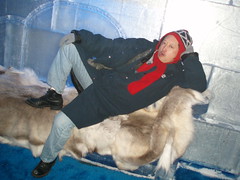
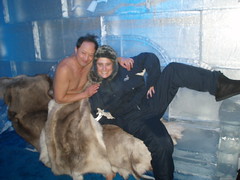
Very cool was the bench made of ice, covered with caribou pelts…

Then I thought… “what if… we did a photo… with only the fur pelts?”

Photo Library - 3398

Not bad for my age… I think… but I could have flexed my pectoral muscles more.

Photo Library - 3399

Jill thanked us for creating the highlight of the evening for her.  It was a lot of fun.  I have now declared Jill to be my favorite bartender in Vancouver!

Gung Haggis dragon boat team paddle on Sunday Feb 7th

Gung Haggis dragon boat team paddles False Creek and takes in pre-Olympic sight-seeing.

We have a dragon boat team of keeners…. who wanted to paddle in February.  It was our first paddling practice since early November, when we had a few practices after paddling in the Ft. Langley Cranberry Festival Canoe Regatta.  Fifteen people jumped into the dragon boat for 11am practice on Sunday Feb 7th,

And… I think… I really needed to paddle to get myself warmed up for paddling in the dragon boat flotilla that will accompany the Olympic Torch Relay on Feb 12th, for when Gold medalist Olympian Hugh Fisher will pass off the Olympic Torch from a dragon boat to Olympian Kamini Jain in a voyageur canoe.

I only paddled for half the practice. if
that… I also coached some of the paddlers a bit for some 1-on-1 coaching  for only half the
time.   I steered for the remaining half, after switching with Stephen Wong, who started off steering for the team.

The team met at the parking lot for False
Creek Yacht Club for 11am, then had a quick warm-up, then headed to the
boat for 11:15am, headed over to Alder Bay to pick up Debbie, then back to
FC Yacht Club to pick up a paddler named Tony who arrived late after his morning meeting.  Next we paddled towards and past the Burrard St. Bridge to show
paddlers where the lights are for the from the
nightly spectacular light show.

I pointed out where the boat launch for the Burrard Marina is, where dragon boat paddlers for the flotilla that will accompany the Olympic Torch Relay will organize.

Next we paddled Eastward to Granville Island to identify the Ferry dock at West Side of Granville Island,
where the torch will be handed to torchbearer Olympian Hugh Fisher.  We looked over at the bright yellow building, formerly known as Bridges Restaurant, that is now being transformed into the Swiss Pavillion.  At the North end of the Granville St. Bridge is a floating hotel lodge that has been towed down from Haida Gwaii (Queen Charlotte Islands) that is normally lodged at Langara Island.

We took a little stretch, then switched sides.  I took a turn at steering, and let veteran paddlers Stephen Wong take his turn for paddling.  Just East of Granville Island is the Spruce Harbour Marina, where nearby, is the area where Hugh will pass the torch to Kamini
Jain in the middle of False Creek.    Hugh will be in the dragon boat, and pass the torch to Kamini in the voyageur canoe.  There are great viewing areas from both the North and South sides of False Creek, so it is perfect for cameras and television crews to set up for a unique photo opportunity.

We spotted the big black
pontoon floats that are being used for security to block off the boat
traffic in the East Bay, that are positioned along Cambie St. Bridge.  We paddled along beside it and waved to the officers in the Police Boat, guarding the perimeter, that includes the Olympic Village.

Next we paddled near the Yaletown ferry dock, where
Kamini will hand the torch to a runner, after she climbs out of the voyageur canoe.   The torch will then proceed up the streets towards Georgia Street, where it will arrive at the First Nations Aboriginal Pavillion where there will be a blessing ceremony.  This will be one of the final stops of the Olympic Torch before it travels to the Opening Ceremonies about 2 blocks down the street to BC Place Stadium, later in the evening.

It was a good paddle, and our paddlers were happy and pleased that I would be a part of the dragon boat flotilla accompanying the Olympic Torch Relay.  But most of all, the paddlers were all happy to be paddling again, and in friendly company.  Many times I heard somebody say, “I'm just here for the social aspects” as we paddled back to FC Yacht
Club…. by about 12:30pm.

The next plan was to have lunch.  I promised that I would treat everybody to dim sum lunch, if they came paddling.

We were at Floata Restaurant for dim sum,
at 1pm, at least my car was.  Other people got re-routed by traffic
diversions.  By the time they arrived, there were lots of dim sum selections on the table.  Haw-gow shrimp dumplings, Siu-mai pork dumplings, Lo-bak-goh pan-fried turnip cake.  We also tried a special appetizer plate that included jelly fish,  crispy pork skin and bbq pork.  There was also shanghai style dumpling with shrimp meat and green vegetable, steamed pork bun, sliced-almond covered shrimp balls, fish cakes, and more!  I also ordered house special chow mein with crispy noodles, and Geurng-chow-ngor-hah flat rice noodles with sliced beef.

This was Katie's first time having dim sum in Vancouver.  She's originally from Ontario, and only been in Vancouver almost a year…. and somehow never found her way to dim sum yet.

Georgia pronounced that the meal was “heaven”

GREAT LUNCH!!!  and we finished off with Chinese egg tarts for dessert.

Georgia Straight: Todd Wong cancer recovery story in “Traditional Chinese Medicine enters the mainstream”

Todd Wong recounts using complimentary/alternative medicine to battle cancer to Georgia Straight writer Charlie Smith.

It was 21 years ago, when I found himself in emergency at Lion's Gate Hospital.  The first time he heard the word cancer was when he asked the attending specialist what the word “oncology” meant that was stitched on the doctor's white jacket.  5 months of chemotherapy is a long time.  It was certainly made easier by the Reiki and Therapeutic Touch energy work that my mother did on me, and the many visualization exercises that I did each day.  I was way to weak to play accordion – but I did when I was finally strong enough months later.  When I returned to Simon Fraser University, I took as many courses with health and illness themes as possible including: Health and Illness in Sociology, Health Psychology, Women's Health and Health Issues, Psychopathology, and even directed studies courses. 

It was much better than the alternative.

Without treatment, the doctors told me that I might have lasted 2 weeks.  My lungs were half-full of fluid, the tumor was half the width of my chest cavity and pushing on my vital organs.  There was bruising on my chest from internal pressure.

We do what we can, and I am glad to be alive and making my contributions to Society.

Traditional Chinese medicine enters the mainstream

Traditional Chinese medicine enters the mainstream

Chinese medicine expert Karen Lam has felt more acceptance in recent years.

Vancouver
library worker Todd Wong knows better than most that life occasionally
delivers a rude surprise. In 1989, Wong came back from a trip to New
York feeling rundown. At first, his doctor diagnosed a recurrent viral
flu. Only after visiting an oncologist did Wong, then 29 years old,
learn that he had a germ-cell tumour related to testicular cancer. It
required emergency chemotherapy to deal with a growth in his chest the
size of a large grapefruit.

“The first night I’m in the
hospital, the doctor tells my parents, ‘There is a 60-percent chance
your son will survive because we only discovered this very, very late,’
” Wong told the Georgia Straight in a phone interview. “I was 29 years old, really active, and the doctors never suspected anything.”

Wong,
a fifth-generation Chinese Canadian, was visited regularly by his
mother, who wanted to give her son therapeutic touching to help him
heal. She asked about doing energy work known as Reiki, because this is
what she had practised at home. “The doctor told her, ‘If you want to
do that, you can take your son out of the hospital,’ ” Wong recalled.

His mother kept
coming to the hospital every night to surreptitiously practise Reiki on
her son, and Wong’s grandmother brought affirmations from a book by
Louise Hay called You Can Heal Your Life. Later, he called a
psychology instructor at Capilano College (now Capilano University) to
learn how to practise visualization. When he was well enough to attend
Simon Fraser University, every course he took had a focus on illness
and health. “I did directed studies on the relationship between stress
and illness,” Wong said. “I learned that psychoneuroimmunology [study
of the interaction between psychological processes and the nervous and
immune systems] was only coined as a term in 1980.”

Two
decades after Wong’s recovery, he sees much greater cooperation taking
place between allopathic and complementary health practitioners. The
B.C. Cancer Agency is backing a complementary medicine education and
outcomes program, which is examining how to safely combine
complementary approaches with traditional cancer treatments. The team,
led by principal researcher and UBC nursing professor Lynda Balneaves,
is exploring the most effective ways to support cancer patients in
making decisions in this area. In addition, the researchers hope to
enhance health professionals’ understanding of this area.

Meanwhile,
the U.S.–based National Center for Complementary and Alternative
Medicine, which is part of the U.S. National Institutes of Health, has
been conducting scientific research on complementary and alternative
healing practices for 10 years. It also trains researchers in this area
and disseminates information to allopathic practitioners. For example,
it has noted that acupuncture has demonstrable therapeutic benefits for
low back pain, and that tai chi may benefit older adults with
osteoarthritis in the knee.

During his recovery, Wong
visited naturopath and acupuncturist Larry Chan, one of the founders of
Integrative Healing Arts on Vancouver’s West Side, who helped him think
“outside the box” about the origins of illness. Wong is convinced that
health is about finding balance and looking at the body system in a
holistic framework rather than focusing exclusively on germs or
viruses. Integrative is one of several facilities—including the
Broadway Wellness Centre, Cross Roads Clinics, and Finlandia Natural
Pharmacy and Health Centre—that offer an interdisciplinary and
complementary approach to health care.

Read the rest of the article here: http://www.straight.com/article-284396/vancouver/tcm-enters-mainstream