
Rev. Tim Nakayama, Prof. Roy Miki and Joy Kogawa at VPL's One Book One Vancouver launch May 24 – photo Todd Wong

Rev. Tim Nakayama, Prof. Roy Miki and Joy Kogawa at VPL's One Book One Vancouver launch May 24 – photo Todd Wong

Joy Kogawa with her brother Rev. Tim Nakayama at the One Book One Vancouver launch May 24 – photo Todd Wong
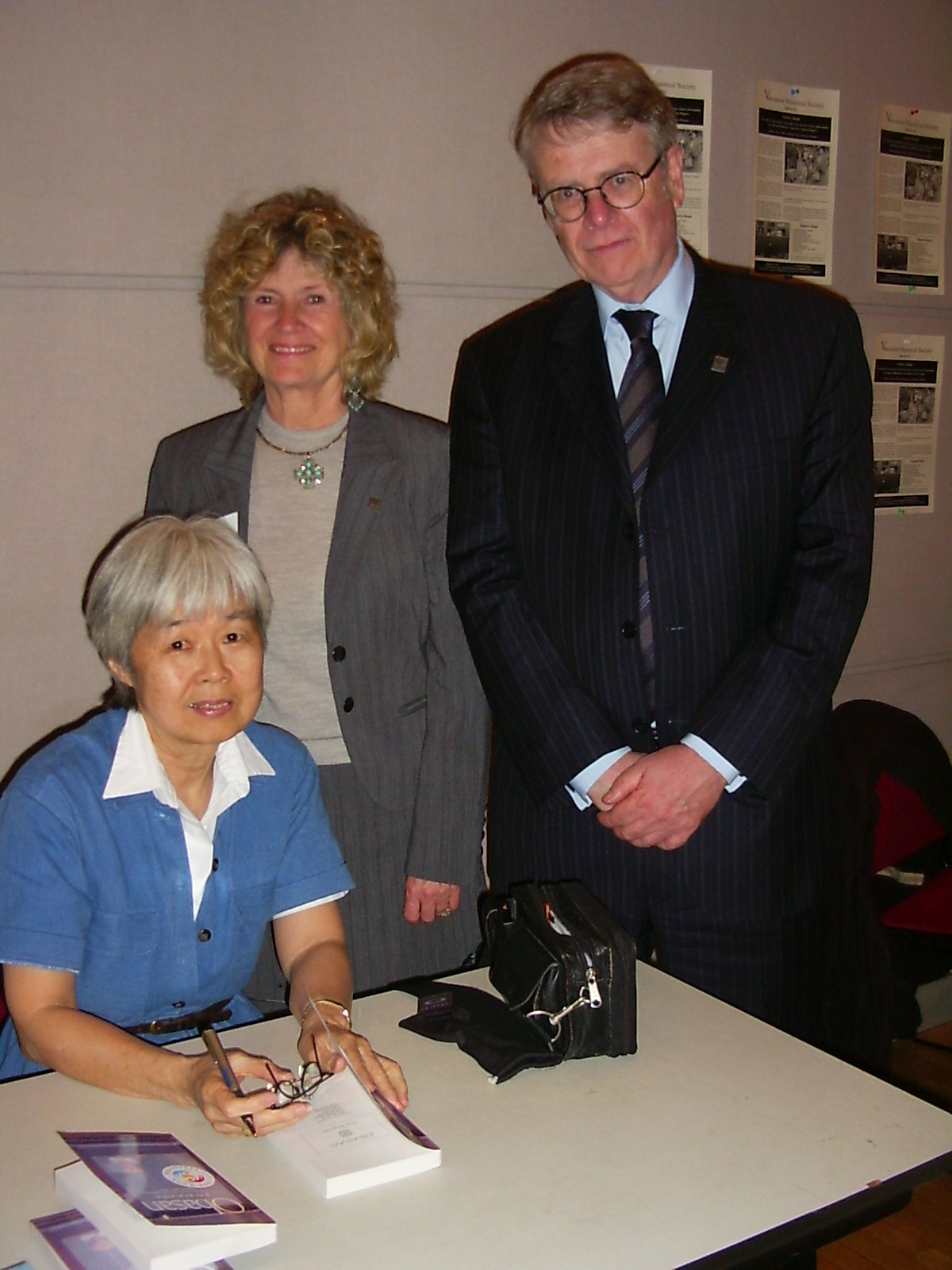
Joy Kogawa, Janice Douglas (VPL Director of Community Programs) and
Paul Whitney (VPL Chief Librarian) at the launch of 2005 One Book One
Vancouver May 24 – photo Todd Wong

Joy Kogawa reading at VPL's One Book One Vancouver launch May 24 – photo Todd Wong

Joy Kogawa at VPL's One Book One Vancuover launch May 24 – photo Todd Wong
Weddings… great places for cultural traditions to mix and match, as
more and more Canadians of diverse ethnic and cultural backgrounds
decide to tie the knot.
I attended a wedding reception for the son of one of my older cousins, Joe Wai, the architect of so many buildings in Vancouver's Chinatown and around this city. Joe recently designed the Millenium Gate,
and previously designed the Chinatown Parkade, the Chinese Cultural
Centre Museum and Archives, as well as being one of the architects of
the Dr. Sun Yat Sen Gardens.
I have always counted Joe as one of my early role models for his vast
amount of community work, and ability to blend East and West together.
His son Jonathan had just gotten married. I had never before met
the bride. But when I walked into the Fortune Garden
Restaurant at
1475 West Broadway St. this past Saturday, I immediately identified her.
She was standing, radiantly beautiful, wearing an intricately
embroidered antique Chinese jacket, and skirt emblazoned with dragons and phoenix
in stunning relief. Calm and serene, she had presence and
dignity. I was to discover later that the jacket and skirt had originally
belonged to my Auntie Rose and Aunt Lannie and had been given to one of my cousin's
wives recently. They were loaned to the bride for this very special
occasion. Definitely now a museum-quality piece in all the good ways!
The bride was also wearing, which was to be revealed later, a red
Chinese cheong-sam – the traditional Chinese wedding dress. Cheongsam
means “long dress.” It is floor length but with a slit on the side up
to the thigh, and it features a mandarin collar. It was featured in the
Spider Man movie worn by actress Kirsten Dunst.
What is amazing is that the bride,
is Caucasian, and the groom is Eurasian. I learned many things
about Lisa Sowden the bride. She is an actor
and she speaks more Cantonese than my younger cousin Jonathan, who is
now developing his law career. Our families have always been
ethnically and culturally diverse. Inter-racial marriage has
generally long been accepted on both sides of my family. On my
father's side, 6 of my 9 cousins including Joe married
non-Asians. On my mother's side, 10 of my married cousins
including my brother chose non-asians.
For me, the small Chinese banquet reception (50 guests) seemed so
Canadian.
More than half of the guests were caucasian, and we dined
on shark's fin soup, prawns, rock cod, crab and lobster, chinese
mushrooms, duck, chicken. It was truly a grand wedding
banquet. Such gourmet delicacies are usually only ordered for
weddings. Long Life noodles and Happy Marriage fried race
finished off the meal with Red Bean soup dessert. As many of the
guests were not familiar with the significance of the menu items.
My cousin Hayne Wai and I explained things such as the importance of
the head and tail being included in the fish and chicken dishes, to
signify wholeness. The chinese pronounciation of Fish (Yee) is
similar to coin, the mushroom caps are uncut like large coins.
The noodles are long to encourage long life.
I got up briefly to talk with the bride and groom, and imagine my
surprise when I returned to my seat to find the cooked chicken head on
my plate. Immediately I told the chinese wedding tradition about
putting the chicken head on a string and dangling it in front of the
bridal couple with the instructions to kiss it to bring good
luck. Of course the person with the string pulls it up at the
last minute, initiating the couple in a kiss. I think it worked
better in the days of arranged marriages when the couple didn't know
each other, and probably were no strangers to kissing each other.
At our table, I sat next to Lisa's friends Maria
(another actor) and her boyfriend Darren who not too familiar with
Chinese cuisine. On my other side, Carole jumped right into each
of the dinner courses and enjoyed it tremendously. While Carole
has a
French-Canadian background, it is her sister Tina, that married Joe's
younger brother Wayne, so… Carole is familiar around many of the
family's Chinese-Canadian activities and dinners.
At the evening's close, I gave a special bottle of Pinot Blanc Special
Late Harvest (-13) desert wine to the bride and groom. It is Red Rooster Winery's “-13” or Minus Thirteen, created to celebrate the Year of the Rooster.
It even has Chinese characters on the label, which is what initially
drew my attention tot he bottle. Checking their website, I was
surprised to discover an Asian-Canadian winemaker, Richard Kanazawa. Of course I chose this bottle to celebrate the year they got married – Year of the Rooster.
What does it mean for a Canadian couple of diverse cultural background
getting married in the Year of the Rooster and the Astrological sign of
Gemini? Many things to many people! And that's the great
thing about being Canadian, or to quote Bob and Doug Mackenzie, “Beauty, eh?”
BC's May 17th provincial election re-elected Jenny Kwan (Vancouver
Mount Pleasant) by one of the biggest majorities in the election.
Kwan's 43% margin over Liberal opponent Juliet Andalis, a Filipino
nurse, was 3rd only to West Vancouver – Capilano's Ralph Sultan's 52%
and Vancouver Quilchena's Colin Hansen's 47%.
Returning Liberals Ida Chong (Oak Bay-Gordon Head) won by a narrow
margin of 1121 votes (5% victory margin), while Richad Lee (Burnaby
North) won a squeaker by only 339 votes (4% victory margin). Former
minister for Multiculturalism Patrick Wong lost his Vancouver Kensington
seat by 1,295 votes to NDP's David Chudnovshky. Liberal newcomer John
Yap handily won Richmond-Steveston by 4,913 votes.
Burnaby Willingdon was an interesting riding to watch as Chinese media
journalist Gabriel Yiu lost narrowly to the Liberal's John Nuraney by a
5% margin of 595 votes. It might have been speculated that the
Democratic Reform candidate Tony Kuo and independent candidate Tom Tao
would split the Chinese vote. When Kuo and Tao's combined votes of 642
are added to Yiu's 5,243 votes to create a grand total of 5,885. He
then comes ahead of Nuraney's 5,828 by 57 votes.
Does the Chinese ethnic vote make a difference? or are Chinese
Canadians voting for the party and the person. Today on Vaughan
Palmer's BC Reports show on Shaw TV, he interviewed retired MLA's
Christy Clark and Joy McPhail and asked them about the Chinese and
Indo-Canadian communities. Both reported that the ethnic communities
are incredibly diverse and “textured.” I also have heard that many of
the ethnic communities vote Liberal, because it was the Liberals that
changed the immigration rulings that allowed them easier access to
immigrate to Canada.
Do Chinese MLA's make a difference in the legislature?
Jenny Kwan was, I think, the first Chinese Canadian MLA in BC. She has
worked extremely hard to represent both the causes and issues of recent
immigrants and the pionneer history of the Chinese in BC. It all comes
down to representation of experience. Mike Harcourt had an
understanding of Chinese Canadians because he had good friends who were
Chinese such as Shirley Chan, his administrative assistant – but he
didn't carry the issues in his life experience as she did.
I have met Jenny Kwan, Richard Lee and Patrick Wong. I believe that
Kwan best understands the Chinese historical roots that best relate to
me as a 5th generation Vancouverite. The issues in the Chinese
community are diverse and transcend many generations. It is only with a
broader range of Chinese Canadian, Indo-Canadian, Scottish Canadian,
and First Nations peoples, that the BC Legislature can truly be
representative of all Canadians. The histories of all our peoples,
Ukranian, French, Spanish and Japanese are imbedded in our province.
If we ignore our cultural histories, then we ignore our understandings
of ourselves. This is what the province did when they invoked the
racist “Potlatch” law against the Native Peoples of this province in an
effort to systematically weaken First Nations culture and traditions. I
believe that culture matters more than economics in defining who we
are. But it is a strong economy that supports a strong culture. I hope
that all our BC provincial MLA's can embrace our province's cultures,
and that our Chinese Canadian MLA's do their best to represent our
shared heritage and culture.
It's hard to believe that Canadians of Chinese ancestry have only been
able to vote in BC since 1947. My grandmother was born in
Victoria BC, in 1910, the grand-daughter of Chinese Canadian pioneer Rev. Chan Yu Tan.
After she turned the legal voting age of 18, she had to wait another 19
years before she could vote in 1947 when Chinese were allowed to vote
in BC.
My Uncle Dan
and his fellow Chinese Canadian war veterans told me the story about
after they were allowed to join the Canadian Armed Forces, they were
stationed in Alberta. On a Canadian federal election day, their
sergeant told them to go vote. Uncle Dan and his mates said “We
can't vote, Chinese aren't allowed to vote.”
The reply was “You're in the King's Army, and you can vote.”
When I became of legal voting age, my father has always emphasized that
I should exercise my right to vote. Dad was born in Victoria BC,
in 1925. He wasn't able to vote until 1947 when he turned 22
years old. But his older brothers and sisters had to wait longer until
the racist voting laws in BC were changed.
Here are some voting and political highlights in Chinese Canadian history
1920
A dozen Chinese veterans who served in the Canadian Army during W.W.I are given the right to vote.
1945
British Columbia passes a law giving the vote to Asians who are Canadian citizens and fought in W.W.II.
1947
Chinese Canadians given right to vote in federal elections.
1949
British Columbia gives all Chinese Canadians the right to vote in provincial elections.
1957
Douglas Jung was the first Chinese Canadian to be elected to the federal parliament.
1993
Raymond Chan (born in Hong Kong) became the first Chinese Canadian to sit on the federal Privy Council.
1998
Jenny Kwan became first Chinese Canadian cabinet minister in BC legislature
Vivienne Poy appointed first Chinese Canadian senator
Below is a picture of Jenny Kwan at the 2005 Gung Haggis Fat Choy dinner in Vancouver.


Liesl Jauk and Brian Pike the principal partners of Rebus with friend – photo Todd Wong

BC Book Prize Soiree host: John Burns of the Georgia Straight draws the winning name for the final prize of the evening – photo Todd Wong