Category Archives: Main Page

Simon Fraser University Pipe Band wins Worlds

Greetings, some results from the World Piping Championships, Glasgow,
Scotland, August 15th. Regards, the other Ron


SFU repeats as the top Pipe Band for the sixth time. To see the Band in competition,
go to http://www.bbc.co.uk/Scotland/music/worlds/2009


Grade 1
Overall

1st Simon
Fraser University (Canada)

2nd
 Field Marshal Montgomery (Northern Ireland)

3rd  St.
Laurence O'Toole (Ireland)

4th
Strathclyde Police (Scotland).

5th House of
Edgar-Shotts & Dykehead (Scotland)

6th Boghall
& Bathgate (Scotland)


Drumming: Simon Fraser University (Canada)

Grade 1
Medley
: 1st
 Simon Fraser University (Canada)

 Drumming: House of
Edgar-Shotts & Dykehead (Scotland)

Judges: I
Wood, T. Sloane (piping); G. Craig (drumming); Joe Noble (ensemble)

Grade 1 MSR: 1st Simon
Fraser University (Canada)

Drumming: 1st Simon
Fraser University (Canada)

Judges:
Malcolm MacKenzie, John Moles (piping); A. Steele (drumming); David Clark
(ensemble)

 Grade 2
(MSR)

1st Inveraray
and District

2nd Ravara

3rd Mauchline
and District

4th Dumfries

5th Grampian
Police

6th New Westminster Police

Other news:

1. Triumph Street Pipe Band
qualified for the Grade 1 final but didn’t make the prize list.

2. Robert Malcolm Juveniles
were 4th in their competition.

All in all, a very good day
for B.C. Bands.

Newly elected board members for The Land Conservancy of BC includes Todd Wong

Newly elected board members for The Land Conservancy of BC
includes Todd Wong

2009_Aug_TLC 052 by you.

9 elected TLC board members + 2 non-elected candidates + Bill Turner = a vow to all work together for the best interests of TLC. David Merner, Alistair Craighead, Cheryl Bruce, Carol Pickup, Elspeth McVeigh, Briony Penn, Charley Beresford, Bill Turner (executive director), Frances Pugh, Gary Holman, Todd Wong, Ken Millard.  Unavailable elected board members Barry Glickman, Magnus Bein

TLC officially announced election results at around 11am Saturday morning August 8th

The entire Save TLC slate was elected including Todd Wong, also president of Historic Joy Kogawa House Society, which oversees programming for Historic Joy Kogawa House, owned by TLC

Click here for TLC Website Election Results

It
was an intense last 24 hours, as I took the 4pm ferry to Victoria with
longtime TLC supporter and board candidate Elspeth McVeigh.  We met
other board candidates and Save TLC Committee members including Bill Turner
for an 8pm  meeting.

Results had been expected to be announced to candidates at the end of voting at 5pm, but were not announced until after 9pm.

There is overwhelming a sigh of relief from the majority of TLC members, staff and volunteers, as many TLC projects and donations have been on hold since March, when TLC executive director Bill Turner was released from his duties by the TLC Board.

Today at a board meeting, which included an open forum, Bill Turner was re-affirmed as Executive Director.

Alastair Craighead is Chair
Briony Penn is Vice-Chair
Elspeth McVeigh is Treasurer
David Merner is Secretary

I
started the day visiting TLC property Ross Bay Villa at 10am, with
candidates Elspeth and David.  It's a wonderful heritage house with a
lovely garden.  We met with many of the volunteers who do restoration and gardending work.  They were very appreciative that we were board candidates, and that I was with the Historic Joy Kogawa House Society.

We met at Abkhazi Gardens at 11am,  for a tour and an all-candidates photo op.  It's an incredible heritage garden and house created by Prince and Princess Abkhazi, shortly after they settled in Victoria in 1946.

We
met at St. Stephens Church and Community Centre in North Saanich for
the 12:30pm board meeting, open forum, followed by a reception.  It was a wonderful reception where many TLC members were able to speak with the newly elected members of the TLC board. 
Elspeth and I left at 4pm to catch the 5pm ferry home.

I received positive response, whenever I mentioned Kogawa House.

August Kilts Night enhanced by World Police & Fire Games

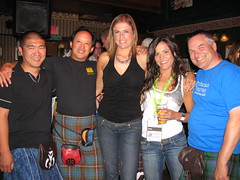
Kilts Night is always fun…  We meet new lovers of kilts – some wearing kilts, some are admirers.

2009_Aug_KiltsNight 004

Raphael, Todd and Stuart + two members from Spanish team for World Police and Fire Games.

Every 1st Thursday of each month we meet at Doolin's Irish Pub.  Why? If you wear a kilt, you receive a free pint of Guinness.

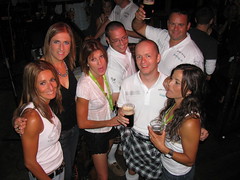
Kilts Night is more than just kilts or Scottish culture.  It's about cultural diversity enjoying cultural diversity.  We have Asians in kilts.  We have surprised cottish tourists not wearing kilts.  On Thursday August 7th, we met members from the Spanish team for the World Police and Fire Games.  The tall blonde woman is competing in pentathalon.  They loved that Vancouver has a beach named “Spanish Banks” and that many places in Vancouver were named by Spanish explorer Juan de Fuca.

2009_Aug_KiltsNight 005

It was Mark Cameron's 40th birthday pub crawl. His kilt met members of the Spanish team for the World Police & Fire Games

2009_Aug_KiltsNight 008 

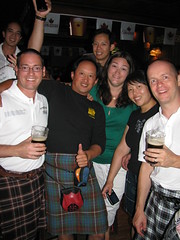
Mark and his buddies created a “Troller to the Raven Pub Crawl” immortalized in the Spirit of the West Song.  We gave them a warm Kilts Night welcome from members of the Gung Haggis Fat Choy dragon boat team.

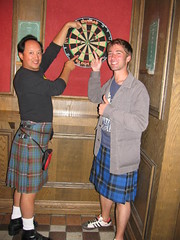
2009_Aug_KiltsNight 003 Louis' first Kilts Night… and we put a kilt on him. Only one year ago, Louis was living in Paris with no kilts night!

Kilts Night August 2009

Kilts Night August 2009

Vancouver vs San Diego? vs Logan Lake?

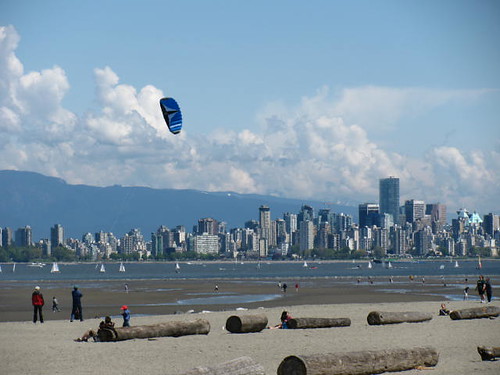
2009_May 164 by you. Vancouver is called one of the “most livable cities” – kite flyers, sailboaters enjoy English Bay from Spanish Banks – photo Todd Wong

Vancouver vs San Diego? vs Logan Lake?
Vancouverism is an architectural concept for which diversity of use, diversity of space and diversity of people is included.

VANCOUVERISM is a wikipedia entry… and a traveling architectural exhibition to Paris and London.

SAN DIEGOISM is non-existent.

And where the heck is Logan Lake?

Vancouverism is also a touring exhibition to London and Paris. see: http://vancouverism.ca

Last weekend in Vernon, when somebody from Logan Lake found out I was from Vancouver, they complained about how “unfriendly” Vancouver was – especially about parking.  I had to ask where Logan was located.  Answer: between Kamloops, Merritt and Cache Creek. It is tiny with a population of only 2,100 people.  The Metro Vancouver area has a population of 2,116,581.  This person complained that mass transit didn't help him when he visited Vancouver, and that there is no freeway.

I pointed out that you cannot apply rural values and issues on a large city and expect similar results. Vancouverites fought against a freeway through Chinatown and Strathcona neighborhoods.  I told him that ubanist Jane Jacobs moved from the U.S.A. to Toronto because she declared it “more livable,” and today Jacob's son Ned Jacobs lives in Vancouver's Little Mountain neighborhood for it's livability where he leads an annual Jane's Walk.

Todays' Vancouver Sun newspapers reported on a San Diego news blogger 

San Diego blogger Arthur Saim compares Vancouver to San Diego, and says that Vancouver is “depressing” for him when he thinks  about the potentials for San Diego. Many comments on the blog have focussed on the social problems of Vancouver

See original article:
http://www.sdnn.com/sandiego/2009-08-03/blog-forum/arthur-salm-th

I think the key to Vancouver is its inclusion of diversity.  Whether it is the architectural concept of Vancouverism incorporating mixed use development, of community and industrial and business needs, – or the cultural diversity of its population.  Vancouver is many things to many people.  This is both it's strength and weakness.

Here are some links and quotes about Vancouverism:

“Vancouverism is characterized by tall, but widely separated,
slender towers interspersed with low-rise buildings, public spaces,
small parks and pedestrian-friendly streetscapes and facades to
minimize the impact of a high density population.”
-The New York Times, December 28, 2005

The word first entered the argot of American architects and city
planners over the past decade, who began speaking of “Vancouverizing”
their under-populated, un-loved urban cores, seeking inspiration from
Canada’s Pacific portal’s re-development successes. Our city has become
first a verb, and now, an ideology promoting an urbanism of density and
public amenity. Vancouverism at its best brings together a deep respect
for the natural environment with high concentrations of residents.
Within condominium residential towers downtown and courtyard and
boulevard-edging mid-rise buildings elsewhere in the city,
Vancouverites are learning to live tightly together; a healthy,
engaging – even thrilling place.

Not Asia, not Europe, not even North America, but a new kind of city
living with elements from all of these – a hybrid that now demands to
be taken on its own terms. In the language of city-building,
“Vancouverism” is fast replacing “Manhattanism” as the maximum power
setting for shaping the humane mixed-use city, important ideas for a
new era of scarce energy and diminished natural resources.

From http://www.vancouverreview.com/past_articles/vancouverism.htm

“Vancouverism is evolving a second and more interesting sense: that
of the latent character, the subjective quirks of urban identity hidden
behind these shiny façades. Call it the theory, or the legacy, or the
idea of Vancouver, but increasingly our writers are producing books
that capture this precious moment of self-knowledge, as this
good-looking adolescent of a city enters a more complicated young
adulthood.

Meredith Quartermain’s new collection of poetry, Vancouver Walking,
deals with this latter sense of Vancouverism, her word-images evoking
our hidden histories and the textures of our streets, especially on the
East Side.

Lance Berelowitz’s Dream City: Vancouver and the Global Imagination
deals with the bricks and mortar and geographies of this town, a
rah-rah appreciation of our downtown and our more officially sanctioned
westerly zones.

Lance Berelowitz is a consultant to the urban development industry
who came to Vancouver from his native South Africa in 1985, after a
decade studying architecture and working in Europe… The first half of Dream
City, in particular has a “Gee whiz, aren’t we bloody marvelous” tone,
no doubt born of these prior commissions. “Vancouver is the poster
child of urbanism in North America” is his opening sentence, and too
much of the book varnishes over that poster with multiple coats of
gloss.

Winetasting in the Southern Okanagan: Summerland and Naramata Bench

Wine tasting and exploring in Summerland and Naramata regions of Southern Okanagan

– Part One

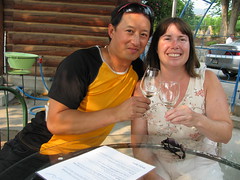
2009_Aug_Kalamalka 085 Todd & Deb taste the delicious fruit wines of Elephant Island Orchard Winery.

I am glad that my girlfriend Deb enjoys wine tasting, and trying out the many different Okanagan wines of BC.  On BC Day, August 3rd Monday, we travelled with friends to the Summerhill and Naramata Bench growing areas.  Only 2 hours south of Vernon, where Deb's parents live, the area is dryer and more sun drenched.  The hills are softer and less steep than Kalamalka Lake's Predator Ridge and Kalamalka Park.

It probably started with our official first date when I brought over a bottle of Summerhill Cipes Brut sparkling wine to help celebrate her new job.  3 months later we explored the Kelowna area wineries of Mission Hill, Quail's Gate, Mt. Boucherie, and Summerhill Pyramid winery.  We also drove up to to Silver Star ski resort to try out the 2nd annual Okanagan Summer Wine Festival. 

Last year, we took our friends Craig and Zsuzsanna to Summerhill Pyramid winery, and Sumac Ridge Estates.  This time we felt it we wanted to explore farther south to Summerland and Naramata Bench – where Deb hadn't been in 20 years, despite being raised in the North Okanagan.

We visited Thornhaven, Dirty Laundry and Sleeping Giant fruit winery in Summerhill, part of the “Bottleneck Drive” group of local wineries to promote the growing wine business on the west side of Okanagan Lake.  Then we visited the Naramatat Bench, home to BC's largest concentration of wineries, but only had enough time to visit Elephant Island Orchard Winery and Soaring Eagle Estates – before they closed at 6pm.

Grapes at Soaring Eagle Estates.

Thornhaven Estates was the first winery we checked in at.  After the 2 hour long drive from Vernon, we ate our sandwiches in the car.  But we could have relaxed and eaten on the lovely and inviting adobe styled outdoor patio at Thornhaven.  It looks exotic in the “Great White North” of Canada – but the Sonoran desert plateau of the American Southwest actually extends all the way into Canada near Oosooyoos.


More pictures on Toddish McWong's flickr link:

2009 July Winetasting

2009 July Winetasting

Blackthorn celtic music band at Fort Langley for BC Day!

Blackthorn is playing at Historic Fort Langley.

Blackthorn is comprised of some of my favorite musicians: Michael  on guitar/vocals, Michelle on flute/pennywhistle/vocals, Tim on bass/bodrana and Rosie on fiddle/vocals.  Blackthorn was our featured band at the 2008 Gung Haggis Fat Choy Robbie Burns Chinese New Year dinner.

Historic Fort Langley is the birthplace of BC, where Gov. James Douglas signed the proclamation almost 150 years and 9 months ago.

www.blackthornband.com.jpg

Monday,
Aug 03
6:30pm Brigade Days
Fort Langley National Historic Site of Canada, BC

Brigade
Days is held every year over the BC Day long weekend in August.
Historically, Brigade was when the fur trappers came down from their
trap lines to the fort, to trade, some took their annual baths and
looked for a new spouse, and in general caught up with friends they
hadn't seen since the year before.

Blackthorn will be bathed and on stage Monday evening.

AND NOW WE HAVE OUR OWN CHANNEL ON YOUTUBE

Todd in Vernon, at Kalamalka Lake

Kalamalka Lake is one of the beautiful and accessible vacation spots in BC's Okanagan. 


Todd Wong paddles an outrigger canoe on Kalamalka Lake.  Todd's friend Craig brought the outrigger canoe up for the weekend.  It is 20 feet long and weighs only 22 pounds. 

Kalamalka Lake Provincical Park.
http://www.env.gov.bc.ca/bcparks/explore/parkpgs/kalamalka_lk/

After being here for last weekend's Greater Vernon Dragon Boat race, with the Gung Haggis Fat Choy dragon boat team, I returned to spend time with my girlfriend Deb and her parents at their lakeside home.  I came up on Thursday night after work.  Construction on Hwy 97 just after the Coquihalla Connection and on the new William Bennet Bridge connecting West Bank to Kelowna, stretched the usual 5 hour trip to 6 hours.

Life is relaxing here, as we spend time swimming, canoeing and kayaking in the lake.  Sometimes we take the border collies out for walks in the park.

But the Terrace Mountain fire is raging again.  Yesterday the fire jumped its fireguards and 1500 people were put on alert.  Ash and smoke filled the sky.  The sun turned an eerie orange through the hazy smoke, as it glistened on the water.  Today, the evacuation order has expanded to affect 2500 people in the Fintry area.  We are keeping our fingers crossed a fire doesn' happen in the Kalamalka Lake Park, where many people are vacationing and enjoying the recreational activities of swimming, picnics, boating and cliff jumping.
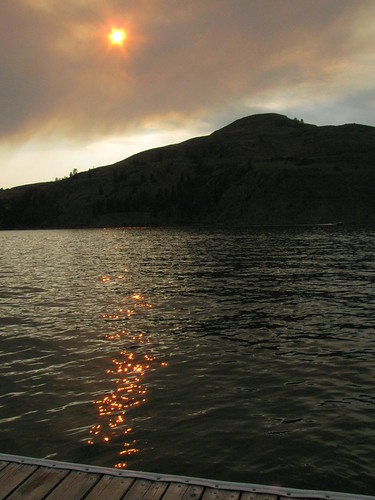
IMG_3388 by you. The sun shines orange through the smoke from the Terrace Mountain fire, and reflects on Kalamalka Lake. – photo Todd Wong

On Friday, I paddled the solo outrigger canoe that my friend Craig Brown brought up for the weekend.  It is 20 feet long, and weighs only 22 pounds.  It is a beautiful boat, and moves easily through the water.  Craig complimented me on my balance and my paddling.  I never hulied (tipped over) by accident.  I practiced tipping over on purpose, as Craig coached me on flipping the boat back over, and climbing back on.  When speeding motor boats went by, I paddled over to crash through their wake. 

“You're surfing now!” Craig called at me, as I rode the waves back to the shore.

Todd paddles solo outrigger! – photo Craig Brown.

Friday night we drove into town to find the airconditioned movie theatre.  We watched “The Ugly Truth” starring Katherine Heigl  It was pretty funny – more raunchy than the classic “When Harry Met Sally” – but surprisingly no nudity!

Saturday morning, Deb and I kayaked towards Kal Beach, along the many lake front homes.  We saw some teenagers rise sleepily from the dock where they had spent the night.  We talked with some swimmers who were friends of Deb's parents.  Then we paddled back and over to Jade and Juniper Bay.

Saturday night, Craig and I missed the big excitement.  After dinner we headed over to Alexander's Beach Pub.  While we we gone, a rattle snake was discovered in the garden.  The weather is so hot and dry, it would appear that the rattlesnakes are looking for water.  A rattle snake hadn't been seen at the Martin residence in 20 years.

Sunday morning,  Deb and I canoed around Rattle Snake Point, over to Cosens Bay.  Around the corner, we saw some teens jumping off cliffs.  We saw a bald eagle sitting in a tree, and a Kingfisher flying from one tree to the next. 

We saw 5 swimmers in wet suits, who were training for triathalons.  We had a short conversation about the benefitis of swimming and paddling in Kalamalka Lake.  They admitted they wouldn't decline a beer, even though it wouldn't be beneficial to their training.

We plan to leave tomorrow on Monday.  Possible activities will be another early morning paddle, followed by wine tastings in Penticton/Naramata area.

Briony Penn speaks about upcoming election for The Land Conservancy of BC

Here's an article about the
current issues and upcoming extraordinary meeting for The Land Conservancy of BC.

I am a
running mate with Briony Penn, for the Save TLC slate – to become new
board members of TLC.

Mail-in ballots have now been sent out for the upcoming extraordinary general meeting and voting for new directors.  The Save TLC committee has had four conference call phone meetings and one in-person workshop meeting.  It's a great group of organizers, volunteers and candidates – all committed to the future of a strong and viable TLC.

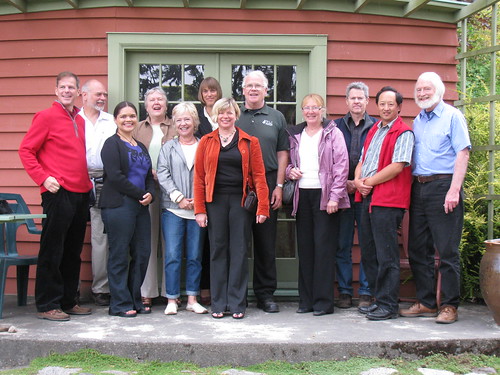
TLC founder Bill Turner (2nd from left) and TLC co-founder Briony Penn (2nd from right sitting) with new candidates for the TLC Board: (standing) Todd Wong, Ken Millard, Magnus Bien, and (sitting) Cheryl Bryce, Elspeth McVeigh.

from The Saltspring Island Driftwood News:
http://www.bclocalnews.com/vancouver_island_south/saltspringislanddriftwood/news/51959192.html

TLC
co-founder Briony Penn,
who is running for a spot on the new board, hopes that the membership
will educate themselves on what she believes was a false accusation
resulting from a lack of due diligence by the board and their lawyers.

“The
allegations were that the moneys donated by the land trust had been
used for other than that intended by the donor. That’s simply not
true,” Penn said.

“The
subtlety of it is that they were confusing what is known as pooling
trust fund accounts instead of setting up independent separate accounts
for every project.”

According
to Penn, the funds were pooled until the time that they were needed,
and the lawyers were misinterpreting the Charitable Purposes
Preservation Act.

Gabelman was unavailable for comment, however, Penn recalls that he was unable to back up the board’s claims.

“I
called up the lawyers and treasurer Colin Gabelman and asked: ‘What was
your written interpretation? What was your evidence?’ And they didn’t
get any written interpretation. They didn’t get any evidence.”

“[Turner] has raised over a hundred thousand dollars [since he was fired],” Penn said.

“Last
Sunday morning I was up at six with him at a bottle exchange in
Victoria. He’s been treated really badly by the board but he’s still
raising money as a volunteer to keep the organization going until it
gets back on track. I might add, I saw no members of the board at that
bottle drive.”

Still,
despite a major disparity between what Penn believes happened and what
TLC’s bean counters have reported, the environmentalist is willing to
work with anyone on the new board should she be elected.

“We’ve gotta put the trust back in land trust,” she said.

For more information see:

Save TLC Committee:  www.savetlc.ca

The Land Conservancy of BC www.conservancy.bc.ca

Powell St. Festival celebrates Japanese Canadian heritage – even if you are half-Japanese or non-Japanese

I like attending the Powell St. Festival.  Somewhere in my clothes drawer I have a t-shirt from the 10th Anniversary festival back in 1986.

Powell St. Festival '07 - photo by Todd Wong  IMG_1459 by Toddish McWong.
This year's Powell Street Festival will take place at Woodland Park – moving Eastward between Clark Drive and Commercial Drive, North of Venables St. – but South of Hastings St. – photo of 2007 festival by Todd Wong

Many of my friends have Japanese ancestry such as Jeff Chiba Stearns, John Endo Greenaway, Julie Tamiko Manning, or Joy Kogawa…. I grew up folding origami cranes, and relating to Japanese culture in a Pan-Asian-Canadian kind of way…

I have even performed my accordion at the Powell St. Festival main stage.  One year I played with my friend Sean Gunn as part of the “Number One Son” band… or maybe it was under the name of “Yellow Lackey Dogs.”

My friend Walter Quan is always there to sell his unique “sushi candles” and once when he was wearing a Gung Haggis Fat Choy dragon boat team cotton shirt, he was asked if he was “Todd Wong.”

 Walter Quan and his famous sushi candles - photo by Todd Wong IMG_1466 by Toddish McWong. Walter Quan and his sushi candles booth at the 2007 Powell Street Festival – photo Todd Wong

Check out the Powell Street Festival on Saturday and Sunday.

www.powellstreetfestival.com

Here's a great article in the Vancouver Sun by Kevin Griffin:

Powell Street Festival: Metro Vancouver's Japanese Canadians celebrate a resilient culture

Powell Street Festival: Metro Vancouver's Japanese Canadians

Julia Aoki, volunteer coordinator for the Powell Street Festival. Photograph by: Glenn Baglo, Vancouver Sun. VANCOUVER — Unlike other festivals that strive


Review: Koto Concert at National Nikkei Museum & Hieritage Centre July 26

The Japanese Canadian National Museum
Koto Concert – Chikako Kanehisa, a benefit concert for the National Nikkei Museum & Heritage Centre
Sunday, July 26, 2009, 3pm

Review by Devon Cooke
– for www.gunghaggisfatchoy.com

Certain parts of Japanese culture export very well.  Sushi and anime are so popular in the West that they have a life of their own that is separate from their Japanese origins.  This is wonderful, but it may leave a somewhat distorted image of Japanese culture as a whole.  Japan is much more than raw fish and giant robots!

Judging by the audience at the Koto Concert put on by the National Nikkei Museum and Heritage Centre, the koto, Japan’s national musical instrument, still has a long way to go before it penetrates Vancouver’s cultural consciousness — nearly all of the crowd was of Japanese origin, with the odd Japanese-by-marriage family member and a few curious seniors mixed in.  If only everyone was so curious!

The concert, which featured professional koto player Chikako Kanehisa and shakuhachi master Mitsuhashi Kifu, was presented as part of the 80th anniversary of Japanese-Canadian relations that also brought the Emperor of Japan to Vancouver earlier this month.  Those fortunate (or curious) enough to attend got to see a part of Japanese culture that is barely visible in the West.

Certainly, I had never heard of the koto before the concert, but the sound is familiar.  Anyone with a passing interest in Asian cultures has probably heard a koto — or one of its relatives — without knowing what it was.  It’s not an easy instrument to describe; it resembles a huge, six-foot long zither with thirteen movable bridges.  The strings are plucked (or strummed, or thumped, or rubbed) with the right hand on one side of the bridge while the left hand is used to create pitch shifts or vibrato on the other side of the bridge.

Listening to it was a complex experience — it’s the kind of music that would be impossible to put in writing because there are so many intangible aspects that aren’t captured by quarter notes on a staff.  It had a very organic feel, like listening to birdsong.  Ironically, the song entitled “Like a bird” (鳥のように) was one of the least like this, it carried a more regular rhythm and more clearly defined pitches than some of the others.

Perhaps because of this, it was one of the more accessible, exciting songs to my Western ear, but I couldn’t help but feel that the beauty of the instrument was captured best in some of the other songs — the ones with slightly bent pitches and somewhat irregular rhythms.  The (Japanese?) idea that beauty is inherent in small, slight imperfections is one that has always resonated with me, and the Koto struck me as an instrument where the skill in playing came from creating just the right pattern of imperfections.

The shakuhachi flute is an instrument that I am more familiar with, but it too impressed me with the range of sounds it could produce.  Like the koto, many of the notes were bent in a way that seems more reminiscent of a saxophone or a trumpet than a flute.  A number of times, Mitsuhashi impressed me by playing a continuous note that rose or fell almost a full scale — an impressive feat for an instrument with only a small, “fixed” set of notes.

I think I enjoyed the duets most of all.  The instruments (and musicans) complimented each other well.  On its own, the lonely, longing timbre of the shakuhachi threatened to overwhelm me with its sadness, but the sharp, epic, almost militaristic presence of the koto helped bring the sound back to earth and remind me that, whatever I was feeling inside, there was still a whole world out there to explore.

For most of the audience, the Koto Concert would have been a breath of familiar air (or, perhaps to the second-generation Canadians, a possible answer to the question “Where did I come from?”)  For me, my personal interest was piqued because it was foreign.  This is not a side of Japanese culture I had previously discovered, and I was happy to have to opportunity to explore it.  Koto concerts in Vancouver do not come along every day (or even every year), so I was happy to discover a new side of Japanese music.