Category Archives: Main Page

Review: Gravity astounds the senses – Tricia Collins takes the audience on a journey into her past and across two oceans

Review:  Gravity astounds the senses – Tricia Collins takes the audience on a journey into her past and across two oceans

Gravity
Chapel Arts
304 Dunley St.
Oct 25 – Nov 3, 2007

It seems like a very Vancouver thing to be from somewhere else, to live in two cultures, and to share your family story, and to do it artistically.  But Tricia Collins is all of this and more.  Both she and her self-penned one-woman theatrical show Gravity are “very Vancouver.”

Tricia Collins is “hapa.”  Her mother’s family came from Guyana, and from China before that.  Tricia is an actor, a  writer and an amazing performer/story teller.  She also does acrobatic work while hanging suspended from cloth draping… and speaking in a lucious juicy Caribbean accent.  This is one smart talented agile woman who can capture your attention…. and hold it for a long, long time.Gravity is a multi-media theatrical work based on similarities in her
family history.  But Collins takes it much much further.  While images of knitting or maps are projected onto the wall, Collins tells the multi-generational story of 4 women.  The stories travel through and co-exist in time… and fall through time. 

When you first walk into Chapel Arts, on Dunlevy and Cordova, it feels different.  The last time I was in the building had been for the funeral of my grandmother’s brother, at least 15 years ago.  The former Armstrong Funeral Home has now been converted to an arts centre.  My grand-uncle Henry had worked for many years at Armstrong, and the building was packed to over flowing.  He had been a well-known community figure and had played and important role of helping to bring up his 13 younger brothers and sisters.  They were all born in Canada, grandchildren of Rev. Chan Yu Tan. 

It’s fitting that I now back in this building where I am attending a theatre work based on the family history of Tricia Collins.  Hers is also a story about the Chinese diaspora coming to Canada.  But her story comes by way of Guyana on the Caribbean coast of South America, where the Chinese worked as replacement labourers after the African slaves had been set free.

The chapel has now been turned into a black box theatre room with chairs set up on two sides of the room.  White sand is in the middle of the stage floor, with small lights in a large
circle.  Theatrical fog hovers over the floor, as fish netting hangs beside one wall, and a large wooden box is in the back corner.  Calypso music plays faintly in the background.   I got the feeling that something special is going to happen.

The house lights dim and Tricia Collins walks to the centre of the stage floor.  She explains to
the audience that her name is Maya, and she is working on her Ph.D. thesis and trying to help
counter the flooding in her family’s ancestral home of Georgetown, the capital city of Guyana.  A screen projection shows on the wall her project, and a map of Guyana, showing its location between Venezuela and Suriname.  A voice whispers…. words appear on the screen… and the storytelling magic begins.

Tricia Collins has created a riveting piece of work that interweaves the tale of her mother, her Granny Ling, and her mother before her, who was kidnapped from China and sold in Guyana, after being shipped in a crate across the ocean.  We learn about the hopes and dreams of each woman, and how they deal with the challenges that they find themselves in. Collins plays each of the women, as she simultaneously tells stories about them, in an attempt to unravel the mystery that binds them together, while pulling them apart.

Gravity is what creates the dynamic tension as Collins tells her story as she twists around, suspended in the cloth drapes. It is a unique visual device that I am more accustomed to seeing in Chinese acrobatic shows, modern dance or Cirque Du Soleil.  Collins moves smoothly, her foot deftly wrapping the cloth around her calves or ankles, or her hands wrapping the cloth into a bundle that becomes a baby as she gently rocks it.

The lighting design by James Proudfoot, video and installation by Cindy Mochizuki, stage  management by David Kerr, and direction by Maiko Bae Yamamoto are fantastic.

“This was the dream team,” Yamamoto repeated several times during the opening night  reception as we talked about the production. “They created all lighting and projections  specifically for this space.  James just lets the space talk to him and tell him what it needs.”

Gravity has been developed in several stages, and this is it’s most complete.  At times Collin’s character Maya interacts directly with the audience, talking as if presenting a lecture or at point – touching the arm of an audience member.  Other times, she is acting out scenes while telling her stories, oblivious to the audience.  Sound, projection, lighting, and Collin’s expressions, voices and movements complement each other on cue. This is an exciting production and well worth seeing, and telling your friends.

see a promotional video of Gravity:
http://www.fathomlabshighway.ca/exposure.asp?page_id=11&play=1watch an interview with Tricia Collins about Gravity
http://www.fathomlabshighway.ca/exposure.asp?page_id=10&play=1


Here is what Colin Thomas wrote in the Georgia Straight about Gravity:
Heart of City finds centre of Gravity | Straight.com Tricia Collins’s one-woman show Gravity explores ideas of love, poverty, and race through her own family history, which stretches back to Guyana and China.


Hip Hapa and Happening… Oct 25+ Heart of the City Festival

Hip Hapa and Happening… Oct 25th to…

Harry Aoki at St. John's College, UBC,
October 25, 2007
 5pm Fireside Chat + 8pm performance


I have known Harry Aoki since around 2002 when he Margaret Gallagher introduced us.  Harry is a walking encyclopedia of trans-migrational music history.  He has performed his harmonica or double bass with me, or for events that I have organized… as diverse as Joy Kogawa House, Canadian Club Order of Canada/Flag Day luncheon, or Gung Haggis Fat Choy dinner events in Vancouver or Seattle.  Harry organizes First Friday Forum, a musical cross-cultural and historical experience at the Nikkei Heritage Centre.

St. John's College
is delighted to host Harry Aoki for a talk and performance. He will be
bringing a special band to SJC and invites people to bring their
instruments and join in. For more information on how to participate,
please contact Prof. Chris Lee (
chrisml@interchange.ubc.ca). This event is part of a series at St. John's College on Asian Canadian culture. Free and open to all.  5:00 PM Fireside Talk and Coffee; and 8:00 PM Performance St. John's College Fairmont Social Lounge, 2111 Lower Mall, UBC.

The Heart of the City Festival has some great things happening this week and weekend!
I am particularly happy to see so many names and faces that I know, and call friends…

Gravity (world premiere)
Chapel Arts
304 Dunlevy Avenue
Oct 25 -27, Oct 31-Nov 3

Tricia Collins is hapa.  She shares her discovery of a historical family mystery through a journey from China to Guyana to Canada.  I first met Tricia in 2003 when she came out to paddle once in a dragon boat –  thanks to her hapa friend Adrienne Wong who was a team member that year.  Tricia is a bright light in the world who always brings joy and enthusiasm to her endeavors.

Maiko Bae Yamamoto does some incredible things in theatre, whether it is creating a small box to perform in, or outdoor theatre with Boca del Lupo or a large production like Concubine's Children.  Here she directs Tricia Collins.

• The Heart of the City Festival is thrilled to present the urban ink productions world premiere of Gravity, written and performed by Tricia Collins and directed by Maiko Bae Yamamoto. Chapel Arts, 304 Dunlevy Avenue Gravity
is an exciting new collaboration of theatre and video installation that
interweaves storytelling, memories and the stitching together of myths
and facts. , Free preview Wednesday
October 24, 7:30 pm. Thursday October 25 to Saturday October 27,
Wednesday Oct 31 to Saturday November 3, 7:30 pm. Pay what you will
matinee Sunday October 28, 2:30 pm. For more information contact
www.urbanink.ca www.urbanink.ca

Sawagi Taiko
Carnegie Community Centre Theatre
401 Main St.
Oct 26 7:30pm


The Heart of the City Festival presents a number of special concerts
this year by some of Vancouver’s finest world artists and musicians,
including Canada’s first all-women taiko group Sawagi Taiko, co-presented with the Powell Street Festival at the Carnegie Community Centre Theatre (401 Main Street, Friday October 26, 7:30 pm)

Silk Road Music (Qiu Xia He and Andre Thibault)

Dr. Sun Yat Sen Gardens
578 Carrall St.

Sat Oct 27 3:00

Qiu Xia He and Andre have been friends since I got to know them in 2003 when they were featured in the CBC television performance special Gung Haggis Fat Choy.  The Silk Road duo has performed at Gung Haggis Fat Choy in 2004, 2005 and 2007.  And we also did a First Night Performance together at Library Square to welcome in 2006. Their concerts are always special and warm-hearted.

Silk Road Music (Qiu Xia He and Andre Thibault)
at the beautiful setting of the Dr. Sun Yat-Sen Classical Chinese Garden.  This show is being taped for CBC Radio. 

CBC Radio 2 105.7FM
  (578 Carrall, Saturday October 27, 3 pm). www.vancouverchinesegarden.com

Riot in Vanocuver (best of the film series)

Carnegie Community Centre
401 Main St.

Sun Oct 28 7:30

Karin Lee is the Gemini Award winning documentary of Made in China, a story about Chinese babies adopted by White Canadian families. She has also made “Canadian Steel, Chinese Grit” and more recently “Comrade Dad.”  She is a great person, and it was a real pleasure to get to know her during the Chinese Head Tax Redress campaign.

•  In commemoration of the 100th anniversary of the anti-Asian Vancouver race riots, we present a powerful evening of short films gleaned from Riot in Vancouver
a four part program by Asian, Aboriginal and South Asian media artists
that confront and question notions of displacement, family, language,
race and culture. Riot in Vancouver Artistic Director Karin Lee, co-presented with Anniversaries of Change 2007. Carnegie Community Centre, 401 Main Street, Sunday October 28, 7:30 pm www.anniversaries07.ca

How I spent my summer and fall during the Vancouver library strike…What did I do on the picket line?

How I spent my summer and fall during the Vancouver library strike…What did I do on the picket line?


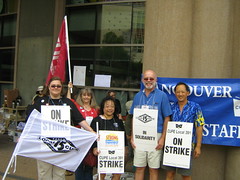
 IMG_2219  2Rosanne, Peter and Todd - CUPE 391 on strike - photo Todd Wong   IMG_1325 3Tai Chi in the morning CUPE 391 on strike - photo Todd Wong    IMG_1335 4 IMG_1569 5IMG_1658 6IMG_1616 6bTrivial Pursuit CUPE 391 on strike - photo Todd Wong      IMG_1366
1) July 26th Strike begins. 2) Day 9 – I got to know my co-workers better such as Roseanne and strike captain Peter deGroot. 3) I learned tai-chi taught by Tim Firth. 4) August 4- I
walked with our union in the Pride parade. 5) I bring my accordion down to the picket line. 6a) Day 15 We share food for our 1st potluck.  6b) Playing Trivial Pursuit with Matt and Rachel

7IMG_1627 8IMG_1672 9 IMG_1690 10IMG_174711IMG_1758 12 IMG_1662 12bIMG_1847
 7) Knitting hats for the homeless – I take pictures of my co-workers Diana and Tanya. 8) Day 16 We go to City Hall for a rally. 9)  I played music with my
co-worker Ross Bliss 10) Day 20 – I invited author Terry Glavin to speak. 11) Dr. Fred Bass, former City councillor gave words of support. 12) We engage the public – Donald works in the Federal Building, and he thanked me for work I did over a year ago on the information desk directing him to head tax documentation. 12b) I hang with fellow library working dragon boat paddlers Harvey and Connie.

13IMG_232714IMG_1843 15IMG_1830 16IMG_2115 17IMG_2133 18 IMG_2146
13) August 24, I invite Stan Persky to read.  14/15) We meet and welcome CUPE 15 members.  16) Aug 21, Day 34 I invite writer Tom Sandborn to come speak. 17) We initiate “Grandeur on Georgia” and wave to cars on Georgia St. 18) We initiate “Flying pickets” and go picket at different library sites spending 1 hr at each branch such as Hastings.

19IMG_2190 20IMG_2197 21 IMG_2218 22 IMG_2289 23IMG_2233 24 IMG_2239
19) Day 35 – I invite World Poetry to come read.  20) Aug 22 I invite Ellen Woodsworth, former city councillor to give words of support.  21) Globe & Mail reporter Laura Drake writes a story featuring James Gemmil and me. 22) Aug 23 Library workers picket with pizzazz appears in Globe & Mail.  24) Aug 23  I invite Chuck Davis to come speak. 24) We initiate “Grandeur on Georgia” with CUPE 15 Vancouver inside workers at Vancouver Playhouse/Q.E. Theatre.

25IMG_224726IMG_232527IMG_237828IMG_247729IMG_249930IMG_257630bIMG_2415
25) I decide to wear lots of Hawaiian shirts on the picket line. 26) Aug 24 I invite Stan Persky to come read.  27) Aug 27 I invite Daniel Gawthrop to come read.  28)  We go to City Hall for another rally.  29) Ellen Woodsworth introduces me to other union and community organizers.  30) I introduced city councillor Raymond Louie to my fellow library workers. 30b This picture of me, my accordion, picket captain Alexis Greenwood and city librarian Paul Whitney made it into the Georgia Straight article Boss and union tell different tales.
31IMG_2705 32 IMG_2760 33 IMG_2765 34 IMG_2814 35 IMG_2803 36IMG_2810
31) Aug 30 – I invite Hiromi Goto to come read.  32) Aug 30 I hurt my back lifting a flat of water and have to use a wheelie-walker.  33) Sep 6- I invite poet Rita Wong to come read.  34) Sep 7 I invite Vancouver poet laureate George McWhirter to come read. 35/36) The media comes to film us doing “the wave” with our strike signs.

37IMG_001838IMG_300139IMG_2990 40IMG_3003 41IMG_003342IMG_0110IMG_0087
37) I have to play accordion sitting down now.  38) Sep 14 CUPE 15's Theatre show comes to Library Square.  39) I take them to CBC studios and find somebody from the newsroom.  40) We are filmed for the evening news. 41) Sep 27  Back to playing accordion for Grandeur on Georgia. 42) Sep 29 – I emcee the inaugural music cabaret for Vancouver District Labour Council, organized by Earle Peach, and funds raised are giving to CUPE 391, by Bill Saunders VDLC president.

43 44IMG_011245Naomi_Klein_Todd 46IMG_0173 47IMG_0187 48IMG_0196 49IMG_0190
43) Sep 30 – I play accordion for Word on the Strike, a parallel complimentary event to Word on the Street.  44) Author Jean Barman came to say Hi while I played accordion at Word on the Strike. 45) Oct 5 – Author Naomi Klein comes to read, invited by Craig Searle.  46) Oct 9 – Voting Day on the mediated recommendations, We visit with CUPE 15 who will be going back to work. 47) CUPE 391 votes 78% NO and rejects mediator's recommendations.  48) Oct 12 Jinder and I play chess.  49) I help with the information booth with Kristie and Angela.

October 21st, we vote 71% to accept new contract with changes to the mediator's recommendations.
October 24, we are back working at the library.
July 26 to Oct 21st – 87 days of strike action.
The first ever strike in CUPE 391's 77 years of union history.

Read Todd's stories about theLibrary Strike

See Todd's pictures at
Todd Wong's Flickr site


Vancouver library workers back at Libraries today: historic first strike is finally over

Vancouver library workers back at Libraries today: historic first strike is over.

No more enthusiastic pickets like this anymore….  CUPE 391 Vancouver library workers really raised the bar for creativity on the picket line. See Globe & Mail story: Library workers picket with pizzazz. This photo si from september 21, 2007. day 58. photo by rabidsquirrel

The historic first library strike is now over.  On Friday CUPE 391 voted 71.4% to accept the new changes in latest contract proposal with their employer the Vancouver Public Library.  The Library board ratified the contract on Saturday morning.  And just like that… all the picket signs were finally officially down. 

On Sunday, Branch and Division heads and seniors attended meetings to discuss re-opening the library for Wednesday.  Late Sunday afternoon I met our CUPE 391 President Alex Youngberg, at the Dream Vancouver conference and we talked with some of Vancouver's community activists, leaders and city councillors.

I went to work at the Oakridge Branch Library today.  This is where I usually have a regular Monday 1-9pm shift.  Tomorrow I will work at Champlain Heights Branch.

Working with my co-workers, many whom I had last seen on the picket line at Library Square, or at the voting meeting on Friday… felt kind of comfortably strange.  “I'm so used to seeing everybody all bundled up,” I said referring to the cold wet weather that had marked the last month of the strike. 

The branch was closed to the public as we unpacked boxes of books, checked them into the computer system, revised them in order and shelved them in their places.  The feeling was generally jovial, as we worked fast and efficiently, taking pride in jobs well done and happy to be finding our groove.  I did raise a concern about RSI injury, because our muscles and joints are not accustomed to the book handling actions, after 3 months of not working.  We switched jobs every now and then, chatted about our strike experiences… the good the bad, the surprising.  It was fun to be back with my co-workers again.

There's going to be some time for reflection about our time on the strike.  There have been friendships and bonds created that will last a long time.  We have seen people step up, that we didn't expect.  We have thanked our committees and leaders, and extended our warm support to them.  But it's not over yet… there are plans to document our historic strike action, and a cook book on how to hold a strike CUPE 391 style!  With puppet shows, chili recipes, knitting for solidarity, author readings, bicycle pickets, bbqs and all the creative and unique things that our members did to engage the public and the media with our message, and to keep our spirits up and build solidarity on the picket line.


CUPE 391 president Alexandra Youngberg with job action committee leader D'Arcy Stainton, a former union president. August 16th, Day 22 on strike.  Who knew there would be 87 days on the picket line? – photo Todd Wong

Today, Monday morning, Alex Youngberg, CUPE 381 President was interviewed on CBC Radio's Early Edition by Rick Cluff.

Rick: “Happy to be back?”

Alex: “Most of our members looked eager to take on their duties again.  It's a mixed emotion of course, we are going back united to carry on our fight for gender discrimination in other venues.

Rick:  “However, do you feel you made inroads.  Because at least you brought the issue to the fore, the city recognized it, mediator recognized it, and they're working on it.”

“Yes, we've definitely raised our profile on this issue this round of bargaining.  The results aren't what we intended, but as you say, the mediator clearly indicated that pay equity is a problem at the City of Vancouver, or we wouldn't have gotten 14 wage adjustments.  That's rather a backwards way of doing it,  We should have established that there was a problem, and the wage adjustments would have been the result.

Rick Cluff: For a union that hasn't been out before… What was it like for your members?

Alex: “Catatonic…  To begin with… because, we are very much engaged with public service, and that direct contact.  The public and the staff tend to support each other in building community.  We take questions, We give answers.  We learn from them what they need, and we learn how to give better responses.  It's a very symbiotic relationship.  We had to learn other ways to engage with the public being on strike.

“It takes a lot for this group, after 77 years, to go out on strike.  So the issue of unfairness of not being paid for equal pay for work of equal value had been an issue for 26 years and it had to be finally dealt with on a different level.”

Rick:  “And for picket line rookies, what was it like when the inside and outside city workers went back a week before you?”

Alex: “Well actually, we had several projects in the pipeline to engage the public.  They hadn't quit at all at that point….

“We actually wanted to give the public back their space.  The public deserved to be back in the libraries and there were other places to take this issue now that we've raised our profile.”

Rick: “Now back to pay equity which was perhaps the major stumbling block, what do you feel you've achieved there?”

Alex: “Well, beyond the recognition… we do have a committee to discuss classifications. The employer has been very careful to keep that term “pay equity” out of the contract when it describes this committee but we will be meeting until 2009 to discuss these issues.  We have also done a great deal of networking across North America on this issue and there's many female-dominated work forces whose issues are similar to ours and they are engaging with us.  So this issue of gender discrimination has become a social justice cause that has gained recognition with a lot of groups and we are working together now politically and we will be seeing different ways to resolve this”.

Well done Alex!.

Listen to the full Rick Cluff – Alexandra Youngberg interview on CBC Radio Early Edition

AUDIO: CUPE 391’s Alex Youngberg reflects on her union local's first strike (Runs 4:50)

For information about the library hours, date due, no fines etc.
see www.vpl.ca


All branches will reopen on Wednesday, October 24 according to their
normal operating hours.


Full services, including complete electronic services,
may not be immediately available.


We are currently preparing the libraries to serve you and
look forward to restoring services in the coming week.


No late fees will be charged for the time the library was
closed or during the first week or reopening.

HOLDS
Items that were on hold when the labour disruption started
will be held for pick up for an additional week.
There will be no charge for holds that expired after July 25.

LOAN PERIOD EXTENSIONS
Loan periods will be extended for all materials checked out during the first week of reopening.


Items normally on loan for 21 days will be extended to 28 days.


Items normally on loan for 7 days will be extended to 14 days.

Vancouver International Writers and Readers Festival delights with authors and intercultural insights

Vancouver International Writers and Readers Festival delights with authors and intercultural insights

On Friday morning I listened to CBC Radio's Sheila Rogers interview with Jen Sookfong Lee as they talked about Lee's debut novel The End of East, which is partly set in Vancouver's Chinatown.  Lee is one of the many featured writers at the Vancouver International Writers and Readers Festival this week.  She is featured in the program Fresh Faces in Fiction on Friday and GAWK on Thursday night.

The interview was pre-taped at the Dr. Sun Yat Sen Garden.  Rogers asked Lee about the state of Vancouver's Chinatown, and what it meant to her, as well as what it meant to be a Chinese-Canadian author.  Lee, of course, said that there are many different views to Chinatown and she could only represent her own.  And in the same way there are many different types of Chinese-Canadians, but to be put in the same grouping as Wayson Choy was wonderful.

Dan Seto, Christine Chin and Todd Wong meet Jen Sookfont Lee in May 2007 – photo Julie Wong

Hearing Jen Sookfong Lee on the radio reminded me of
meeting her at the CBC Radio Studio One Book Club back in May.  She is lively, expressive and articulate.  She loved the SKY Lee book “Disappearing Moon Cafe” and would use that as a guide post for her own novel. “No incest – good,” she joked. 

The Festival runs until Sunday.  And many writers from around the world and from different cultures are featured including Helen Oyeyemi, Kiran Desai,

I would have loved to have seen Severn Cullis-Suzuki, who is hapa and the daughter of the famed Dr. David Suzuki, dicuss how youth can help change the world.  Vincent Lam won the Governor General's award for his novel Bloodletting and other Miraculous Cures – which I enjoyed immensely.

But somehow being on the picket line at the library seemed to deny me the usual connections with books, literary festivals and money.

If you can check out events for Sunday, October 21.  It includes the 11:30 Sunday Brunch at Performance Works  hosted by Gloria Macarenco  and authors Peter Behrens, Justin Cartwright and others.

Maritime Medley features author Alistair MacLeod and the Chor Leoni Choir, at 1:30 at Waterfront Theatre.

Paul Gran hosts the After Noon Tea at 3:30 at Performance works with Gail Anderson-Dargatz, Edward O. Phillips, and Célestine Hitiura Vaite – who comes originally from Tahiti and writes about frangipani.

The Bill Duthie Memorial Lecture is given by Eleanor Wachtel who will speak about her long friendship and communications with author Carol Shields. “Random Illuminations is Wachtel’s collection of
those discussions, which offer us an intimate portrait of a great
Canadian writer. Wachtel is widely admired for her contribution to arts
journalism and as the host of CBC Radio’s Writers & Company.”

Accordions, multiculturalism and the evolutionary psychology of Charles Crawford.

Accordions, multiculturalism and the evolutionary psychology of Charles Crawford.

I spent 5 years studying psychology up at Simon Fraser and I never took a course with Charles Crawford, known as one of the leading figures in evolutionary psychology. 

I was more interested in the relationship of psychology and health, so I took courses in health psychology, psychology of emotions, behavioral methods, mental health.  I was interested in humanistic and transpersonal psychology, so I took history of psychology, social psychology and I also did my own directed studies.

So I never learned that Charles Crawford played accordion. 

I learned that James Marcia played trombone, because I took his upper division course on Issues in Social Psychology which that year concentrated on Mythology.  Reading Joseph Campbell was great…  I even brought my accordion into class one time, when we did a presentation about creation myths.  I played J.S. Bach's Toccata in D Minor… because for me, it's all about the creative process.

Check out this story by Charles Crawford.
http://www.sfu.ca/sfunews/sfu_news/regular_features/comment11270301.htm

Charles discusses multiculturalism,  the brain drain and the accordion.  He inter-relates these seemingly different topics when the last accordion teacher registered with the BC Music Teachers Association leaves Vancouver for more work in the US. 

Charles cites the demise of the Bordignon accordion factory in Vancouver (formerly on Hastings St.) while in Seattle, the Petosa Accordions flourised.  Crawford writes:

“Vancouver was once a vibrant centre of the accordion. We had
outstanding accordion performers and teachers, such as Alf Carlson, Bob
Dressler, Joe Morelli, and Ernie Rilling. The Bordignon family built
accordions in Vancouver for 75 years. Their skill was such that they
repaired accordions and other free reed instruments for the
Smithsonian. Why had the Petosas prospered in Seattle while the
Bordignons faded in Vancouver?

“We had a rich repertoire of
folk accordion music brought to Canada from all over Europe. What
happened to it? We have modern composers, such as Barbara Pentland and
Murray Schaffer, who write for the modern art accordion. Yet, our one
remaining accordion teacher was planning to fly south.”

I can certainly attest to Seattle's vibrant accordion scene.  When I was still entering accordion music competitions, my teacher would always enter us in the local Vancouver Kiwanis and Coquitlam music festivals.  As numbers became smaller for these events, we would enter the North West Accordion Teachers Music Festival in Seattle.  It was huge.  You could enter your age class, and open division, and also the King or Queen division.  One year I played the 17 page Manhattan Concerto in my bid to become “King of the Festival.”


a) Bagpiper Joe McDonald (in Lion mask) and Todd Wong in 2005 rehearsal for Gung Haggis Fat Choy; b) Todd Wong filmed by CBC camera crew for the CBC documentary Generations: The Chan Legacy at the open house event for Joy Kogawa House; c) Todd Wong and his accordion on the picket line during the recent CUPE 391 Vancouver library workers strike d) Gypsy jazz guitarist Ross Bliss and accordionist Todd Wong trade licks for versions of Sweet Georgia Brown and O Solo Mio.

Maybe Charles Crawford and I will have to get together.  I have a Titano free bass acordion.  My repetoire includes Gershwin's Rhapsody in Blue, Orpheus in the Underworld Overture, Puccini's Un Bel Dei from Madame Butterfly, and Scott Joplin's The Entertainer.

Maybe I will have to play some celtic jigs and reels.  I have played jazz, and folk tunes with Japanese-Canadian musicologist Harry Aoki.  I have played with gypsy jazz guitarist Ross Bliss.  I have even played the Chinese traditional song “Jasmine Flower (Mo-li Hua) on accordion for CBC radio while my friend soprano Heather Pawsey sang in mandarin Chinese. 

Vancouver Library Workers vote 71% to go back to work: state that important advances toward pay equity have been achieved

Vancouver Library Workers vote 71% to go back to work:
state that important advances toward pay equity have been achieved

Craig Searle, author Naomi Klein and Todd Wong – Klein visited the Library Square picket line to give words of support to the Vancouver library workers on Oct 5th.

Vancouver library workers voted today (Friday) to accept new changes to a contract proposal that included most of the Brian Foley mediator recommendations.  The vote was 71.4% in favour of the new contract.

(update) The Vancouver Public Library board ratified the agreement today, on Saturday morning.

The union meeting started at 10:30 am on Friday, and with questions went 15 minutes past the 12 noon starting time that had been designated for voting to start.  Voting went on until 6pm.

After the voting, some members went out to picket sites at Brittania Branch and Library Square.  Votes were taken back to CUPE 391 headquarters where the announcement was to have happened at 7pm.

I attended the meeting, and picket duty at Brittania Branch library.

It was an emotionally charged meeting where the CUPE 391 Bargaining committee expressed their reasons for urging the membership to accept these proposals.  While the agreement did not give the Vancouver library workers two of the main issues they fought hard for such as pay equity and part-time/auxilliary benefits, the bargaining committee was able to get a “Classification Committee” added.  While this is not the Pay Equity Committee that CUPE 391 was fighting for, it will basically provide a mechanism for the library workers to compare library job classifications with other comparable job classifications in other City of Vancouver unions.

Burnaby library workers did achieve the “job review committee” that Vancouver library workers wanted, but were denied by Vancouver Library Management.

Donn Stanley CUPE National assistant regional director and Jim Gorman CUPE National representative were also in attendance.  Stanley praised the CUPE 391 bargaining committee, stating that “You have to be proud of your bargaining committee.  They did and incredible job.” 

A heart-felt standing ovation by Vancouver library workers was then given to their union bargaining committee.  Donn Stanley Long stated how impressed he was by the creativity, dedication and solidarity of the Vancouver library workers. 

CUPE 391 President Alex Youngberg had just returned from a CUPE National conference in Toronto and told the membership that “Everybody knew about CUPE 391.  I am so proud of you all.”

“You all raised the bar for job action with your activities. 
Never before in labour history did strike action see knitters, puppet
shows, author readings, bicycle pickets…. and everything else you
did, like Word on the Strike.  Libraries and unions everywhere are
watching us.”

Time and time again, library workers stated how proud they were of their union brothers and sisters. At the same time, other library workers said they were bitterly disappointed at the library management's refusal to address pay equity, as well as part-time/auxiliary issues.

Many workers vowed a stronger commitment to the new friendships they had made while on the picket line, and to union issues. 

The Vancouver Public Library Board meets Saturday morning to ratify the agreement in order to make it official.

The Bargaining committee wrote this on the CUPE 391 website:

We are pleased to be back so that we can once again offer to the
citizens of Vancouver access to the great service that each and
everyone of the membership provides. Unfortunately, this is a
bittersweet sentiment, as more than half our membership have not had
this work fully recognized in this new collective agreement.
Nevertheless, the fight for our issues, in particular the fight for Pay
Equity, will continue beyond the venue of the bargaining table, and we
believe we will one day soon realize our goals.

Onward.

Here is the CUPE 391 announcement that was released to the media
http://www.newswire.ca/en/releases/archive/October2007/19/c6462.html

Attention News Editors:
Library strike ends: CUPE 391 makes important steps towards pay equity

    VANCOUVER, Oct. 19 /CNW/ – After 88 days on strike, CUPE 391 members have voted 71 per cent in favour of the tentative agreement reached yesterday
between bargaining representatives of the library workers' union and the
Vancouver Public Library (VPL). The VPL Board will be holding their
ratification vote tomorrow morning.
    The agreement was based on recommendations issued by mediator Brian
Foley: http://www.fairnessforcivicworkers.ca/www/news/ALERT_Foleys_recomme on
October 5, 2007 but included adjustments that were vital for the union before
the members could accept the deal. A primary adjustment was the addition of a
joint-committee on classification issues whereby the union can express their
pay equity concerns.
    “We've been saying all along that we went out on strike on a principle,”
says CUPE 391 President Alex Youngberg, “now we're going back on a principle.
We are going back knowing we have made important advances towards the
long-term goal achieving pay equity and paved the way to make further advances
in the future.”
    In addition to Foley's recommendations, the tentative agreement also
includes the:

    <<
    –   Inclusion of three more librarian positions into pay grade
        increases/wage adjustments.
    –   Expansion of benefit coverage to include orthodics.
    –   Improvements to the return to work agreement, including: maternity,
        paternity, adoption leave coverage; improvements on how to handle
        vacation upon return to work and extension of timeline on grievances.
    >>

    “We are looking forward to working with our employer to fully restore
public library services,” says Youngberg. The library workers are expected to
return to work as early as Wednesday, October 24, 2007.
    “The public is encouraged to approach us in the library and ask us about
pay equity. We'd be happy to tell you everything we know and point you to a
book or two on the subject.”
    CUPE 391 represents 770 library workers employed by the Vancouver Public
Library. This was their first strike in their 77-year history. It began on
July 26, 2007.

For further information: Alexandra Youngberg, CUPE 391 President, (604)
908-6095; Ed Dickson, CUPE 391 bargaining chair, (778) 840-0207; Diane Kalen,
CUPE Communications, (778) 229-0258, www.cupe.bc.ca

Bill Tieleman takes out the garbage on media coverage of the Vancouver civic strike

Bill Tieleman takes out the garbage on media coverage of the Vancouver civic strike

IMG_1843
Cupe 15 workers came for a visit to the CUPE 391 Library Square picket line to share solidarity

Bill Tieleman has written Vancouver newspaper columnists, editorials get facts wrong in trash talking CUPE Vancouver workers over strike and exposes the lapses of journalists who succumbed to all the “strike myths” propagated by Mayor Sam, the City and it's media spin doctors. 

Thieleman writes:

There is a lot of garbage left
around town from the end of the Vancouver city workers' strike – too
bad so much of it was printed in newspapers.


Those who insist on trash-talking workers should at least get their facts straight, but apparently that's asking too much.

Or maybe some columnists are simply suffering amnesia about why and when the strike got “personalized,” strangely forgetting Vancouver Mayor Sam Sullivan's lead role.

My friend Mike Smyth in the Province railed that: “The labour movement chose to personalize their attacks on Sullivan from Day 1.”

And the Vancouver Sun's Pete McMartin opined that the Canadian Union of Public Employees gained momentum: “by its clever, and unfair, campaign of painting this as 'Sam's Strike.'”

Did the people who advised Mayor Sam on his Olympic spin also advise him to say that the next Vancouver civic election will be “Sullivan vs the unions”?  A true leader would recognize that he is Mayor to every citizen in the city – not just the 47.3% of the voting public.  Gee… that's not even 50% + 1.

Who controls the media and why did they write the stories / editorials they did – is a good question.

The city of Vancouver is the biggest contributor to the GVRD/Metro Labour Relations Bureau that bargained on their behalf, while other munincipalities did away with their “services” which included hiring the high priced public relations firm The Wilcox Group.
http://www.fairnessforcivicworkers.ca/www/news/Wilcox_Group_reveale

The Wilcox Group was hired specifically to spin the 39 month contract, a CUPE National executive member told me.  When that failed, they were fired.

It's interesting that the Wilcox Group's clients include BCTV/CHEK TV/Can West Global Communications and Pacific Newspaper Group (Vancouver Sun and The Province) – two of the largest media influences in the Vancouver region. 

But not all the media stories were generated by high priced communication experts.

It was the creative and community minded library workers that created bicycle pickets, puppet shows, author readings, knitting for the homeless, Word on the Strike Fair, and many videos to promote their cause.  It was these grass roots actions – not CUPE paid staffers,  that inspired stories in the Georgia Straight, 24 Hours, and the Metro such as the Globe & Mail's “Library workers picket with pizazz”

The library workers did this all on volunteer time.  We did not sit around on the picket line creating a “War Room.”  We wanted peace and resolution.  We are on the front lines at the library.  We engage the public when they need a book, ask directions or need to be told to “Shh…”

Wherever we set up pickets we were thanked and supported by our patrons.  They brought us cookies, coffees and soups.  We received donations and letters of support from library unions as far away as Florida and New York.  I personally met librarians from St. Paul's Minnesota and Australia who came to the Library Square picket line.  Everybody was friendly toward us, with the exception of a few ill-informed people that yelled at us to “pick up the garbage.”

see the brilliant video Grandeur on Georgia about The Wilcox Group vs Pay Equity at
http://jamesandannie.cyberflunk.com/portfolio/video15.html

+ “Wage & Term” a comparison of Bobby Burnaby vs Vicky Vancouver
http://www.youtube.com/watch?v=e7LkxkQf7Yc

See more videos on www.cupe391.ca
including:

Vancouver Library Strike settlement soon? More media attention on the library now

Vancouver Library Strike settlement soon?
More media attention on the library now.

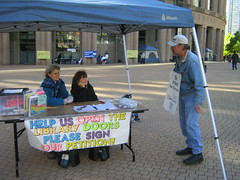
IMG_0189
My
library co-worker friends Kristie, Angela and Alex staff the
Information booth and ask passers-by to sign a petition asking the
library management to return to the bargaining table.- photo Todd Wong

It's been hard for my fellow library workers on the picket line.  This is our first strike in the library worker union's 77 years of history.  Who would have predicted a strike would have gone on this long?  Well people at city hall did…  City spokesman Jerry Dobrovolny said back on August 20th, “Typical city strikes tend to be about six to eight weeks.”  But this 2007 strike was exacerbated by the city bargaining tactics of constant stonewalling and delay and walking away from the bargaining table from December through the spring, through the summer and into the fall. 

Today there's still a media blackout in effect.  So why is the Vancouver Sun publishing this story Striking library workers, city reach tentative deal on their website?  Who told them the information?

A CBC website story reports that Vancouver city manager Judy Rogers sent out a memo and talked with CBC News.  see CBC: Library staff, City of Vancouver reach tentative deal. This story was posted at 7:27 pm PST

News 1130 posted Possibility that Vancouver libraries could be opening next week at 5:19 pm PST

The CUPE 391 page lets library workers know there are “rumors” and “stories” going around, but they can't publish anything on the webpage.  The Bargaining committee will be down at Library Square for the morning crew talk, and apologizes for the confusion caused to its members.

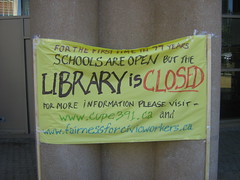
When the CUPE 1004 and CUPE 15 unions for the Vancouver City inside and outside workers settled their contract disputes with the City of Vancouver, our job action committee leaders told us that maybe now, the media would pay attention to the library issues such as pay equity, and how the library strike has affected Vancouver citizens.  It's the middle of October and long after a schools started after Labour Day, the issue that students can't get books is now a news story.  see: Parents, schools suffer as libraries remain closed

But you can't settle a contract if the other party doesn't come to the
table.  The city negotiating teams were  roundly chastised in the media
for not understanding the definition of the word “negotiate” (see Vancouver Sun: Collective bargaining: Democracy in the workplace”).

The City negotiating team was also accused of an unfair labour practice called Boulwarism
where the city didn't even bother to negotiate settlements but instead
took a “take it or strike” approach to it's “offers” that were
couriered to CUPE 15 offices, moments before they were announced to the
media.  (see CUPE > City's failure to negotiate keeps its workers on strike.)

IMG_3004

Meanwhile the media continues to print stories about how the striking workers shouldn't be able to take another job to put money on their table for their family or to help pay the mortgage.  Having enough money for food, or to pay the bills has been an issue for a lot of library workers.  A hardship committee was set up in the before the end of the second week of the strike.  Our union was sympathetic for these people and asked that people who were taking jobs elsewhere still put in some picket time both to keep in touch, and to keep solidarity. 20 hours of picket duty does not go far on $200 a week. When part-time jobs became available through our community networking, job contacts were first offered to people through the hardship committee.

And there are still other writers who believe that the CUPE unions were mistaken to rename strike action as “Sam's Strike” after Mayor Sullivan made several erroneous comments about the strike such as the right to picket the Olympics and also said that settling the strike not being a priority for him.

Check out Bill Tielman's column in 24 Hours.  Bill explores each of the “strike myths” and gives the resource links to set the stories straight.

Vancouver newspaper columnists, editorials get facts wrong in trash talking CUPE Vancouver workers over strike Vancouver newspaper columnists, editorials get facts wrong in trash talking CUPE Vancouver workers over strike. Bill Tieleman’s 24 Hours Column …

Here are some of the latest stories on a google search.  Including a wonderful story about the reception that Vancouver library workers received at the CUPE National Convention in Toronto – where they shared their stories of the strike and the creativity of Vancouver libary workers in creating bicycle pickets, puppet shows, etc.

Striking library workers, city reach tentative deal
Vancouver Sun,  Canada – 1 hour ago
vote will be set, likely Friday or Saturday. The two sides have not formally signed the agreement, Once they do, a strikeVancouver's library workers walk
Convention delegates pledge funds to CUPE 391 struggle: Striking
Trading Markets (press release), CA – 1 hour ago
Vancouver's 800 library workers have been on strike for 86 days and without a contract for 289 days. Forced into job action by the employer's unwillingness

Parents, schools suffer as libraries remain closed
Globe and Mail, Canada – 15 hours ago
Students at Britannia Secondary School usually benefit from having the vast resources of the Vancouver Public Library at their fingertips.

Attention turns to library workers
Vancouver Sun,  Canada – 16 Oct 2007
Youngberg said the union met Monday with representatives of the Vancouver Public Library and the Metro Vancouver Labour Relations Bureau to discuss

A Place of Compassion: Joy Kogawa's Dream Vancouver statement

A Place of Compassion:
Joy Kogawa's Dream Vancouver statement


Joy Kogawa holds up her arms to embrace and support everything she loves in the world
– photo Todd Wong

Joy Kogawa, author of Obasan, has written A Place of Compassion for her submission  to the Dream Vancouver conference and website, organized by Think City. While Joy will not be attending the conference, I will be as one of the directors of the Joy Kogawa House Society

Dream Vancouver is an all-day conference which will take
participants from their dreams about Vancouver to a possible agenda for
change. The conference will be facilitated by Bliss Browne, internationally-renowned speaker and president of Imagine Chicago.  Former City of Vancouver Co-Director of Current Planning Larry Beasley is key note speaker. 
Ms. Browne will then facilitate a discussion-based session which will
take participants through a series of questions designed to bring them
to a collective vision of what the city could be. 

To attend you must register, click here.

Registration: 9:30 am – 10:00 am

Conference: 10:00 am – 3:30 pm

Reception: 3:30 pm – 4:30 pm

Location: Jewish Community Centre, 950 W. 41st Avenue, Vancouver (at Oak Street).

photo courtesy Joy Kogawa

Is Joy a Vancouver dreamer?  She was born in Vancouver in 1935.  During WW2 in 1942, when she was 6 years old, her family was removed from Vancouver and sent to internment camps for Japanese-Canadians.  She forever dreamed about returning to the the house in Vancouver's Marpole neighborhood, even after the Canadian government confiscated the property of the Japanese-Canadian internment victims, and resettled them to work as labourers on Alberta beet farms.  She lives mostly in Toronto but returns to Vancouver often, and has great hopes for Vancouver as a city, and as a cultural entity.

Joy Kogawa and her brother Rev. Timothy Nakayama, at the opening event for Obasan, the 2005 choice for One Book One Vancouver at the Vancouver Public Library – photo Todd Wong

Joy is acknowledged as one of Canada's most important writers in the 20th Century for her ground breaking novel Obasan – a story about the impact of the internment on the Japanese Canadian community.  Since May 2005, when I met Joy, at the first Obasan event for One Book, One Vancouver event at the Vancouver Public Library, our developing friendship was been a wild ride as I became a key player on the Save Kogawa House committee (See my articles on Joy Kogawa & Kogawa House).


I have witnessed Joy speak in numerous circumstances and she always seems to have an unwavering position that calls for peace and compassion in so many circumstances.  It embraces her anti-war stance, the Japanese-Canadian redress, South African apartheid, the Chinese-Canadian head tax issue, Japanese atrocities against China in WW2, the history of her ancestor's home of Okinawa, the naming of the 401 Burrard building after Howard Green.  Joy doesn't look to find blame for right or wrong, she looks to find resolution.

Joy
Kogawa and Todd Wong at the 2006 Canadian Club Vancouver's annual Order
of Canada / Flag Day luncheon.  Joy was key note speaker, and Todd was
one of the event organizers – photo Deb Martin

Vancouver has long had a reputation for a history with peace activism.  This is part of our social-cultural make up, and can be embodied through social policy initiatives.  Perhaps it has become such because so many people have come to Vancouver after leaving war, destruction, starvation, revolution, upheaval in their home lands.

Joy has given Dream Vancouver a very apt and fitting dream statement to find reconciliation and understanding “within and between the
faiths, between rich and poor, among immigrant groups, in established
neighbourhoods, in the Downtown Eastside, among those who are still
suffering from unresolved injustices of the near and distant past can
come to healing and hope and inner freedom.”

Joy
Kogawa and children from Tomsett Elementary School in Richmond.  After
seeing the Vancouver Opera Touring Ensembles production of “Naomi's
Road”, the children were inspired to helps save Kogawa House from
demolition.  Joy and the children stand in front of the house for their own private tour and reading event. – photo Joan Young

On November 10th, come to the 2nd open house event at Kogawa House.
Sunday, 3-5pm.  1450 West 64th Ave. (just East of Granville St.)
Admission is by donation.  Proceeds go to restoring historic Joy Kogawa House, now owned by The Land Conservancy of BC.

A Place of Compassion

Joy Kogawa, poet and novelist: The
dream I have for this west-coast city on the edge of the peaceable
ocean is the dream I have for the world – a dream of peace. What better
time than this to abolish war as we face our common planetary fate?

We have choices – to continue blithely on our way, fighting and
devouring one another for the rest of our dwindling days, or we can
individually and collectively lay down our weapons and practice the
ways of truth and reconciliation, cooperation and peace.

In a city where east-west faces and races meet and mix, where
cultures both clash and blend, the ways of peace can be cultivated,
watered, nurtured and the seeds of that action can fly to the farthest
corners of our hearts and the world.

As a Japanese Canadian, I have welcomed conversations with two
granddaughters of Howard Green, the politician whose public words
against us during the Second World War were dreaded in our community.
If they can seek to make peace with us on behalf of the grandfather
they loved, ought we not to walk with them? What an opportunity for
peace making and for walking on.

And ought we not, as Canadian descendants from Japan, to stand with
those Canadian descendants of China, who seek a fulsome parliamentary
acknowledgment from the country of our ancestors for the horrors their
ancestors faced in the Rape of Nanking? Or is it our choice to turn
aside and say, “These are no concerns of ours.” I believe that the
morally appropriate action is to respond to those who suffer and who
call our names.

But it is not for me to say what is right for anyone else. We are
each required to struggle with our own conscience and to respond to the
many voices that call us.