Category Archives: Main Page

Hip Hapa and Happening: Intercultural activities for Aug 31 to Sep

Hip Hapa and Happening: Intercultural activities for Aug 31 to Sept

If my back wasn't bothering me today, I would be at the Dr. Sun Yat Sen Gardens on Friday night, as my friends Qiu Xia and Andre Thibault put on a very special music concert with their erhu playing friend Ji-Rong Huang. 

Andre and Qiu Xia have a very special place in the world of Gung Haggis Fat Choy.  Silk Road  Music Ensemble performed in the CBC Vancouver television performance special, and Silk Road Music Duo have performed at Gung Haggis Fat Choy Robbie Burns Chinese New Year dinners over the years.

Enchanted Evenings

featuring Silk Road Music Duo

Dr. Sun Yat Sen Chinese Classical Gardens

Silk
Road Duo is a new music performance that introduces audiences to
different cultures through the experience, discoveries, and travels of
Qiu Xia He with her Pipa, accompanied by multi-instrumentalist Andre
Thibault. The pipa, a Chinese lute with a wide range of expression,
will be the focal point. This husband and wife team is well equipped
for this cultural mission. Both have lived passionately as professional
musicians. Their common bond and love of music have taken them on tours
all over the world.

Georgia Straight: Todd Wong 30 year library employee interviewed

Georgia Straight: Todd Wong 30 year library employee interviewed

I arrived at the Library Square picket line just before noon today, as
I had spent the morning in a picket captains orientation meeting.  Some
of my co-workers were wondering if there had been a misprint in the
Georgia Straight because I couldn't possibly have worked in the library
for 30 years.  Todd couldn't be that old!

I explained that I had actually started working for the library in
uetero, while my mother was working in the library catalogue
department, before I was born.  Officially, I joined the Vancouver
Public Library staff when I was 15 years old, back in 1975.

Today, the Georgia Straight published a news story, Boss and union tell different tales,
about the library strike containing an interview with me and a picture
from my website.  The picture shows myself with fellow picket captain
Alexis Greenwood, smiling with city librarian Paul Whitney, while on
the picket line on Monday.  We have the friendliest picket line – we
don't try to block anybody.  I have known Paul for many many years…

Even though he is library management and our Union bargaining committee
has to talk tough with him and the library bargaining representatives,
I would prefer to get along with everybody.  We still have to go back
to work with management when the strike is over – the city negotiating
team doesn't.  Paul told me personally, “It's not about you and me,
there are bigger things at play.”

Hmmm… maybe this explains why our formal employer “Vancouver Public
Library Board” had an in-camera meeting last night but have been conspicuously absent from advocating for the library.  Many of the CUPE 391 picketers are now
sporting picket signs that say “Where is the Library Board?”

see Boss and union tell different tales – Georgia Straight


Boss and union tell different tales

News Features By Charlie Smith
Todd Wong, an accordion-playing library employee, picket captain Alexis Greenwood, and city librarian Paul Whitney remain on friendly terms.

Todd
Wong, an accordion-playing library employee, picket captain Alexis
Greenwood, and city librarian Paul Whitney remain on friendly terms.

Read the entire article: Boss and union tell different tales – Georgia Straight

Here are the interview bits from me:

Todd
Wong, a 30-year employee, told the Straight in a phone interview that
the closure of the library will mean that fewer Vancouver residents
will learn about the 100th anniversary of the anti-Asian riots in
Vancouver in September. (See page 15 for more information.) He said
that people can't check e-mail at the library and they don't have
access to ESL programs in many of the branches.

“At the end of
July, I noticed that the Vancouver Intercultural Orchestra had to
cancel one of their programs,” Wong said. “They do incredible work.”

Wong,
a community and cultural activist, said public librarians are paid less
than their counterparts in the corporate and academic sectors, adding
that he can't understand why the City won't agree to mediation.
“Obviously, there seems to be a hidden agenda,” Wong claimed, noting
that the City has hired a public-relations company called the Wilcox
Group
to handle communications during the strike.

“Library Square conceived of being a cultural heart of the city,” he added. “It
seems like City Management is trying to prolong the strike.”

Whitney
said the union “booked out of mediation” in July when it served strike
notice. “The City is our primary funder, so it's logical we would be
consulting closely with them on the movements in our negotiations,” he
said. “And the issue around mediation, I'm assuming, would be discussed
in the context of all three city locals.”

Here are the interview bits CUPE President Alex Youngberg:

Alex Youngberg, president of CUPE Local 391, described Whitney's
comment as “insane” and “downright outrageous” in a phone interview
with the Straight. “He's not giving librarians a very good reputation
as far as math goes,” she added.

Youngberg claimed that the
union's last offer, including provisions for pay equity, would work out
to a 29.5-percent increase in wages and benefits over a nine-year
period if the city granted every aspect of the package. She said that
the union has “trimmed back” its request for benefits, and is only
seeking coverage for eye examinations, laser surgery, and composite
dental fillings because of problems associated with mercury fillings.

She
claimed that the city has already saved more than $1.4 million by not
paying unionized staff during the strike. That contrasts with only one
percent of payroll, or about $200,000 per year, that she said would be
allocated for pay equity. In addition, Youngberg emphasized that this
$200,000 per year would only be forthcoming if the union could prove
that female workers were not being paid the same as male city employees
for work of equal value.

“In Burnaby, their council was actually
in favour of them having pay equity and they urged the employer to
comply with giving…internal equity,” she said.

City Councillor Raymond Louie meets CUPE 391 library workers

City Councillor Raymond Louie meets CUPE 391 library workers

IMG_2578
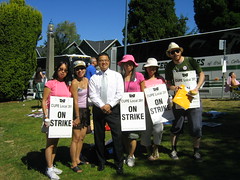
Picketers in Pink with Raymond
Louie:
Nancy, Sherry, Jean,
Margaret + Randy

at the Aug 29,
2007
Civic Strike rally at Vancouver City Hall – photo Todd Wong

It was a busy day at City Hall on Wednesday, Aug 29, as three civic unions marched from Science World to City Hall for a rally.

After the speeches were made, City Councillor Raymond Louie was seen talking to some of the city workers.  One of my library co-workers suggested giving Councillor Louie one of our “My Civil City has Pay Equity” buttons.  I walked over to Raymond, gave him a button, and offered to introduce him to CUPE 391 Vancouver Library workers, as I don't think he knew any of our library workers, nor was aware of the Vision-CUPE conspiracy that was earlier reported in the Georgia Straight: Vision using strike for political gain.

Raymond was pleased to be introduced, and shared that he was a union member with CEPUC, the Communications, Energy and Paperworkers Union of Canada, as he had worked for the Pacific Press Group for many years, and also endured many strikes.

Some of our members asked Councillor Louie what he was doing to end the civic strike, as last week Louie had called for a mediator to help bring the unions and city back to the bargaining tables. At that press conferience Louie had said:

“Enough is enough, it's time for the
city and the union leaders to sit down with a mediator and get this
strike resolved,” said Councillor Louie

“We're asking the parties to agree to a mediator, as negotiations
seem to be heading in a negative direction and the duration of this
strike is unacceptable… 

“The buck stops with the mayor! He should be the one to make
the first move in terms of calling on a mediator.”

 – but the City had still not responded days after the call, while the unions have said they would welcome a mediator.  Louie also said that Mayor Sam Sullivan and the NPA caucus have been very locked into their thinking and difficult to budge.

Louie also asked me how important pay equity was to our union because it would be expensive.  I explained that entry level librarians in Toronto are making $7 more than entry level librarians in Vancouver, and that library salaries were far below academic wages at UBC,

“Our former Human Resources Director left for the business sector, and one of the HR assistants went with her!” I explained as I pointed out that the corporate sector pays more for similar positions.  Salaries for Vancouver Public Library employees have fallen behind for 30 years.  Our union would accept the Burnaby contract, because it has pay equity.  Can we please have the same contract as Burnaby?

IMG_2579
Todd Wong with Raymond
Louie
at the Aug 29,
2007
Civic Strike rally at Vancouver City Hall – photo Todd Wong

Aug 29 Rally to City Hall, Day 35 Library Strike

Aug 29 Rally to City Hall, Day 35…

see Labour relations strain under NPA reign – Vancouver Courier

see Vancouver's Library Strike: Women's Pay on the Line – The Tyee

see Boss and union tell different tales – Georgia Straight

Globe & Mail: Fiona Tinwei Lam has an essay about her music, her mother and dementia

Globe & Mail: Fiona Tinwei Lam has an essay about her music, her mother and dementia

Fiona Tinwei Lam
was a finalist for the Vancouver Book Prize in 2003 for her poetry collection “Intimate Distances.  Over the years we have become friends, and have shared our joy of Robbie Burns poetry, things Scottish, and discovered we were related through shared cousins.

Fiona was born in Scotland, moved to Canada as a young child, and has been a guest for both Gung Haggis Fat Choy: Toddish McWong's Robbie Burns Chinese New Year Dinner and also the Gung Haggis Fat Choy World Poetry readings.  She has a younger sister who is a librarian, and whom once paddled on the Gung Haggis Fat Choy dragon boat team.

I heard about when Fiona's mother was moved to a care home, as her sister Shona gave me some of their mother's old accordion music.  I regret that I was never able to play my accordion for their mother, as she used to play accordion in addition to piano.

The following is a very touching story that Fiona has written for the Globe & Mail.
http://www.theglobeandmail.com/servlet/story/LAC.20070828.FACTS28/TPStory/?query=Fiona+Lam

Playing for time

Although dementia often made my mother's speech
nonsensical, she could sustain a wonderful musical dialogue through
rhythm, tempo and volume

I used to wake up some mornings as a teenager to the sounds of my mother playing the piano. But it was never Rustle of Spring or a gentle Minuet in G. Rather, it was the thunderous chords of Chopin's Funeral March. Either it was time to get up, or someone – probably me – was in deep trouble.

My petite mother would be perched over the keyboard, small hands
hammering down, creating sounds that made the room shake. If I tried to
close the door, she'd only open it again and return to the piano to
play even louder.

What my mother played always signalled her mood. A waltz meant
all-clear. A nocturne meant she needed to be left alone. But the
opening bars of the Funeral March spelled doom and had me racing for cover.

It was expected that I take piano lessons and piano exams, even
stumble through recitals, despite my mortification. Worse yet was the
year I was required to play the national anthem at high-school
assemblies.

One time, I misplaced the score. As I had played it so often, and
almost had it memorized, I thought I could manage. After everyone stood
up to sing, I began to play. When I reached “the True North strong and
free,” my panicked fingers faltered and stopped. People kept singing,
but the right notes eluded me. It happened again another time. I
decided I'd had enough of the piano.

After I left home, my mother had to retire early because of
deteriorating eyesight. Eventually, she couldn't read music. I hardly
noticed this, as she had committed so many pieces to memory.

She then developed Alzheimer's disease. Her repertoire began to
shrink along with the rest of her memory. But it didn't stop her. Once,
while we were visiting a care facility, my mother spotted an ancient
upright piano in the corner of the room. She marched over faster than
you could say Battle Hymn of the Republic, and launched into a medley of pub tunes intermingled with hymns, ending with a rousing rendition of Ten Little Indians.

I smiled wryly at the doctor as she arrived. “Sorry about this.”

“No one minds! It's wonderful that your mother still plays!” She went over to lavish her with praise.

Delighted with her audience, my mother played on.

As I watched song after song evaporate from her memory, I decided to
take up lessons again as an adult. But my performance anxiety was
almost insurmountable. At the introductory audition with the new
teacher, I tried to avoid playing a single note.

“Do I have to actually play?” I asked the teacher in desperation.

When I finally learned one of my mother's former pieces, the adagio from Beethoven's Pathétique
sonata, I played it for her. She listened for a while, nodding but
looking confused. After a few moments, she stood up: “Can I go home
now?”

Other attempts failed as well. Classical music just couldn't keep
her attention. I resorted to Christmas carols, whatever the season. I'd
urge her to clap or la-la along, trying to recover even a small portion
of the mother I had known growing up.

Later, I started playing the piano on my mother's secure floor at her care facility, sight-reading and stumbling my way through Red River Valley and Tea for Two.
Slowly, the other residents would find their way over from the TV
lounge. A few (usually mute) residents would suddenly start to sing;
others would even dance. My mother would pat my shoulder appreciatively
or pound out the time on the dining table. One time, she stood up at
the end of a song to applaud.

As my mother's dementia deepened, our family arranged private
one-on-one music therapy for her. Although my mother's speech was often
nonsensical, she could sustain a wonderful musical dialogue through
rhythm, tempo and volume that would deeply satisfy and calm her.

During my mother's last weeks, as she lay unconscious in palliative
care at the hospital after suffering a stroke, I talked to her, held
her hand, read to her, played her favourite tunes on the CD player. But
it didn't feel like enough.

So one day, I started to sing, self-consciously, quietly, so no one outside the room could hear: “Now
you are come, all my cares are remov'd./ Let me forget that so long you
have rov'd./ Let me believe that you love as you loved./ Long, long
ago./ Long ago.”

Suddenly, it felt as though my mother were singing to me, even while
I was singing to her. Every phrase became clear and alive. Years of
occasional tension, of living on opposite sides of the country, a
decade of dementia – it all fell away, leaving only the essential
truths.

Recently, I've been searching for a piano of my own. In stores, I
look around furtively to ensure no one's around, choose a piano and sit
down to play Chopin's Funeral March. The major piano stores must know me as the Morbid One.

Although I doubt I'll ever learn a third of my mother's extensive
classical repertoire, I'm going to make the effort, piece by piece.
It's my way of remembering her – not so much how she telegraphed her
dark moods when I was growing up, but how she could create such beauty
through her hands.

Fiona Tinwei Lam lives in Vancouver.

Daniel Gawthrop, author and CUPE National worker, speaks and reads to Vancouver Library workers

Daniel Gawthrop, author and CUPE National worker, speaks and reads to Vancouver Library workers

Author
Daniel Gawthrop (Rice Queen Diaries, Highwire Act: Power, Pragmatism
and the Harcourt Legacy, Affirmation: The AIDS Odyssey of Dr. Peter)
and also a CUPE national worker, comes to read at the Library Square to
library workers.

Daniel talked to the Vancouver Library workers about how important their jobs are to the community, especially when it comes to promoting and supporting writers.  He complimented the reading events put on by VPL, and said that “No matter if you are a major figure like Alice Munro or Margaret Atwood, or little me… everybody gets the same poster!”

He also gave words of support to the striking library workers, telling them to hold tight, speak their truth, and get their message out.  He criticized the city of Vancouver's use of the Wilcox Group PR firm, to create a media spin on the labour dispute, instead of using their resources to manage a resolution.  He praised the creativity of the CUPE 391 library workers in getting their message out and getting recent media attention:

see: Globe & Mail: Library workers picket with pizzazz
see video: “Grandeur on Georgia”  Wilcox Group vs Pay Equity
see video: “Pay Equity – Recipe for Disaster”

Daniel Gawthrop then told the assembled library workers that he had brought a number of short articles to read from and offered them a choice:  a story about The Curse of Leni Riefenstahl, the killing of Theo Van Gogh, an article about post 9-11, an article about 9-11 in Thailand… but the winning vote was for an debut reading for a soon-to-be-published story titled “Marriage: Why I took the plunge.”  It was an entertaining and enlightening story about gay marriage, and the social impact of it both personally and culturally to somebody who had said that he would never get married.

Check out pictures of Daniel Gawthrop reading at Library Square:
Aug 27 CUPE 391, Daniel Gawthrop comes to read

IMG_2376IMG_2377IMG_2374IMG_2373

Paul Whitney, city librarian stopped briefly by the picket line to say hello.  Okay, Paul is management and the union doesn't like some of the things he has said to the media.  I have known Paul for over 20 years, mostly by association, but he's always been a nice guy and supportive of some of the events I have organized.  He's probably caught between a rock and a hard place as the City negotiates with our Union… so in his own way, he's walking the line.

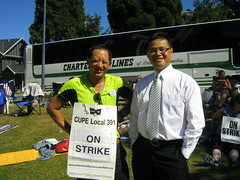
IMG_2414IMG_2415Paul Whitney, City Librarian, with picket captain Alexis Greenwood and library employee/accordionist Todd Wong

Tom Hansen, retired library finances officer, union rep and former VPL board member also came by.  But Tom was not diplomatic in his criticism of the city's handling of the civic strikes.  Tom congratulated on us going on strike to stand up for what we believe in, and to tell city hall what we think.  He told me that the city is saving a big whack of money every week we are on strike.  “$1 million dollars every two weeks,” he told me.  Hmmm… so much for the library's motto ”
Inspiration through information. Access for all.
http://www.vpl.ca/general/collDevPolicy.html

IMG_2419IMG_2420 Tom Hansen, retired library worker, former union organizer and former VPL board member comes to give support.


Author Stan Persky speaks to library workers because his books are “locked up” during the strike

Author Stan Persky speaks to library workers because his books are “locked up” during the strike


Stan Persky, spoke to Vancouver city library workers on Friday August 24th.  He told his audience of picketers, lunch time loungers, and visitors to Vancouver that he came to speak at the library because his “books are locked up.”  Stan read from his latest book Autobiography of a Tatoo.

The
BC Book Prize winning author of  The Short Version: An ABC Book, was one of my political activist
role models and College instructors.  I was taking his classes in
Political Science at Capilano College when the Solidarity movement was
happening, and I was a member of the Capilano Courier student newspaper
collective.  He has written many books such as Then We Take Berlin, Son of Socred, Bennet II, and Buddy's.

Stan is no stranger to strike or bargaining action.  He was a member of CUPE while working up north, and he was the original editor of the “Solitarity Times” during the BC Solidarity movement of the 1980's.   He has also author a book about the Polish Solidarity
movement titled “At the Lenin Shipyard” and the “Solidarity Sourcebook


CUPE 391 president Alex Youngberg is surrounded by media as she speaks to Vancouver library workers.  Alex told us that with recent positive and understanding articles and columns about library worker issues, she feels that the tide is turning.  She cited the recent Globe & Mail article “library workers picket with pizzazz” and Don Cayo's column in the Vancouver Sun.

Daniel Gowthrop will speaks today on Monday, August 27th.
Gawthrop is the author of Affirmation : The AIDS Odyssey of Dr. Peter, Highwire Act : Power, Pragmatism and the Harcourt Legacy, The Rice Queen Diaries and also Vanishing Halo: Saving the
Boreal Forest
.  Daniel also works in the CUPE national office.  Hmmm… what a coincidence.

More pictures at: Todd Wong's Flickr site

For more information on the Vancouver Library workers strike:

Check out www.cupe391.ca
and www.fairnessforcivicworkers.ca

Barb Waldern report from Korea: Masan City Part 1

Barb Waldern report from Korea: Masan City Part 1

Barb Waldern is a beloved member of the Gung Haggis Fat Choy dragon boat team.  She is currently teaching  English in South Korea. 

Barb joined the Gung Haggis team last summer and paddled with us at Cultus Lake and Vancouver Taiwanese dragon boat races.  This year she paddled in the ADBF regatta, Lotus Sports Club regatta in Burnaby and the Alcan Dragon Boat Races.  We gave her a send off party at the end of June.

August update from Barb Waldern in South Korea

 
Masan City
Part 1
 
Masan
City is located on the southeastern tip of the Korean peninsula in a
subtropical zone. It is a 4 to 5-hour drive to the capitol from here.
 
All
of Korea is mountainous. Masan is an industrial harbour town of 1/2
million people nestled against the hillsides with their terraced farms
and lush mixed forests of coniferous and deciduous trees. Most industry
is not located right in the boundaries of the city proper.
 
Date,
fig, pomegranate, ginko trees and the occasional palm are scattered in
and around the city, their fruits about halfway to ripening now.
Grapes, tomatoes, white peaches, and many other fruits are ripening and
on sale in the markets.
 
The severe heat is
lingering beyond seasonal norms and the monsoons continue. While
cicadaes still roar in waves upon waves, a strange bug can now be heard
over the: the big brown thing with long rear legs that flies makes
amazing noise. It sounds like a Jews harp playing frog-sparrow. It
begins by buzzing like a group of cicadaes, then twanging to an
accelerating rhythm, exciting itself into a fit of loud chirping.
 
At
night or early in the evening, the cuckoo calls. It really does cuckoo
every hour! One in my area begins at 7:15 and repeats at every quarter
of the hour. Magpies and other birds unknown to me besides the sparrows
are numerous and make enchanting calls all day long.
 
Koreans
appear to take pride in nature and there are many parks/conservation
areas and outdoor activities. There is a large national park west of
Masan. The nearest such place to Masan is Muhak Mountain.
Koreans consider that mountains have spiritual value. For one thing,
graves are located on mountains. Pairs of perfectly round grassy
mounds, often with stone markers, can be spotted here and there.
 
Hiking
Muhak mountain is one way Masan residents get regular exercize. Elderly
and mid-aged men and women often head up Muhak in the early morning,
wearing protective clothing and carrying backpacks, to return before
noon.
 
School yards are also popular places
for power walks  or  jogging as well as socializing in the evening air.
Groups of old women often congregate under a tree on benches near a
track. Public spaces are few and far between, and what exist are small
patches.
 
Elderly people group themselves in
dry and shady areas during the day, gossiping and playing
games. Some squat together on street curbs, a rendez-vous point for the
frail to wait for friends to emerge and spread the news.
 
Most
of the elders have been raised on traditional farms in peasant life.
They have seen fantastic changes, the good and bad, over the past 35
years since monopoly capitalism was systematically planted and S. Korea
rose as a “Tiger” state.
 
When
they are not in school or some kind of training, boys meet in PC stores
to play computer games for hours at a time. Some 30 to 50-something men
join them. (That makes me an oddity here.) The girls are likely having
visitors or going shopping if they are not helping their mothers and
grannies with housework.
 
The youth? As I said
before, young people study a lot and adults spend long days working
hard. The people have known severe poverty through decades of
occupation and war, and they invest a lot in education and work while
they can. There is a university here. Teens and university students
hang out in the two fashion/shopping districts, one on the eastside and
the other on the westside (both are affluent areas). There are sports,
from martial arts to golf, swimming to soccer, happening…somewhere.
There are gyms and bowling allies in Masan.
 
Koreans
today are attracted to the cosmopolitan while they retain a strong
sense of national pride. The are eager to explore and benefit from the
world's riches, tangible and intangible, while protective of their
country and ways.
 
I hear of a lot of cultural
events taking place in Pusan, where theatre and music and visual arts
are quite active. There is not much happening in that regard in
Masan. I hear of public events such as laser shows, sandcastle exhibits
and others taking place around the province (Kyong-nam) from the
children. Hollywood and international moves are shown in cinemas in
most cities. Masan has one.
 
Dating is
generally a slow process wherein couples usually spend a long time
getting to know each other as friends before engaging in a more intimate
and serious relationship. Here, one shouldn't assume that a
“boy/girlfriend” is a lover. Couples are generally in for the long
haul. Marriages are performed by neither state or religious
officials–teachers are often selected to officiate. I imagine that
there must be some sort of state registration, but I understand that
divorce is a simple process here, though the divorce rate is still
lower than that in, say, Canada.
 
Foreign
men may be interested in having relationships with Korean girls, but I
would say that their chances are not good. It is expected that the man
make an effort at an elaborate romance and make most of the moves. When
they make a move they must be very cautious because a woman could
easily take offense. I know an anglophone foreigner guy who's been
dating a young woman for four months. He and the woman have never
kissed.
 
Men from Europe, UK, Canada or the
US would likely lose patience. They generally approach sex and
relationships more casually and tend to be fast. Not that there aren't
sluts and fast women here too, and some of them seek out foreigners for
flings. Foreign guys often wait for the woman to initiate things, make
most of the moves. If a woman calls a man in Korea, it's taken as a big
sign of romantic interest by the man. Of course, one ought to be
skeptical about the boasts of another, for they may wish to impress.
Also, people will often prefer to give misleading information when they
do not know an answer to a question, rather than expose their
ignorance.
 
The girls ought to be cautious
with foreign men. After all, foreigners are largely here on a temporary
basis. Even if the relationship got serious, there is a lot involved in
making a decision to have a life with a foreigner, such as the prospect
of emigration. There is also the question of national pride, among many
others. There is also reaction to ethnically mixed couples and certain
kinds of foreigners (see the news article I'm forwarding along with
this one that gives an international rating of racism in SK). For
example, a viewer will notice the occasional “white” face on TV, but no
Asian other than Korean.
 
Koreans
travel for work, business, pleasure or family, frequently between
cities in Korea, and the middle class goes to neighbouring countries
often. However, the price of gasoline and oil is very high, because
Korea does not have its own petroleum sources. Korea imports oil and
gas to power motor vehicles, and produce electricity, as well as
plastics I suppose. Electricity prices are also relatively high. There
is a VAT (value added tax) on gasoline and a lot of merchandise, a
source of state revenue for state expenses. Yet numerous taxis roam the
city streets 24/7, and flatbed trucks laden with fresh farm or wharf
products cruise day and evening constantly, megaphones blaring,
especially in this season. The system of diesel buses is thorough and
very accessible. (I've seen one experimental natural gas bus so far.)
And, Koreans, always in a hurry, love their Korea made cars
and “camions” (SUVs).
 
Korea
has a limited welfare state system. I wonder how it will fare given the
recent signing of the US-Kor FTA and Eur-Kor FTA. I do not think it
will play out the way it has in North America. For one thing the
progressive labour movement is well warned and prepared. Already laws
such as the new one regarding part-time and temp workers are in place.
For another, Korean nationalism is inspiring regional trade
negotiations (N-S Korea, SK-China, etc). Thirdly, traditions die hard.
 
Work
days in non-unionized environments are long, often up to 12 hours with
just a one-hour break. A Korean office worker that we know, who used to
work at our school, says she works those hours.
 
Service
in Korea is great. I think retail service in the Korean context is
reinforced by the norms and traditions of hospitality and courtesy just
as much as it is by the motive to promote and sell store products. Many
men and women work in retail service. If you want help, you'll get it.
And someone will always be there to acknowledge you with a nice smile.
 
As
an example of the effects of resistance to free trade, take the E-Land
group of big box stores. It is Walmart in disguise. (The “E” is
actually an upended “W”.) In disguise because of Walmart's bad rap
internationally. Nevertheless, the progressive unions main focus of
attack is the E-Land store chains. 
 
Business
leaders hope for a North Korea-South Korea FTA, but I expect there to
be a particular regional trade agreement instead, eventually. There are
state health insurance and state supported health care, with clients
and employers each being obliged to pay half of the insurance premiums
for basic medical and dental coverage. In parts of Masan, there is a
city garbage collection service with recycling program in many
(precincts??), the latter being paid for through the consumers'
purchases of official plastic bags. There is a government postal
service. Government workers maintain road, sewers and other aspects of
the infrastructure.
 
I'm
surprised at the number of taxis in this town. Transportation is
largely privately owned. The taxi drivers (all men) are often quite
pleasant and courteous, but not so the bus drivers. The bus system is
extensive and while city and suburban buses may be few and far between
in some areas and at some times, intercity buses are frequent and
rapid. I have not been on a train in Korea yet.
 
General
education through secondary school is government paid and run. Private
schools are supplementary and not an option as opposed to regular
public school Teachers never flunk or expel students, whatever the
case, because the state believes that rejected students will become
hostile to society and fall into a life of crime or addiction. Teachers
get a year-round full-time salary, with a month of paid vacation in the
summer. It is illegal for many kinds of employees to take a second job.
 
Most
jobs are full-time. If an employee agrees to perform some other service
for someone else, they may be paid a stipend or remuneration in kind,
or at least have expenses covered. The Union movement is expanding
because of the surgence of a progressive federation of labour that was
legalized only a few years ago and that is countering the yellow
confederation supported by employers and big corporations. There are
labour standards, though I don't know much about them.
 
Telephone
service is private, with many available firms providing it. SK Telecom
is one such firm. It has been suffering a major scandal; all I can
figure out from Korean language (Hangukaw) news media is that SK
Telecom executives were caught on a recording device hatching up some
sort of scheme and dumpsters full of discarded client records were
discovered.
 
New and old converge, sometimes
meshing sometimes jarring. For example, haggling is the normal practice
anywhere except department stores. I'm not good at it, but vendors and
merchants are usually very kind. I think they appreciate foreigners
attempting to shop in regular Korean places. I think they are concerned
about strangers managing and adjusting in the new country.
 
END OF PART ONE
 
Barbara

Hip, hapa and Happening…. July 24 to 31

Hip, hapa and Happening…. July 24 to 31

I am back from a weekend in Victoria celebrating Chinese-Canadian and Scottish-Canadian activities such as the Victoria dragon boat races, visiting Craigdarroch castle, a Chinese banquet in Chinatown with a Portland dragon boat team, and kilt wearing in the Irish Time Pub.

see my pictures on flickr
http://flickr.com/photos/53803790@N00/sets/72157601627492033/

But for Vancouver this weekend…
check out:

Enchanted Evening series
Sunny and FriendsAn ecclectic blend of India's finest sounds
Dr. Sun Yat Sen Gardens
doors open 7 pm
concert starts 7:30pm

image

These events almost always sell out.  Get there early.  Sunny has performed at Gung Haggis Fat Choy events with Joe McDonald's musical group Brave Waves.  I have also crossed paths with him many times for the group Vishwa, which he formed with his sister and celtic violinist Max Ngan.

ANNIVERSARIES '07 FILM FESTIVAL


FRIDAY NIGHT (AUG 24TH) 
AT KEEFER AND COLUMBIA. 
VIDEO PROJECTIONS STARTING AT 8:30 PM
on the Sun Yat Sen Park wall.  

CURATED BY KAMALA TODD, THIS PROGRAM HIGHLIGHTS THE 60th ANNIVERSARY OF 1947 AND LOOKS AT ISSUES OF CITIZENSHIP IN CANADA. 

1947
Citizenship Ltd.
A
lot of gains were made in 1947, including voting rights for Canadians
of Chinese and Indian descent, and the eradication of many race-based
legislations and social exclusions. Hard fought victories worth
celebrating for sure. But do voting rights mean equality? This program
explores the complexities of citizenship and belonging—from Aboriginal
people’s struggles with colonial policies, to Japanese-Canadians
experiences of internment, to Chinese-Canadian veterans fighting for
recognition.

THE PROGRAM:
1.  Michael Fukushima, Minoru: Memory of Exile, 1992, 15:00 
2.  Stephen Foster, X-Patriotism, 2001, 6:00. 
3.  Jari Osborne, 1999, Unwanted Soldiers, 48:48. 
4.  Cherie Valentina Stocken, A Fine Line, 2005, 4:43. 
5.  Rick Shiomi/Powell Street Revue, Images of the First Hundred Years, 1980, 11:00 


VANCOUVER KILTS NIGHT
imageimageimage

Date:
Friday, August 24, 2007
Time:
7:00pm – 11:55pm
Location:
Wolf and Hound Irish Bar
Street:
3617 West Broadway

For the first time we are going to Kitsilano.  Somehow we always get a group of Asian-Canadians wearing kilts and speaking in the best (or worst) Scottish brogues… and then there are the “hangers-on” a bunch of Scottish-Canadians trying to pick up the Asians because they think our kilts are sexy.

Vancouver authors, writers and poets come to Library Square to address striking Vancouver library workers

Vancouver authors, writers and poets come to Library Square to address striking Vancouver library workers

“Writers
for Library Workers”
1 pm reading/speaking program
South Plaza of Library Square
Robson and Homer St.

I have only made this program up
this past week…

Terry Glavin was our first speaker, on Tuesday August 14th.  Terry addressed pay equity issues, his life experience with strikes and the importance of libraries… and how he had planned to do some research at the library – but couldn't because we were on strike.


Tom Sandborn speaks to CUPE 391, Randy, Tom, Alexis and Peter – photo Todd Wong

Tom Sandborn was our 2nd speaker a week later on Tuesday, August 21st.  It was very timely because Tom had just written a piece on CUPE 391's call for pay equity, in The Tyee.  Vancouver's Library Strike: Women's Pay on the Line
http://thetyee.ca/News/2007/08/20/LibraryStrike/

Tom spoke about the importance of pay equity and how it works.  He compared the Vancouver library to other comparative systems.  He also spoke about how the media works and how it is important for Vancouver library workers to keep their support strong and write letters to get their views across, and ensure that correct information and perspectives about their contract struggles are presented.

Tom
joked that if the library workers settle before next Wednesday, it will
ruin his column for the Vancouver Courier.  After speaking to CUPE 391
library workers, he took some pictures of us waving at cars on Georgia
Street, then he reappeared on his bicycle waving to us… and everybody
yelled “Thank you Tom!”


The World Poets wrote original poems and read them to the audience, (l-r) Jan, ??, Alejandro and Ariadne – photo Todd Wong

The World Poetry Society presented poems specifically written for the Vancouver library workers on Wednesday.  Ariadne Sawyer and Alejandro Mujica Olea have organized World Poetry Nights at the Vancouver Public Library for over 5 years usually on the 3rd or 4th Monday of each month.  Ariadne was one of the first people I called to come speak/read to Vancouver Library workers, as their group is one of many small community organizations that rely on VPL for a venue and adverstising of their events.

The World Poets received heart-felt and appreciative applause from their library worker audience.  Ariadne's poem mentioned many of the library workers whom she specifically works with in setting up a World Poetry event at the library.  Barbara who does the bookings, Adrienne who does the posters, Paul who presents ideas… It was a very touching tribute.  Alejandro closed it up with a passionate fiery speech that implored library workers to stand up for the issues they believe in and not to back down… “because you deserve it!” he cried out.


Ellen Woodsworth gives words of support to CUPE 391, while strike leader Peter DeGroot holds Ellen's bicycle – photo Todd Wong

Ellen Woodsworth, former COPE city councillor, gave words of support to the striking city library workers.  I got to know Ellen through her assistance with the Joy Kogawa House campaign and we became supportive friends.  Woodsworth encouraged library workers to stay visible, and keep up their campaign – because they are winning public sympathy and public opinon.  She urged the library workers to write to city councillors and to newspapers to ensure that their views were included and that correct information was being presented.

Chuck Davis speaks through the make-shift PA system that is Todd Wong's boom-box – photo Todd Wong

Chuck Davis spoke today.  He opened talking about the second most stolen book in VPL history, his self-penned reference book The Vancouver Book.  He told many funny anecdotes including phoning up the Vancouver Public Library to ask when the first traffic light was installed.  “Well… according to the Vancouver Book… it was…” came back the answer.

Chuck told some fascinating stories about how Vancouver history has been recorded, researched and recycled.  The library plays an important part of that as a cultural and historical storehouse of information and archives, he told the listening audience.  We also joked about how the first strike in CUPE 391's 77 year history will have to go onto Chuck's website: www.vancouverhistory.ca

Stan Persky, is coming on Friday August 24th.
The BC Book Prize winning author of  The Short Version: An ABC Book will speak on  Friday, August 24th.  Stan was one of my political activist role models and College instructors.  I
was taking his classes in Political Science at Capilano College when
the Solidarity movement was happening, and I was a member of the
Capilano Courier student newspaper collective.  He has also author a book about the Polish Solidarity movement titled “At
the Lenin Shipyard” and the “Solidarity Sourcebook”

Daniel Gowthrop will speak next week on Monday, August 27th.
Gawthrop is the author of Affirmation : The AIDS Odyssey of Dr. Peter, Highwire Act : Power, Pragmatism and the Harcourt Legacy, The Rice Queen Diaries
and also Vanishing Halo: Saving the Boreal Forest.  Daniel also works in the CUPE national office.  Hmmm… what a coincidence!