Kadoya Sushi on Davie St. Try the specialty rolls

Kadoya Sushi on Davie St.  Try the specialty rolls

I went to Kadoya for the first time on Friday night, March 23… and I LIKED it!

On the walls are many compliments to the restaurant, staff and the food.  It is entertaining just reading all of the different place mat sized drawings and compliments.  There is even a sign up on both sides of the restaurant stating if you are allergic to something, please tell the serving staff.

The specialty sushi rolls are REALLY SPECIAL.  They are truly creations of culinary art. They are named Rainbow (each piece a different colour), Cinderalla, Snow White, Queenie, Princess, Canuck.  They are large, eight pieces and cost $7.95.  They almost fill you if you are going for dinner.

My girlfriend and I shared the Dinner for Two which included 1 Specialty Roll, Miso Soup, vegetable and prawn tempura, terriyaki beef (or chicken), + special rice.  It was a lot of food for $30, and we felt it was a good deal.

The service seemed friendly.  Our party of 5 included 1 Japanese student, 2 Caucasian-Canadians, 1 Swiss born Canadian, and myself a multi-generational Chinese-Canadian.  We thought our waitress had a mandarin Chinese accent.  Our Swiss-Canadian friend goes to the restaurant regularly with his Japanese friend.  It was the first for the rest of us.  We all definitely enjoyed ourselves, and plan on returning.

Did the “slanted eyes” comment defeat Boisclair in Quebec election or was it because of other judgments and gaffes?

Did the “slanted eyes” comment defeat Boisclair in Quebec election or was it because of other judgments and gaffes?

Andre Boisclair has led the Parti Quebecois to one of it's most stunning defeats.  Boisclair recently won the anger of Asian-Quebeccers for refusing to apologize for “slanting eyes” comment aimed at Asians.

Did it make a difference in exposing the poor judgements of a man who wanted to become the next separatist leader of Quebec?  Did it demonstrate the problems of misunderstanding multiculturalism when the man wanted to create a sovereigntist monoculture?

Prior to the election, a coalition of Asian Canadians in Quebec sent out the following letter on Saturday afternoon, March 24, 2007, in both English and French.  The strategy was to focus on the voices
of Asian Quebecers. The signatories were those who responded before today's media release.

It's a well written letter and exposes the problem that there are leaders in Canada who still stereotype and generalize all Asians because they look the same re: “slanting eyes.”  It is a pity that many Candians cannot recognize or do not know the long and valid multigenerational history of Asian-Canadians in Canada.

(ENGLISH VERSION)

March 21, 2007

The undersigned deeply regrets that Mr. André Boisclair used derogatory and deplorable references to describe persons of Asian and Indian origin during a speech to students at the Université du Québec in Trois-RIvières.

Our objection concerns not only his use of the French expression “yeux bridés” to describe Asians in general.  This common expression in the French language dating from the 19th century, during a period of expanding colonization of Asia by European countries, is essentially a western invention to label peoples of the Orient.  It may appear to be acceptable for persons who do not care, including Asians.

However, Asians do not form a homogeneous group:  the reactions vary according to their respective history, social experiences and national  cultures.  In North America, the simplistic expression “yeux bridés” has been largely rejected by many Asians because of its derogatory and condescending meaning, in whatever possible language.

We find the comments of Mr. Boisclair, a former minister of immigration and who is looking to become the Premier of Quebec, unacceptable since they reinforce stereotypes when he says he was surprised to see that one-third of the students in Boston in an undergraduate program had “les yeux  bridés”.

Firstly, why the surprise?  If he admires the spirit of entrepreneurship and the other qualities of these persons, why be surprised that there are so many Asians at Harvard where he spent one year.  Also, was he talking about Americans of Asian origin or foreign students from Asia?  If he is unable to make this distinction, it speaks volumes about his awareness.

Lastly, his reaction after protests about his use of these terms  surprises us since it is inappropriate and disrespectful towards a group in society who felt directly insulted by his words.    Mr. Boisclair should have shown a sensitivity and maturity by withdrawing those comments and the matter would have been closed.  Having been personally targeted by some people’s unacceptable remarks about him, Mr. Boisclair should readily understand
that words can be harmful, whatever the intention of the person saying them.

In refusing to apologize for the use of this expression in a statement that is just as insensitive towards Asians around the world, Mr. Boisclair has lost a golden opportunity to show his openness of spirit and sensitivity towards these persons.  It is this obstinate refusal which unfortunately leaves a poor impression in the minds of many.  

Mr. Boisclair still has time to show a greater spirit  We would be prepared to publicly  welcome him only if he makes this magnanimous gesture of a retraction of the expression as well as his reference to being “surprised”, and which would be a confirmation of his undertaking for a Quebec free from bias.

And we offer him our hand in friendship and honour for a better understanding and mutual acceptance – in all languages of humanity. 

Alan Wong, co- président- Gais et Lesbiennes Asiatiques de Montréal
Howard Tan,  président- Fédération de Professionnels Chinois Canadiens-Québec
Martin Liu, président- Association des Jeunes Professionnels Chinois
Savan Thach, président- Association Cambodgien Khmere Kampuchea-krom du Québec 
James de la Paz, président- Fédération des Associations Canada- Philippines du Québec
Evelyn Caluguay- présidente- Association des Femmes Philippines du Québec-Pinay
Jocelyn Toy, président- Association Chinoise de la Ville de Québec
Napoleon Woo, Société de Bienfaisance Chinoise de la Ville de Québec
Jeanne To-Thanh-Hien, Communauté Vietnamienne Gatineau-Ottawa
Walter Chi-yan Tom, avocat
Dr. Alice Chan-Yip, médecin pédiatre
Virginia Lam, avocate
Lily Luangphakdy, avocate
Millie Lum, pharmacienne

Raymond Liew, enseignant collegial
Lynette Lim, comptable agrée
Raymond Tsim, agent en immobilier
Esme Lo, femme d’affaire
Wah-Keung Chan, éditeur & rédacteur
Ting-Ming Chen, ingénieur
Warren Lee, planificateur financier
Wallie Seto, éditeur & rédacteur
Tess Augustin, femme d’affaire
Sylvia Ho, analyste en marketing
Douglas Yip, avocat
Delia So
Zhimin Hu
 

Walter Chi-Yan TOM, L.L.B. lawyer/avocat
5898 Clanranald, Montreal, Quebec Province, Canada, H3X 2T1
Telephone : 514- 341-3929  Fax : 514- 733-6670
E-mail: walter@tomlex.ca

Vancouver Sun: Where Harper Falls Short – article about failed promises

Vancouver Sun: Where Harper Falls Short – article about failed promises

image
Octogenarian Gim Wong thinks that Prime Minister Harper should give cheques to the families of
each of the more than
80,000 Chinese head tax certificates… even if their original head tax
payers and spouses died before the Conservative promise was made. –
photo Todd Wong

The Vancouver Sun published a story on Saturday, March 24th titled Where Harper Falls Short.

Peter
O'Neil's article is aimed primarily at how the Harper governent has not
addressed the party's election promises.  In particular, the
article also focusses on the ethnic issues of Chinese head tax, First
Nations fisheries and Air India inquiry, as well as leaky condos and
BC's under-representation in Parliament.

Octogenarian WW2 veteran Gim Wong is quoted as saying that
the “Harper government's apology and redress package involving
$20,000 cheques which went to surviving head tax
payers or their surviving widows of payers, was a 'huge'
breakthrough.”

“But that's just the first step,” he said, stressing that $20,000
cheques should go to the families of each of the more than 80,000
Chinese immigrants who paid the charge imposed between 1885 and 1923.

Gim
should know.  Gim has been a staunch advocate for head tax apology
and repayment, and was there to witness his friend Charlie Quon receive
the very first head tax ex-gratia payment from Canadian Heritage
Minister Bev Oda.  But Gim will not receive a payment for his
father's head tax certificate, because both his parent's are
predeceased, even though Gim had to live through the enduring hardship
while his father worked hard to repay money borrowed to pay the $500
head tax, prior to 1923.

Sid Tan who accompanied Gim on his first
motorcycle “Ride for Redress” to Craiglelachie, BC, site of  “the
last spike.” has written the following letter to the Vancouver Sun,
stating that Harper's promise to reconcile the head tax issue is still
unfinished. 

Where Harper Falls Short.
 

Re: Where Harper Falls Short
      Peter O'Neil, March 24, 2007
 
Dear Editor.
 
It is incorrect and misleading to state Prime Minister Stephen
Harper fulfilled the promise: “Apologize and provide financial redress
for victims of racist Canadian laws aimed at Chinese immigrants.”
 
What the Conservative government did was apologize and provide
financial redress to 0.6 of one percent of over 82,000 head tax
families. That would be ex gratia payments of $20,000 to approximately
500 surviving head tax payers and spouses of deceased head tax payers.
 
Sons and daughters, many of them now elderly, of deceased head tax
payers were also victims of government legislation (1885-1947) to
financially punish and separate Chinese families. Many of them excluded
by the government's unilaterally imposed so-called settlement continue
to seek justice and honour for pioneer families.
 
The PM's advisers have shown great political acumen and finesse in
this matter by garnering photo-ops and pandering for votes. While not
exactly promise broken, their appalling message to the excluded
families is, “We were wrong. We are sorry. We will keep the money. Too
bad your father and mother didn't live long enough. Take it or leave
it.”
 
Of course some head tax families will take it. But not the over
four thousand and growing represented by our Society, the Chinese
Canadian National Council and redress seeking groups from coast to
coast to coast. We say it ain't over until we say it's over. We say it
ain't over.
 
Now with rights and the vote, these head tax families have built a
movement to outlast the Harper government and those following should a
just and honourable redress not be forthcoming. We are seeking what any
Canadian would want – refund of an unjust tax.   
 
Simply put, the redress is incomplete. The government must
recognize all head tax families are equal and begin good faith
negotiations with their representatives. 
 
Yours sincerely,
Sid Chow Tan. co-chairperson
Head Tax Families Society

Here is the Vancouver Sun article below:

Where Harper Falls Short

Unfilled election campaign commitments aimed at B.C.:
Boosting parliamentary representation, ending racially divided fisheries, leaky
condo probe


Peter O'Neil

Vancouver Su


Saturday, March 24, 2007

OTTAWA – The
spirits of British Columbians Leslie Budden, Carmen Maretic, Perviz Madon and Gim Wong rose in 2006 when
a newly-elected Conservative government took power armed with an unusually
robust series of B.C.-focused campaign commitments.

The
four British Columbians had long advocated for action on issues that might have
best been directed to the Apostle Jude, Christianity's patron saint of lost
causes: B.C.'s $1.5 billion leaky condo crisis; the Chinese head tax redress
issue; the quest for truth if not justice in the 1985 Air India terror
bombings; the so-called “race-based” rights controversy in fishing
communities.

All
were files that had languished for years if not decades.

Today,
as Prime Minister Stephen Harper prepares for a possible spring election, he is
facing a reckoning over the dramatic pledges that surprised many political
observers when they were delivered on a sleepy Saturday morning in
Victoria during the 2006
campaign.

Harper,
anxious to secure a B.C. political breakthrough he felt crucial to winning
government, took a calculated gamble that not only copied a successful B.C.
Liberal strategy from the 2004 election campaign — but drastically increased
the stakes.

While
the Liberals scored political points with a platform-style “Made in
B.C.” campaign in the 2004 election, Paul Martin's promises for the West
Coast
were for the most part dominated by political platitudes.

Armed
with policy ideas from close to two dozen MPs who had spent years cooling their
heels in opposition, Harper produced an almost breathtaking “Stand Up For B.C.” platform with far more dramatic pledges than
Liberals or New Democrats pondered.

Only
Quebec , which
unlike B.C. rewarded Harper with more seats rather than fewer, warranted its
own region-specific agenda.

He
moved quickly on many, striking an Air India judicial inquiry, cancelling the
controversial Liberal privatization of a strategic port facility in
Prince Rupert , and
providing an apology and compensation to surviving head taxpayers or the widows
of those victimized by the racist tariff put on Chinese immigrants before 1923.

But
Harper has thus far fallen short on some of the more daring commitments,
including the pledge to boost B.C.'s representation in Parliament, his
post-election vow to end the policy of “racially-divided” fisheries,
and his promise to hold an inquiry into possible federal culpability in the
leaky condo crisis.

Maretic, an advocate for leaky condo
owners, has prepared a tough letter after shedding tears here last month while
meeting with Human Resources Minister Monte Solberg, who is responsible for the
Canada Mortgage and Housing Corp.

She
was frustrated that the Tory government, despite promising an inquiry, followed
the position of previous Liberal governments by saying it could say or do
nothing that might imply culpability. The government is facing several lawsuits
in B.C. courts.

“You
are aware of the toll this has taken particularly on our most vulnerable
citizens — single parents, young families, low income earners, disabled people
and seniors,” she wrote in a letter provided to The Vancouver Sun.

“The
outstanding question is whether your government will call the promised review
or state frankly that it has no intention to do so before an election is
called.”

Budden, 41, also fights back tears as she
voices frustration over the Harper government's refusal to shift gears from the
approach taken by successive governments since 1992 allowing separate,
native-only commercial fishing openings.

A
member of the Steveston fishing community, she has
struggled to make a living in the industry with her fisherman husband Glenn.

But
the issue goes deeper. Both her parents were Japanese-Canadians interned during
the Second World War. Her grandfather, Rintaro
Hayashi, was a Japanese-Canadian fisherman who fought against federal laws in
the mid-1920s that sought to reduce the number of “oriental”
fishermen.

One
law allowed only whites and aboriginal Canadians to use motorboats.

The
Conservative party was committed during the 2004 election to “equality of
all Canadians” in the commercial fisheries. While nothing was promised by
Harper in the 2006 campaign, he sent a letter to a
Calgary newspaper after the election
declaring that his government would oppose the “racially divided”
West Coast fishery.

“When
that statement came out I was ecstatic, I thought it meant they were actually
going to hold true to their word,” Budden
recalled this week.

“I
sent a letter saying how much it meant to us as a family. We thought they were
going to be different.

“Of
course, it hasn't turned out that way.”

The
Tory government, despite public statements saying Harper meant what he said,
has gone on to initial several treaties entrenching exclusive aboriginal
fishing rights. Indian Affairs Minister Jim Prentice has since defended the
government's policy as consistent with the Harper declaration, although Budden isn't buying it.

She
said her late grandfather is probably “rolling in his grave” at the
government's position.

“I
just really believe in my heart that we've failed him, failed what he fought
for and stood for.”

While
the Tory government has fulfilled many of the commitments, by striking an Air
India Inquiry and compensating Chinese head taxpayers, other unfulfilled
commitments hang like a heavy cloud over the government as it contemplates a
possible spring election.

They
include the pledge to end B.C.'s under-representation in Parliament, the
promise to strike a judicial inquiries into the
Fraser River
fishery, and the commitment to probe possible federal culpability in B.C.'s
$1.5-billion leaky condo crisis.

Both
Madon, whose husband died in the Air India bombing,
and Wong, whose parents paid the head tax, advocated less complex and divisive
issues that made it higher up on the Tory priority list.

Madon said she appreciates the launching
of the judicial inquiry, although she said family members deserve at least as
much credit as politicians for pushing the matter.

Wong,
84, is more effusive, saying that Harper and his lead MP on the redress issue,
Multiculturalism Minister Jason Kenney, showed far more respect for the
community than their predecessors. Wong should know. In 2005 he put on his old
air force uniform from the Second World War and rode his Honda Goldwing motorcycle from Victoria
to Ottawa to
push the redress case.

But
he couldn't get closer than a few metres from
then-prime minister Paul Martin before being “pounced” on by RCMP
security.

Wong
said Thursday the Harper government's apology and redress package involving
$20,000 cheques which went to surviving head tax
payers or their surviving widows of payers, was a “huge”
breakthrough.

“But
that's just the first step,” he said, stressing that $20,000 cheques should go to the families of each of the more than
80,000 Chinese immigrants who paid the charge imposed between 1885 and 1923.

Those
four issues were far from the only ones sure to be brought back under the
spotlight if the minority government falls and an election is triggered.

poneil@png.canwest.com

CHECKLIST
OF KEY B.C. PROMISES:

FULFILLED


Appoint an independent judicial inquiry into the Air India bombing of June 23,
1985.


Freeze the sale of the Ridley Island Coal Terminal in
Prince Rupert .


Apologize and provide financial redress for victims of racist Canadian laws
aimed at Chinese immigrants.

(note:
Only surviving headtax payers and spouses were offereded ex-gratia
payments, meaning only 0.05% of 81,000 head tax certificates were being
honoured.  The sons, daughters and grandchildren of pre-deceased
head tax payers are being purposefully ignored and excluded. – Todd
Wong )


Offer financial help to Victoria
to stop dumping raw sewage into the Juan de Fuca Strait.


“Protect” B.C.'s softwood lumber industry, a commitment which led to
a controversial settlement of the longstanding trade dispute with the
U.S.


Invest $100 million a year for 10 years in the fight against the pine beetle
epidemic in B.C. forests. (That money was committed in the 2006 budget, though
Harper acknowledged Wednesday that the money has been slow in getting to B.C.
projects.)


Deliver at least the five-year federal funding commitment of $591 million for
the Pacific Gateway Initiative. The government has committed $1 billion over
eight years.

NOT
FULFILLED YET


Initiate an independent judicial inquiry into the collapse of the sockeye
salmon stocks on the Fraser
River .


Establish a regular army presence in B.C.


Review CMHC's handling of construction regulations
and leaky condos. Harper said during the campaign that he'd consider
compensation if the review proved federal responsibility for the widespread
moisture damage caused by flawed construction. Tory MP John Cummins, who helped
convince Harper to include the promise, has uncovered internal documents
suggesting the condo crisis was caused by federal National Building Code
regulations of the late 1970s and early 1980s.


Give British Columbia
additional seats to achieve fair representation in the House of Commons and
give the province “more equitable representation in the Senate.”

Harper
hasn't taken any steps to accelerate the next redistribution of seats in the House,
which is expected in 2014, and has actually opposed a bid by two senators to
pass a motion calling for more Senate seats for Western
Canada .


Require mandatory prison sentences for convicted operators of marijuana growing
operations and crystal meth labs. (The government has
delayed the legislation due to resistance from opposition parties, but has
promised a bill on the matter this spring.)

© The
Vancouver Sun 2007


Jen Sookfong Lee's new novel “The End of East” is profiled in Vancouver Sun, G&M + More

Jen Sookfong Lee's new novel “The End of East” is profiled in Vancouver Sun, G&M + More

Jen Sookfong Lee
is celebrating the book launch of her novel The End of East, today at
2pm at the Salt Tasting Room in Blood Alley, located in Vancouver's
Gastown.  Her novel tells the story of the early Chinese pioneers
to Vancouver during the time of head tax (895-1923) and the 1923
exclusion act.  She also parallels a contemporary story of present
day Samantha Chan who tries to run away from Vancouver to Montreal to
escape her “Chinese-ness” but ends up returning when she discovers her
grandfather's head tax certificate.

This is all very timely with the Chinese
Head Tax redress movement kicking into higher gear, asking Prime
Minister Stephen Harper to recognize and honour all head tax
certificates before any more survivors and spouses die off, such as the
recent deaths of Mr. Ralph Lee and Mrs. Der.   Will “End of
East” contribute to a greater understanding of the head tax issue in a
similar manner that Joy Kogawa's “Obasan” helped to spread better
knowledge of the hardships undergone by the internment of the Japanese
Canadian community, leading to their 1988 redress?

Time will tell….  But for now,
good reviews are coming for Jen Sookfong Lee.  The Vancouver Sun
profiled her in Saturday's March 24th Arts & Review.  The
Globe and Mail's Joe Weibe profiled her in Friday's March 23rd
edition.  I especially liked George Fetherling's March 17th Globe
& Mail's review of “The End of East.”

See below for links.

March 23, 2007
“The End of East is just her start”
Jen Sookfong Lee profiled in 7 section of The Globe and Mail

March 22, 2007
“End of East chronicles immigrants' gamble”
The End of East reviewed in The Georgia Straight

March 22, 2007
“Vivid Vancouver”
The End of East reviewed in NOW Magazine

March 17, 2007
“Uprooted from Vancouver”
The End of East reviewed in The Globe and Mail

March 10, 2007
Listen
to the archived conversation of SPiN talking with Sheryl
MacKay on North by Northwest at CBC Radio One's archive,
www.cbc.ca/nxnw

Tartan Day for Canada? Should Scots' contributions to Canada be recognized?

Tartan Day for Canada? 
Should Scots' contributions to Canada be recognized?


A Bill for
Tartan Day
is before the House of Commons right now. 
This is to recognize that the Scots have made important contributions
to the building of Canada as a nation.  Afterall Canada's first
prime minister, John A. MacDonald was born in Scotland, as was the
second – Alexander Mackenzie.  British Columbia's first governor
James Douglas was born in Guyana to a Scottish father and Creole mother
and sent to Scotland to be schooled. 

When
CBC created “The Greatest Canadian”, it was Tommy Douglas, the Scottish
born father of Medicare, who rose from the cream of the crop to be
number one.

But
it was also the Scots who played a big role in creating and supporting
the Chinese head tax, when it was feared that incoming Chinese were
taking jobs away from whites.  When Scottish nanny Janet Smith was
murdered in Vancouver, there was an “ethnic war” between Scots and
Chinese, when a Chinese house boy was accused, then aquitted…
described in the book
Canadian Holy War A Story of Clans, Tongs,
Murder, and Bigotry
by Ian Macdonald and Betty O'Keefe.  

Ahhh….
such was the early conflict between Scots and Chinese in BC's early
pioneer life, before they started falling in love with each other and
having babies together.  This is what makes organizing Gung Haggis
Fat Choy Robbie Burns Days so satisfying.  Nothing like a little
“Romeo and Juliet” to make everybody a little gushy.  
Hmmm…. maybe I should write a story about a Scottish-Canadian maiden
falling in love with a Chinese-Canadian male and set in in pioneer BC?

Anyways…  The Calgary Saint Andrew – Caledonian Society's website has created the following information. www.standrew-caledonian.ab.ca

Tartan Day needs
your help! Get on board!


TARTAN DAY FOR CANADA

A Bill to recognize the contribution Scots and their descendants have made to the development
of Canada has been introduced by Peter Stoffer MP of Nova Scotia. It is a private member’s Bill
and must pass before the closing of this session sometime before summer recess.

WHAT

Bill C-402 An Act Respecting Tartan Day (6th of April each year)

WHERE

Parliament of Canada – Ottawa

WHY

Whereas Canadians of Scottish descent have played an influential role in the
development of Canada …

WHEN – NOW

First reading passed 12 February 2007

HOW

Mail can be sent postage-free to a Member of Parliament at the House of Commons address.
Contact your Member of Parliament and any others you like by mail,
phone, email and/or fax and express your support for Bill C-402.

Contact List of Calgary and Area Members of Parliament
(click here)

You can contact any Member of Parliament.
A List of Members of Parliament for Canada can be found at: www.parl.gc.ca
Select your language
Select Members of Parliament (Current)

The Bill

You can read the bill at: www.parl.gc.ca
Select your language
Select Bills
Select House of Commons – Private members
and then scroll down the long list to C-402

Remember, Canada’s first Prime Minister – John Alexander MacDonald, Glasgow 1815
Alberta’s first Premier – Alexander Cameron Rutherford, Osgoode, ON 1857 (Scottish descent)
Calgary’s first Mayor – George Murdoch, Paisley 1850, and,
Canada’s Citizen of the 20th Century – Tommy Douglas, Falkirk 1904

For Statistics Canada 2001 information on Population by selected ethnic origins go to – www40.statcan.ca/l01/cst01/demo27v.htm

Tartan Day is based on the date of the Declaration of Arbroath. To read the declaration, click here.

Head Tax cheque finally ready for Mrs. Der; PM & Kenney to apologize to family

Head Tax cheque finally ready for Mrs. Der; PM & Kenney to apologize to family

It's
sad to think that it took the death of the oldest surviving head tax
spouse to galvinize the Conservative Government and Heritage Canada
into action over the long-delayed ex-gratia payments to head tax
spouses. 

I know that many of my colleagues in
the head tax redress movement are greatly saddened this past week by
the passing of both Mrs Quon Chung Shee Der in Vancouver and Mr. Ralph
Lee in Toronto.  From coast to coast, people have been recalling
stories of Mrs. Der climbing 2 flights of stairs to attend an
information meeting back in November 2005, or of Mr. Lee wheeling
around parliament in his wheelchair on June 22, 2006 – the of the
parliamentary apology. 

While many of us were too young
to have been born during the time of head tax or exclusion act
(1885-1947), we have heard many of our parents and grandparents tell
their stories or refuse to talk about hard times and racism.  We
have seen the younger generation rise up during the 1980's asking for
head tax redress.

It's
already been a few months since my own grandmother and her sister
received acknowledgement that their spousal claims had been
received.  And that was after months of spouses asking how and
when they could claim.  The problems were that Heritage Canada and
the bureaucrats and their lawyers couldn't agree on how to
proceed.  They harangued over the definition of spouse.  They
wondered about the possibility of multiple wives.  They questioned
how and if conjugal relations defined a spouse.

Der
family friends and head tax activists Daniel and Cynthia Lee first
learned of Mrs. Der's passing and immediately left voice and e-mail
messages for Mr. Kenney, PM Stephen Harper, Libby Davies, Jas Johal of
Global National TV and other friends. They also contacted Heritage
Canada to ask if her cheque could be processed immediately.  In
the chinese tradition of burning fake paper money so the deceased could
take it with them to the after-life, the Der family wished that Mrs.
Der could take a photocopy of the head tax cheque to show her deceased
husband.  It was Daniel and Cynthia Lee, as well as CCNC
National Chair Sid Tan that were interviewed by Global News on Sunday
morning – not former Liberal MLA  Patrick Wong, who is claiming
that he pursuaded Jason Kenney and Prime Minister Harper to send a
letter of apology to the Der family.

This is the first time many
of the head tax activists have heard the name Patrick Wong associated
with head tax. Patrick Wong has not ever been seen at any of the
previous head tax rallies, meetings or protests over the past two
years.  It would have been nice if Wong had offered to the Der
family to help them, but I have only heard of Wong calling media
outlets telling them that he had played a role in asking Jason Kenney
and Prime Minister Harper to write an apology letter to the Der
family.  Hopefully Wong can become a positive advocate for the
continued redress of all head tax certificates with refunds to
descendants whose parents and grandparents predeceased the Conservative
apology and redress program before they could see repayment, and not
just a political opportunist at the time of passing sorrow.

The following is from www.chineseinvancouver.blogspot.com

Cheque finally ready for Mrs Der; PM, Kenney to apologize to family


Following the death of the oldest surviving head tax spouse Mrs Quon Chung Shee Der (謝關仲樹), who was regretful for not being able to see the head tax refund cheque the minute before she died, the federal government now says her cheque has been approved and will be mailed to her family before her funeral.

Patrick
Wong, a former BC Liberal MLA who is now seeking Tory nomination in
Richmond, claimed he was touched by Mrs Der's story and had persuaded
PM Stephen Harper and minister of state for multiculturalism Jason
Kenney to write an apology letter to Mrs Der's family for the delay of
the cheque.

At first, Mrs Der's friends and family thought the
cheque would not arrive for another while and asked Heritage Canada to
issue a fake compensation cheque to be buried with Mrs Der. They knew
Mrs Der would want to carry the cheque to meeting her husband in
heaven, who paid the head tax.

A source
with the government said Mrs Der's cheque has been approved for some
time. It was only waiting to be signed. The bureaucratic red tape was
the main reason for the delay. Bureaucrats have been debating whether
“conjugal partners” should be compensated.

However, formal
marriage registration wasn't the norm during the 1900s among the
Chinese. But the bureaucrats were insisting on the technical debate.

Critics have been saying that it took much longer for the head tax spouses than the payers to get the compensation cheques.

Heritage
Canada yesterday said processing of the first batch of head tax
spouses' applications is now complete and cheques will be mailed out in
a short while.

Mrs. Der, oldest living head tax spouse, dies without head tax refund

Mrs. Der, oldest living head tax spouse, dies without head tax refund

Mrs Quon Chung Shee Der
(謝關仲樹), 102, died last Friday,  Daniel Lee, fellow head tax
activist told me on Sunday morning.  Daniel and his wife Cynthia
were family friends and had visited her earlier in the week.  Mrs. Der
had by default, become the oldest living head tax spouse.  She had
been an active senior in the redress campaign.

I remember when Mrs. Der came to the November 20, 2005 meeting. 
Everybody applauded when she was introduced.  She climbed 2
flights of stairs, with two men helping her because she WANTED to be at
the meeting.  She was more than just feisty.  She kept asking
“When is the government going give me my husband's money back?” 
Okay… she said it in Chinese.

This was at the planning and information meeting prior to our historic Nov 27 Chinese Head Tax: Protest in Vancouver Chinatown
Mrs. Der and many other people vocalized the pent-up frustration of
having justice denied for generations.  It's more than just a
simple wrongful but legal at the time monetary issue.  Mrs.
Der  really understood the issue as moral too.  The Canadian
government made an unfair tax.  It was a racially motivated tax against
only people of Chinese ancestry, and meant to deter Chinese immigration
to Canada..  In 1923, they changed it to an act of outright
exclusion.  But in 1947, they recognized it was wrong and
recanted.  They should give the money back.

Sid
Chow Tan, CCNC National Chairperson issued the following statement of the
passing of Mrs. Quon Chung Shee Der:

On Saturday,
I learned of the passing of Mrs. Quon Chung Shee Der, who at 102 was one of the
oldest surviving matriarchs of the head tax families. On behalf of the Chinese
Canadian National Council, the Head Tax Families Society of Canada and the
Chinese Canadian community, I extend our deep condolences to Mrs. Der's family
and friends.

Quon
Chung Shee Der was one feisty and tenacious advocate for redress of the
Head Tax and Chinese Exclusion Act and we will miss her greatly.

My
colleagues and I will always remember Mrs. Der climbing up two flights of
stairs to attend a community meeting held on November 20, 2005. It was at this
pivotal community meeting that head tax families decided to mobilize the
community to protest the former Liberal Government's efforts to impose the
ill-fated Agreement-in-Principle. Mrs. Der stirred all of us with her simple
question: “When will the Government give me back my husband's head tax
money? She became an instant media star on that day.

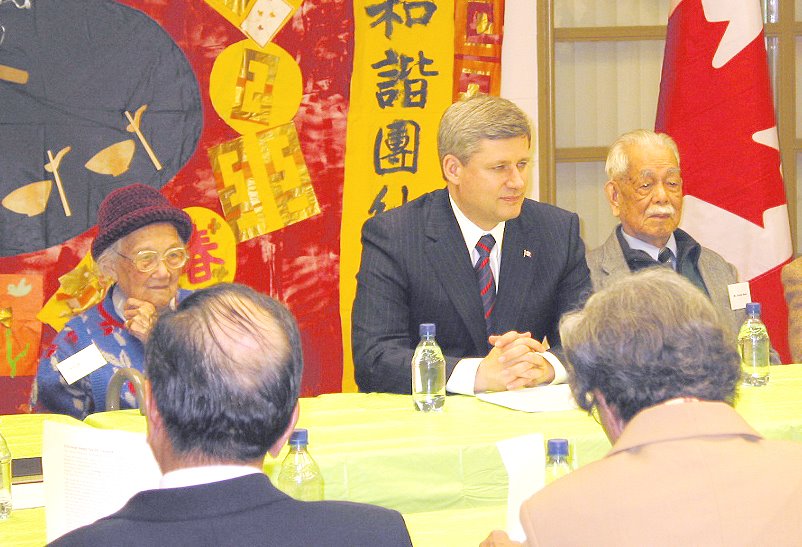
Mrs.
Der made an effort to involve herself in the redress campaign. There she was on
May 25, 2006 sitting beside Prime Minister Harper when he visited with our
seniors to discuss the redress issue. The Prime Minister and Hon. Jason Kenney
pledged that she and others would not have to wait too long for redress.
However, while Mrs. Der did submit her redress application in early December
2006, unfortunately, she was unable to hang on any longer and passed away last
Friday.

The
Government has lost the opportunity to complete the redress apology with Mrs.
Der and about a dozen others who have now passed away since June 22, 2006. To
date, none of the more than 400 head tax spouses who applied have received
their redress payments. We pledge to redouble our efforts to achieve a complete
the apology for Mrs. Der and others like her. We will never forget her.”

May
she rest in peace.

History books have continued to write about the “black mark” in
the racist history of Canada.  But the government still wouldn't
apologize, or give a refund, as they do for other “tax mistakes.” 
The government did not want to have to pay for the $23 Million with interest.

But now with an acceptable “symbolic refund” and apology by Prime
Minister Stephen Harper, why is his Conservative government so
S-L-O-W?  No spouses have yet been offered ex-gratia 
payments.  Thank God, they finally gave head tax payer 
Ralph Lee
,
his cheque on March 10, before Lee passed away 5 days later at age
107.  But why wasn't Lee presented with his cheque 5 months ago
when head tax payer Charlie Quon received his?

The government has been confused and quagmired in it's definition of
“spouse” and it's refusal to acknowledge descendants as legal heirs to
head tax refunds.  

Make it simple.  One payment per certificate.  Recognize each
and every certificate.  Please do it before any more surviving
head tax payers, spouses, sons or daughters go empty handed to meet
their ancestors.

This is what the CCNC had proposed to the Conservative government when
they asked for suggestions for redress.  First stage proposals was
to Give immediate apology for Chinese Head Tax, give immediate
“symbolic” monetary redress payment to living head tax payers and
spouses.  Stage Two was to develop a plan to address “symbolic”
monetary redress payment to descendants where original head tax payers
or spouses are pre-deceased.”  To date, the Conservative govt has
not acknowledged the Stage Two proposal.

It's only been since 1984, since MP Margaret Mitchell stood in
Parliament to ask the govt for head tax redress… 23 short but long
years ago.

The following story if from Chineseinvancouver.blogspot.com

Head tax payer's spouse dies with regret


An
icon in the fight for redressing the head tax, Mrs Quon Chung Shee Der
(謝關仲樹), died at the age of 102 with the regret that the final
compensation cheque didn't reach her in time.

“My
colleagues and I will always remember Mrs. Der climbing up two flights
of stairs to attend a community meeting held on November 20, 2005. It
was at this pivotal community meeting that head tax
families decided to mobilize the community to protest the former
Liberal Government's efforts to impose the ill-fated
Agreement-in-Principle. Mrs. Der stirred all of us with her simple
question: “When will the Government give me back my husband's head tax
money? She became an instant media star on that day,” said CCNC's
national chair Sid Chow Tan.

Cynthia Lee
was Mrs Der's friend who helped her fill out the redress application
form last year when Heritage Canada announced head tax payers' spouses could apply for compensation. Mrs Der's husband paid the head tax. To her, getting the tax refund was all about having justice done.

Ever
since, Mrs Der kept asking if her application had been approved. Lee
said Mrs Der had been in anxiety for the last few months. Her health
deteriorated rapidly at the same time. She broke her arm and was
admitted to a long term care facility towards the end of last year.

Lee
questioned why the government needed so long to process applications
filed by head tax payers' spouses. It only took one month for the
payers themselves to get the checque. However, spouses have waited for
over four months and so far none have got the compensation yet.

Tan
said Mrs Der was one feisty and tenacious advocate for redress of the
Head Tax and Chinese Exclusion Act. “We will miss her greatly.”

Last
year when PM Stephen Harper met with head tax survivors in Vancouver's
Chinatown, Mrs Der sat beside Harper, so did another head tax payer
Charlie Quan (關祥國) of 99 years old.

Quan became the country's first head tax payer compensated last October.

“Mrs.
Der made an effort to involve herself in the redress campaign. There
she was on May 25, 2006 sitting beside Prime Minister Harper when he
visited with our seniors to discuss the redress issue. The Prime
Minister and Hon. Jason Kenney pledged that she and others would not
have to wait too long for redress. However, while Mrs. Der did submit
her redress application in early December 2006, unfortunately, she was
unable to hang on any longer and passed away last Friday,” Tan said in
a statement.

Tan blasts the Tory government for having lost the
opportunity to complete the redress apology with Mrs. Der and about a
dozen others who have now passed away since June 22, 2006.

“Slanted Eyes?” Does Parti Quebecis leader Andre Boisclair have a “slanted” view of Asian-Canadians?

“Slanted Eyes?” Does Parti Quebecis leader Andre Boisclair have a “slanted” view of Asian-Canadians?

PQ leader Andre Boisclair has called Asians “yeux bridés”
which translates as “slanted eyes.”  He is not making an apology
for this racist slur.  He says it is an acceptable term in french
language.  The Chinese-Canadian National Council
has called on Boisclair to apologize.  He is refusing.  Even
May Chiu the Chinese-Canadian born in Quebec who ran as a Bloc
Quebecois candidate in the 2006 federal election against Paul Martin
has said that “
yeux bridés” is a derogatory term and she will review her membership in the PQ party. 

Is
Boisclair living in the dark ages?  There used to be a time when
the term “coloured person” was acceptable in society… or “chink”…
or “blackie”…  Communication is about people understanding the
message you are trying to convey, not telling people they are wrong for
misunderstanding you.  This is why racism is wrong and
hurtful.  Imagine telling somebody that because they don't like
the term you call them, you are not wrong – they are!  Maybe
Boisclair should read the book “
Black Like Me (1961)” by John Howard Griffin, to discover what it is like to walk in the shoes of non-white people.

I
have been called many names as I have grown up such as: Chink,
Chinaman, Nip, Nipper, Boat people, and more.  Many times they
were uttered by people who were ignorant, frustrated or angry. 
Sometimes they were said by British immigrants to Canada. 
Sometimes they were said by multigenerational Canadians.  I
consider myself 5th generation Canadian, after my
great-great-grandfather Rev. Chan Yu Tan came to Canada in 1896.

Boisclair's comment is similar to the 1985 Campus Giveaway story run on CTV's W5 program which resulted in the historic W5 protest
by Chinese Canadians across Canada.  Just because people have
Asian features and could be immigrants or foreign students doesn't mean
they aren't actually multi-generational Canadians of Asian ancestry,
born in Quebec!

See below for some of the newstories + statements from the CCNC.

March 16, 2007

FOR IMMEDIATE RELEASE


CCNC Slams PQ Leader On “Slanting Eyes” Comment

TORONTO. Chinese Canadians today slammed Parti Quebecois leader Andre Boisclair
for his refusal to correct his offensive description of Asian students as
having “slanting eyes.” Mr. Boisclair was
speaking to Quebec
students on the topic of global competition on Wednesday when he said:
“The reality is these countries are not just working to create jobs in
sweatshops. When I was in Boston ,
where I spent a year, I was surprised to see that on campus about one-third of
the students doing their bachelor's degrees had slanting
eyes
.”

“These are
not people going to work in sweatshops. They are people who will later become
engineers and managers who create richness. There is a ferocious competition
happening in the world today. What I would like to do is equip you and equip
Quebec to face (the
challenge).” Source:
Montreal
Gazette: http://www.canada.com/montrealgazette/news/story.html?id=307e19e1-f727-4086-9ef1-d899d2852706&p=2

“We were extremely disappointed to learn that Mr. Boisclair did not avail himself of the opportunity
yesterday to correct himself and simply withdraw the remarks,” Colleen
Hua, CCNC National President said today. “Mr. Boisclair’s
failure to recognize his harmful comments and his refusal to make amends calls
into question his suitability to be the next Premier of Quebec.”

“How can he
defend the interests of all Quebecers when he fails to recognize the harmful
nature of his words.

In response to questions about whether the term is derogatory, CCNC
cited two dictionary references:
 

From: http://www.wordwebonline.com/en/SLANTEYE
 

Noun:
slant-eye
  slant I

1.       
(slang) a disparaging term for an Asian person (especially for North Vietnamese soldiers in the Vietnam War)
gook [N. Amer]

Derived forms: slant-eyes

Type of: Oriental [archaic], oriental person

From: http://dictionary.reference.com/browse/slant

slant-eye  Slang: Disparaging and Offensive. an Oriental person, esp. a Chinese or Japanese.


“Mr. Boisclair has alienated some of
his supporters including members of his party’s campaign with his lack of
sensitivity,” Victor Wong, CCNC Executive Director said today. “Is
it acceptable to refer to school children as students with slanting eyes?

“If they are a source of amazement to Mr. Boisclair,
then why not be more respectful and just refer to us as Asian Canadians or
Asian Quebecers?”

While the French expression « yeux bridés » may have a nuance, it is clear that
many Asian Canadians are offended. CCNC urges Mr. Boisclair
to seize this opportunity during this Action Week Against
Racism in Quebec
to correct himself, that is, to withdraw his harmful comments, and to do so
immediately.

CCNC is a community leader for Chinese Canadians in promoting a more
just, respectful, and inclusive society. CCNC is a national non-profit
organization with 27 chapters across
Canada with a mandate to promote
the equality rights and full participation of our community members in all
aspects of Canadian society.

-30-

For more information, please contact Victor Wong at (416) 977-9871.

end

'No way' will Boisclair apologize for remarks

From Friday's Globe and Mail

QUEBEC
Parti Québécois Leader
André Boisclair refused to apologize yesterday
for referring to Asians as having “slanted eyes,” even as he faced
criticism from Asian-Canadian and other groups that the comments were
offensive.

The
Chinese Canadian National Council said Mr. Boisclair
should withdraw his words, which it said were disrespectful and traded on
caricatures. And a Montreal
civil-rights group said the PQ Leader should apologize because the remarks
betrayed “racial bias.”

“It's
a character issue,” said Victor Wong, executive director of the council,
which has members in Quebec .
“You're aspiring to be premier, and aspiring to be premier of all of us.
To refer to Asian students as having slanting eyes is offensive.”

Mr.
Boisclair said during a campaign speech to students
on Wednesday that they would face growing competition from emerging powerhouses
like India and
China .
He said he was struck by the large number of Asian students while he was
completing his one-year master's degree at Harvard
University in
Boston .

Related to this article

Articles Related Articles
Photogalleries Photo Gallery
Interactives Interactive
Internet Links Internet

Mr.
Boisclair studied at the John F. Kennedy School of
Government before running for the PQ leadership in 2005.

“I
was surprised to see that on campus, about a third of the undergraduate
students had slanted eyes,” he said.

“They're
not going to work in sweatshops. They're people who will later work as
engineers, managers, and will create wealth. They're people who will innovate
in their countries. There is ferocious competition in the world today.”

The
PQ has spent years trying to build bridges with ethnic minorities, who have
traditionally backed the Liberal Party, and Mr. Boisclair
has tried to make inclusiveness and tolerance one of his selling points since
his election as PQ leader in 2005.

Yesterday,
faced with repeated questions from reporters, Mr. Boisclair
said he stood by his remarks and didn't understand why a fuss was being made,
since he has used the “slanted eyes” phrase repeatedly in stump
speeches in the past.

“There's
no way I will apologize,” he told reporters during a campaign stop in
Quebec City . He said he
used the expression because “these people are a source of amazement for
me. I've been to Japan ;
they are my friends, my colleagues. No way I will
apologize.”

Asked
why he was referring to the Japanese, when he had talked about Chinese students
the day before, Mr. Boisclair said he meant students
from various Asian countries.

Mr.
Boisclair was speaking French to a classroom of
university students when he referred to “yeux bridés,” which
translates as slanted or slanting eyes. He suggested yesterday the term might
have a more negative connotation in English than in French.

“I'm
doing politics, not linguistics,” he said, adding that he believes
“Quebeckers are 100 per cent behind me” on the issue. Even Mr. Boisclair's rivals said they think he did not intend any
malice.

“He
might have used a better choice of words, but I know Mr. Boisclair
enough to know his intention was not to be disrespectful,” Liberal Leader
Jean Charest said.

The
issue has become a distraction for Mr. Boisclair.
While the French media have reported the comments, most of the questions
yesterday came from English-language reporters.

Fo
Niemi of the Centre for Research-Action on Race Relations, a Montreal
civil-rights group, said he was surprised to hear the remarks come from Mr. Boisclair, whom he considered a socially progressive leader
from a new generation of Quebec
sovereigntists.

Mr.
Niemi said he called the PQ yesterday to simply alert them to what he
considered the inappropriateness of Mr. Boisclair's
remarks. But then he said the party's director of communications for the
election campaign, Shirley Bishop, aggressively told him over the phone that
she saw nothing wrong with the comment and blamed “people like you”
for making racism an issue.

That's
when Mr. Niemi said he decided to issue a news release condemning Mr. Boisclair's comments.

“It's
a very derogatory remark and very racially offensive,” Mr. Niemi said in
an interview, adding that the comments were ill considered at a time when
Quebec needs to increase ties with the economies of Asia
and India .

http://www.theglobeandmail.com/servlet/story/RTGAM.20070316.wxboisclair16/BNStory/National/home
 

March 15, 2007

FOR IMMEDIATE RELEASE

CCNC Calls on PQ Leader To Correct “Slanting Eyes” Comment

TORONTO. The Chinese Canadian National Council
called on Parti Quebecois leader Andre Boisclair to clarify comments attributed to him in the
Montreal Gazette and Globe and Mail today:

From Montreal
Gazette:

PQ leader sees
Asian rivalry

In speaking to
students yesterday, Andre Boisclair warned that the
working world they will graduate into is totally different from the one of
their parents, but wound up using an unusual turn of phrase. He said in an open
economy, competition from emerging economies like India
and China
is stiff. Every year, 80,000 young people leave India
and 60,000 leave China to go
to study in the United
States .

“The reality
is these countries are not just working to create jobs in sweatshops. When I
was in Boston ,
where I spent a year, I was surprised to see that on campus about one-third of
the students doing their bachelor's degrees had slanting
eyes
.

“These are
not people going to work in sweatshops. They are people who will later become
engineers and managers who create richness. There is a ferocious competition
happening in the world today. What I would like to do is equip you and equip
Quebec to face (the
challenge).”

© The Gazette (
Montreal ) 2007

  http://www.canada.com/montrealgazette/news/story.html?id=307e19e1-f727-4086-9ef1-d899d2852706&p=2

“It is rather disappointing to hear Mr. Boisclair,
and an aspiring Premier at that, refer to students of Asian heritage in this
manner,” Colleen Hua, CCNC National President said today. “Indeed,
it is ironic that today marks the start of Action Week Against
Racism in Quebec .”

“So we are taking action in asking Mr. Boisclair
to correct his statement immediately.”

CCNC is a community leader for Chinese Canadians in promoting a more
just, respectful, and inclusive society. CCNC is a national non-profit
organization with 27 chapters across
Canada with a mandate to promote
the equality rights and full participation of our community members in all
aspects of Canadian society.

-30-

For more information, please contact Victor Wong at (416) 977-9871.

From Montreal
Gazette:

PQ leader
sees Asian rivalry

In
speaking to students yesterday, Andre Boisclair
warned that the working world they will graduate into is totally different from
the one of their parents, but wound up using an unusal
turn of phrase. He said in an open economy, competition from emerging economies
like India and
China
is stiff. Every year, 80,000 young people leave India
and 60,000 leave China to go
to study in the United
States .

“The
reality is these countries are not just working to create jobs in sweatshops.
When I was in Boston ,
where I spent a year, I was surprised to see that on campus about one-third of
the students doing their bachelor's degrees had slanting
eyes
.

“These
are not people going to work in sweatshops. They are people who will later
become engineers and managers who create richness. There is a ferocious
competition happening in the world today. What I would like to do is equip you
and equip Quebec
to face (the challenge).”

© The
Gazette ( Montreal )
2007

  http://www.canada.com/montrealgazette/news/story.html?id=307e19e1-f727-4086-9ef1-d899d2852706&p=2


From Globe and Mail:

Boisclair remarks on 'slanted eyes'

MONTREALParti Québécois Leader
André Boisclair said during a speech on global
competitiveness that he was surprised to see so many students “with
slanted eyes” when he was studying at
Harvard University .

Speaking
to university students in Trois-Rivières
yesterday about growing competition from emerging economies such as
India and
China , he said he had witnessed the
trend firsthand while on a master's program at Harvard.

Mr.
Boisclair studied at the John F. Kennedy School of
Government before running for the PQ leadership in 2005.

“When
I was at Harvard, where I spent a year, I was surprised to see that on campus,
about a third of the undergraduate students had slanted eyes,” he said to
a large classroom packed with students. He went on to say that 80,000 students
from India and 60,000 from
China study in the
United States yearly.

“They're
not going to work in sweatshops. They're people who will later work as
engineers, managers, and will create wealth. They're people who will innovate
in their countries. There is ferocious competition in the world today.”

Mr.
Boisclair also told the students they had benefited
from the language battles their parents' generation had fought.

“The
English sales ladies at Eaton's . . . you didn't live through that,” he
said, evoking a rich symbol of English dominance in
Quebec .

http://www.theglobeandmail.com/servlet/story/LAC.20070315.QUEBECEYES15/TPStory/National


Vancouver Heritage Award of Honour given by Mayor Sam Sullivan to Save Kogawa House Committee and TLC

Vancouver Heritage Award of Honour given by Mayor Sam Sullivan to Save Kogawa House Committee TLC: The Land Conservancy of BC

It was one month ago that the Vancouver Heritage Award of Honour was
given to Save Kogawa House and TLC The Land Conservancy of BC. 
Now I have a picture from the event. 
You can check out the stories and press releases below

GungHaggisFatChoy.com  :: TLC and Save Joy Kogawa House committee both

Kogawahouse.com  VANCOUVER HERITAGE AWARD OF HONOUR GOES TO TLC

TLC The Land Conservancy :: NewsVancouver Heritage Award of Honour Goes to TLC & Kogawa House Committee and the activists and visionaries of our community, “says Todd Wong of the


Todd Wong of Save Kogaw House Committee, Vancouver Mayor Sam Sullivan,
and Bill Turner, executive director and founder of TLC The Land
Conservancy of BC, pose with the award certificates following the
ceremonies of the Vancouver Heritage Awards – photo Deb Martin.

Ralph Lee, 107, was oldest to pay head tax – passes away 5 days after receiving cheque

Ralph Lee, 107, was oldest to pay head tax – passes away 5 days after receiving cheque

Ralph Kung Kee Lee
passed away only five days after receiving his ex-gratia payment from
the Canadian government.  In 2006, Lee was the oldest activist
asking the government to make a sympbolic return of head tax money
charged only to immigrants of Chinese ancestry.  It seemed like
only days ago, that the Conservative government had a photo op with Mr.
Lee.

Unfortunately the same cannot be said for Mrs. Der – the
oldest living head tax spouse who passed away in Vancouver on Friday
evening.  Back in December 2005, the 101-year old Mrs. Der climbed
2 flights of stairs to attend a meeting organized by the BC Coalition
of Head Tax Payers, Spouses and Families.  In early 2006, Mrs. Der
met with both MP Jason Kenney, and Prime Minister Steven Harper – who
both promised her  quick action for giving immediate symbolic
repayment for surviving head tax payers and spouses.

Due to poor heath on June 22, 2006. Mrs. Der was unable to attend the
ceremonies at the Vancouver Hotel, for the simulcast apology
announcement by Prime Minister Harper.  Mrs. Der was also unable
to attend the Oct ceremony of the first head tax ex-gratia payment
given to Charlie Quon in Vancouver.

Below are stories about Ralph Lee from the media.

Chinese immigrant, 107, was oldest to pay head tax

Last Updated: Monday, March 19, 2007 | 5:29 PM ET

CBC News

Three generations of Ralph Lung Kee Lee's family gathered
for a memorial in Toronto Monday to say goodbye to the oldest member of
the Chinese-Canadian community to have paid the head tax.

Lee died at his residence in Pickering, Ont., on
Thursday, five days after celebrating his 107th birthday.

Ralph Lee, at 106, carrying the symbolic 'last spike' used in the completion of the Canadian Pacific Railway, arrives in Ottawa aboard the 'Redress Express' in 2006.Ralph Lee, at 106, carrying the symbolic 'last spike'
used in the completion of the Canadian Pacific Railway, arrives in
Ottawa aboard the 'Redress
Express' in 2006.

(Canadian Press)

“I'll miss him being around in terms of honouring
our ancestors, having the traditions passed down through the community,”
his granddaughter Lindy Anderson
said, fighting back tears.

Born March 10, 1900 in China's Guangdong province, he
immigrated to Canada at the age of 12 and moved to the northern Ontario
community then known as Fort William, now the city of Thunder Bay.
 
He spent five years working as a dishwasher there in order to pay off the $500
head tax he was forced to pay upon entering
Canada .

All Chinese immigrants entering
Canada from 1885 to 1923 had a head
tax imposed on them, with the intention of deterring Chinese immigration after
Chinese workers helped build the Canadian Pacific Railway in 1885.

A symbol of community's history

Lee later worked at maintaining the railway a previous
generation of Chinese labourers had helped to build.

To many in the Chinese-Canadian
community, Lee represents the history of Chinese immigration to this
country, said Colleen Hua, president of the Chinese Canadian National Council.

“What they see him as symbolizing is a person who,
although excluded, still persevered and worked through it and lived to the very
end to make sure that he saw an end to the exclusion and the redress,” Hua
said.

Lee returned to China
and found a wife before returning to
Canada .

But because the Chinese Exclusion Act prohibited Chinese
immigrants from bringing their families to
Canada , Lee's wife and son were
unable to join him. By the time the act was lifted in 1947, his son had died
during the Second World War.

Eventually, his wife and two daughters were brought to
Canada
to live with him.

Lee later started his own business importing and exporting
goods from China .

Joined 'Redress Express' journey

He participated in another historic chapter for the
Chinese-Canadian community when he was one of several head-taxpayers who
travelled to Ottawa from
Vancouver  in 2006 on a train dubbed the
“Redress Express.”

At the end of the journey on June 21, Prime Minister
Stephen Harper formally apologized for the fact that the head tax had been
imposed and promised symbolic payments to those who were affected.

Lee, who was 106 at the time, carried the symbolic
“last spike” given to the Chinese community by author Pierre Berton
in recognition of work done by immigrants to build the railway.

He is survived by two daughters, seven grandchildren and
12 great-grandchildren.

Of an estimated 80,000 Chinese immigrants who paid the
tax, about 30 remain alive, as well as several hundred widows of men who paid
the tax.

http://www.cbc.ca/canada/toronto/story/2007/03/19/headtax-obit.html


Family hopes memory and legacy of centenarian
head-tax payer lives on


Allison Jones

Canadian Press


Monday, March 19, 2007


TORONTO (CP) –
Ralph Lung Kee Lee has earned a place in Canadian history books as the oldest
Chinese head-tax payer to accept the government's official apology and redress,
and his family said Monday at his memorial service they hope his story lives on
long after his death.

Lee
received his $20,000 redress cheque from Ottawa
on March 10, his 107th birthday – just five days before he died.

“It
was almost like, 'I waited this long, here I am. I'm going to stay alive to get
it,”' Lee's daughter Linda Ing said of her father, who received his
apology and compensation 94 years after coming to Canada.

Born
in 1900, Lee came to Canada
when he was 12 and paid the $500 head tax imposed on all Chinese immigrants
between 1885 and 1923.

He
returned to China to marry
and fathered three children, but the Exclusion Act prevented him from bringing
his family to Canada .

After
the Exclusion Act was lifted in 1947, Lee was finally able to reunite with his
family in Canada .
For Ing, who was then 12, it was the first time she had ever laid eyes on her
father.

On
June 22, Lee was the oldest of six surviving head-tax payers who saw Prime
Minister Stephen Harper deliver the government's official apology.

Lee
had a fun and loving personality, Ing said, and he was quite tickled when he
finally received his redress cheque.

“I
said, 'You're going to be 107,”' Ing recalled telling her father the day
before his birthday.

“He
said, 'Me?' I said, 'You,”' Ing said in mock wide-eyed amazement.
“'You're going to get your cheque.' And he just laughed.”

Ing
said when she was younger, she didn't appreciate the sacrifices her father
made.

“It
was in one ear and out the other,” she said.

Ing's
son Leo said now that Lee is gone, it's important for those who remember his
story to pass it on so his legacy never dies.

“As
we move on, the younger generation has to look back and to look at people like
grandpa and think (about) why we came here, what we've accomplished here,”
he said.

“One
day I won't be here to speak, so I want to make sure that grandpa has passed
the torch on to the younger generation. I want the younger generation to
realize where they came from, to be proud to be Chinese.”

Lee's
granddaughter Landy Anderson said she is extremely proud to tell people about
her grandfather and her connection to Canadian history.

“It's
really hard to talk about grandpa without referring to the head tax, since my
entire family history revolves around this event,” she said, adding even
though Lee had to overcome years of adversity and racism, he was a loving soul
who doted on his family.

Lee
is survived by two daughters, seven grandchildren and 12 great-grandchildren.

© The
Canadian Press 2007


http://www.canada.com/topics/news/national/story.html?id=4b839cd4-e837-4ecf-89e9-8b999df7d253&k=66676


******************************

Victor Wong

CCNC Executive Director

national@ccnc.ca

(416) 977-9871 (tel)

(416) 977-1630 (fax)

CCNC: www.ccnc.ca

PanAsian Network: www.ccnc.ca/panasian

Health Equity Network: www.ccnc.ca/health

“Remembering the contributions of the Head
Tax payers, Chinese railway workers and their families.”