Yearly Archives: 2006

Vancouver Storyscapes: Where the Chinese met the First Nations peoples


Vancouver Storyscapes: 
Where and when the Chinese met the First Nations peoples

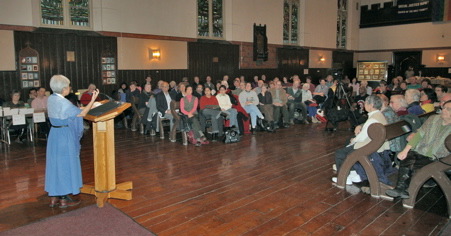
On Friday, I had the pleasure to be part of the first Chinatown storyscapes
event bringing Chinese and First Nations peoples together and sharing
stories.  Storyscapes began as a project to discover and tell the
First Nations stories of Vancouver, growing out of the Aboriginal Art
program with Kamala Todd, Aboriginal Social Planner for the City of
Vancouver. I had been contacted by researcher Diana Leung, one of the
“story gatherers,” who was looking for stories of interactions between
Vancouver's Chinese and First Nations.

It
has been said that to know who we are, we need to know the stories to
which we belong. When you are an Aboriginal person living in the city,
it can sometimes be difficult to connect to your stories.

Vancouver.
This land is layered with ancient history, important happenings,
valuable teachings, and sacredness. But it’s not always easy to see
amongst the streets and buildings, signs and commerce of the city. Much
was erased with the colonial building of Vancouver. The stories and
cultural landscapes that have greatest visibility tend to be those of
the dominant Anglo culture. Consequently, many residents and visitors
have limited knowledge of the incredible depth of stories here on this
land. The roots we all share go much deeper than 200 years.

The
land and waters can tell you a great deal—stories about generations of
seasonal movements, animal paths, stream meanderings, abundant riches.
Likewise there is much to be learned about the knowledge,
contributions, struggles, and everyday lives of Aboriginal people
here—both the indigenous Coast Salish people and the diversity of urban
Aboriginal people who have made this place their home.


            –
  from the Storyscapes description

The Storyscapes team introduced themselves:  Kamala Todd and George Hui are the project leaders, with
Tania Willard, Project manager;  Helen Ma, Planning
Assistant;  Storygatherer/researchers are Terry Point, Mandy
Nahanee, Michelle Mah (Fred Mah's daughter), Diana Leung with Karen
Henry, Public Art Consultant.

We were at the SUCCESS Hall, on Pender St., right beside the Millenium Gate,  How fitting that one of the special guest panelists was Vancouver architect Joe Wai
(my cousin), who is considered one of Chinatowns heritage guardians
according to Vancouver Magazine October 2005 story, “Chinatown
Calculations.”  Wai said our grandfather had come to Canada in the
1800's, and that he came as an young immigrant.  Wai said he had
more questions than stories, and acknowledged the early history of
Chinese pioneers such as the voyages of Chinese admiral Zheng He in 1421, and the first recorded landing of Chinese artisans at Nootka Sound with Captain John Meares.

Just before we got started, I asked Larry Grant
if he'd ever been mistaken for being Chinese.  He told me he was
half-Chinese and had grown up on both the Musqueam Reserve and in
Strathcona neighborhood.  His former sister-in-law is former
Musqueam Chief, Wendy Grant.  Larry gives a welcome in his
language, and speaks very thoughfully and gentlely.  He
acknowledges the ancestral Musqueam land, and Qayqayt lands, nodding to
Qayqayt Chief, Rhonda Larrabee sitting beside him. Larry shares some of
his stories and experiences growing up.

Rhonda Larrabee grew up in Vancouver Chinatown/Strathcona, thinking she was Chinese, a descendant of Rev. Chan Yu Tan.  But she learned later that her mother was Qayqayt First Nations, and in 2005 a film called Tribe of One,
told her story to reclaim her First Nations status and heritage. 
Rhonda acknowledged our Uncle Dan (her father's and my grandmother's
younger brother), who was sitting in the audience.

Howe Lee is a retired lieutenant colonel, and a founding member of both the Chinese Canadian Military Museum and the Chinese Canadian Historical Society of BC
Howe talked about how some of the Chinese railway builders found refuge
in First Nations villages, after the railway was finished and the
promise to send Chinese back to China was reneged.  He grew up in
in Shuswap, in the North Okanagan and told some stories from that area.

Fred Mah is one Chinatown's historians putting in lots of work on the Chinatown Revitalization Committee, and many others.

Bing C. Wong,
more known for being Chinatown's first Chartered Accountant, is also a
WW2 Veteran, and has been working to develop a First Nations project
called “Totem Town”, that could be a tourist attraction next door to
Gastown and Chinatown.  “Uncle Bing” is an old family friend, whom
I have known ever since I was a child.  He grew up at Alert Bay,
where his father ran a store amongst the large aboriginal population
there.

Louis Smith is an aboriginal veteran, whom I have met
when attending events for the Chinese Canadian vetertans.  Louis
talked about his roots in the aboriginal and mixed race Canadian
background. 

It was a very interesting afternoon, hearing
the intersections of Chinese and First Nations peoples and it served to
help develop a bonding between the groups.  People in the small
audience could relate to the stories told by the many special
speakers. 

I shared a creation story, about why First
Nations and Chinese peoples are born with blue spots on the
bottoms.  It is called a Mongolian spot, or Mongolian Birthmark.
My story relates to how the two cultures believe that their real home
is the spirit world, and the physical world is full of lessons, and
hardships…. so the soul has to be “kicked out.” 
Everybody can relate to the story, and some of them laugh in
recognition.  I think it serves to show that despite our stories
about Chinese seeking refuge in First Nations villages, and aboriginals
seeking refuge in Chinatown – all from racist elements from the
dominant Anglo culture, that we really do have more in common than just
discrimination for not being White.  Perhaps we really all ONE
people, spiritually at least.

Joy Kogawa in Toronto March 9th, Church of Holy Trinity

Joy Kogawa in Toronto March 9th, Church of Holy Trinity


Joy
Kogawa addresses the large crowd the filled the Church of the Holy
Trinity for the fundraiser book launch of Emily Kato – photo Henryk
Fibich


A large book launch for Joy Kogawa's rewritten “Emily Kato” and fundraiser event for the Save Kogawa House campaign too place at the Church of Holy Trinity in downtown Toronto on March 9th.

Anton Wagner is the Toronto coordinator and the national chair of
the Save Kogawa House committee.  There were several speakers and
lots of pictures taken.  And we will do our best to post them.


Joy Kogawa reads from “Emily Kato” at the Church of the Holy Trinity for
the fundraiser book launch of Emily Kato – photo Henryk Fibich

Anton writes:

It's going to take me a day or so to write up Joy's reading last night  for the www.kogawa.house.com website and to thank all the participants who contributed to its success.

Fortunately
we decided to start the evening early with selling books  and
having Joy sign them. There were long line ups before the official
welcome and  at the conclusion when Joy again signed books and
spoke to the many
friends who came to see her. I was also glad to see a good number of Japanese
Canadians present and the editor of the Nikkei Voice taking notes for a future
article.  Many thanks to Tomoko Makabe  who handled the book sales and subsequent accounting so efficiently.

Great
side benefits were a strong show of support for Joy, the big article in
the Globe and Mail, one or two CBC radio spots Joy did.

Regrets
from Bill Graham's and Jack Layton's office for not being able to
attend, a very good turn out that showed the writers groups and donors
that there is public support for what we are doing, and building a
strong base of support at the Church of the Holy Trinity.

There
were five photographers present so we should get some good photos and
the whole event was filmed by videographer Edimburgo Cabrera. I'm
passing on two dvds of the event to Bill for distribution.
Best wishes, Anton.

The
event was also attended by Bill Turner O.C., who is executive director
of The Land Conservancy, which is spearheading the fundraising campaign
for the preservation of  Kogawa House.

Anton
and friends did a wonderful job and a wonderful thing.  It was
packed.  Every one was very moved.   It has opened
several new doors.    We will have some number together
in the next day or so.
I just can't thank the “Toronto” crew enough.  It is so good to see these good people working together for a common good.
– Bill Turner, executive director The Land Conservancy

MingPao: May Chiu blasts Bev Oda for the Heritage Department turning down request to help save Joy Kogawa's childhood home

imageimage
MingPao:  May Chiu blasts Bev Oda for the Heritage Department turning down request to help save Kogawa House

May Chiu
was the fiesty Chinese Canadian who ran against then Liberal Prime
Minister Paul Martin in the 2005 Federal Election.  May ran for
the Bloc Quebecois, and also on a committment for Chinese Canadian
redress for head tax / Exclusion Act.  She also had a baby 5 days
before the election.  The first polling result had Chiu in the
lead before Martin took over the path to re-election.

Cheuk Kwan is a film-maker and created the wonderful documentary series Chinese Restaurants which I wrote a review about.


Joy Kogawa is the author of Obasan
who wrote fictionalized accounts about the Japanese Canadian
internment, redress and other issues, in her books Obasan, Naomi's
Road, Itsuka / Emily Kato, and The Rain Ascends.  Information and
  donations about the
Save Kogawa House can be sent to The Land Conservancy.


The following article ran in MingPao – a chinese daily newspaper

MingPao March 10, 2006 Friday Page A3

 
May
Chiu blasts Harper saying Oda appointment was a mistake – says Oda is
the wrong candidate to negotiate Head Tax redress compensation
 
MingPao in Ottawa
– The Conservative Heritage Minister Bev Oda has made a decision
refusing 350 thousand dollars in funding to help a human rights and
cultural group to buy up and preserve the former residence of a well
known author of Japanese descent.  The reason given was “the lack of a
suitable item”.  Author Joy Kogawa’s 100 year old house is going to be
torn down at the end of this month.  Oda’s decision has brought attacks
from head tax redress groups from major cities all over
Canada.
 
In the book “Obasan” published in 1981, Kogawa described how 22 thousand Japanese-Canadians in Western Canada were labeled “citizens of an enemy country” and were confined during the 2nd World War and she wrote about the pain of separation of families.
 
In that book, she once again mentioned the former residence built with wood that she and her family had lived in.  
 
Kogawa
and her parents were all locked up in concentration camp.  Japanese
Canadian human rights groups went to the federal govt after the war
demanding apology and compensation.  The Oda family belonged to the
group which opposed redress.
 
Legal
counsel May Chiu representing the Montreal Head Tax Redress Alliance
said: “ Conservative’s Harper “has eyes but failed to see”, in
appointing someone as Heritage Minister who has no respect whatsoever
for the historical contribution made by different ethnic groups within
the country and what these groups did during nation building process in
Canada.  This person does not have a sense of social justice, and is
not a candidate to negotiate the Head Tax redress that we are asking
for. “
 
Cheuk Kwan, long time participant in Head Tax redress efforts in Toronto
pointed out that Oda is against individual compensation.  “Prospects
don’t look good in negotiating with her for an apology and redress”.
 Sid Tan agrees with this view.  Tan is a well known fighter/Head tax
activist in
Vancouver.
He
said:”Oda and her father together both were opposed to the Federal
Conservative Government's offer back in 1988 of an apology and
compensation made to the Japanese Canadians in the entire country.
 That she suggested only an acknowledgement but without individual
compensation comes as no surprise at all to me. “
 
King Wai Tse (editor's note: I think this is William Dere) of the Montreal Head Tax Alliance feels that Oda’s  refusal to acknowledge Kogawa’s contribution to the history of Canada was most unfortunate.”

Richmond News: Story about Tomsett Elementary students visiting childhood home of Joy Kogawa

Richmond News:


Story about Tomsett students visiting childhood home of Joy Kogawa


Joy Kogawa accompanies Tomsett
Elementary School children's visit to her childhood home, after the
teacher and students contacted her.  They had read the book
Naomi's Road, and seen the Vancouver Opera touring production of
Naomi's Road.  Principal Sabine Harper and teacher Joan Young were
thrilled when Joy returned their letter inquiry, and an offer to visit
the house was extended. – photo courtesy of Joan Young.

I just found this Richmond News on-line story about Joy Kogawa with
the Tomsett Elementary School children visit which took place on
February 21st.  On February 25th, I met teacher Joan Young as she
joined the Save Kogawa House committee for a dinner social meeting. She
sent me pictures and a letter describing the visit
Joy is presently in Toronto for the Emily Kato book launch at Trinity
Church – pictures and description from Save Kogawa House Toronto
coordinator, Anton Wagner, to come soon.  He did send me as
message today that it went well, and that he would send pictures soon.

Richmond News reporter Eve Edmonds writes

Students join campaign to save Kogawa house

By Eve Edmonds

What began as a history
lesson about the internment of Japanese Canadians has morphed into a
political campaign for a group of Grade 3/4 students at Tomsett
elementary.

The students will meet
face to face with Vancouver Mayor Sam Sullivan tomorrow to appeal to
him to save the childhood home of author Joy Kogawa.

“This is a wonderfully
real educational experience,” says Tomsett principal Sabrina Harpe.
“It's an opportunity for public speaking, letter writing and field
trips.”

Kogawa wrote Naomi's Road,
an autobiographical novel about a child who was interned with her
family in the Slocan Valley during the Second World War.

The students read the book
and saw the children's opera version of the story when the Vancouver
Symphony Orchestra toured through a number of Richmond schools.

For full story click on http://www.richmond-news.com/issues06/025106/news/025106nn2.html

Globe & Mail: Restoring a book to life – Michael Posner interviews Joy Kogawa about rewritten “Emily Kato”

Globe & Mail:  Michael Posner interviews Joy Kogawa about rewritten “Emily Kato”


Restoring a book to life:

Joy Kogawa has rewritten one of her novels. It's less easy to save her family home, writes MICHAEL POSNER,

Globe and Mail, March 9, 2006. p. R3.
MICHAEL POSNER

For
Joy Kogawa, this should be a time of celebration and fulfilment.
Penguin has just released her new novel Emily Kato, a substantially
revised version of an earlier book, Itsuka. Instead, it's become a time
of great anxiety. In less than four weeks, the city of Vancouver is
expected to issue a demolition permit to the Taiwanese owner of a
small, wood-frame home at 1450 West 64th Ave. in Vancouver's Marpole
neighbourhood.

It was in that home that Kogawa spent the first
six years of her life before being summarily evicted and resettled,
along with some 22,000 other Japanese-Canadians, as part of the federal
government's 1942 Second World War internment program. After the war,
Kogawa's childhood home was expropriated by Ottawa and auctioned off at
below market value.

Now, the Land Conservancy of British
Columbia (TLC) is desperately spearheading a campaign to raise
$1.25-million to buy it, stop its demolition and convert the heritage
property into a writers-in-residence retreat. But as of Tuesday, TLC
had managed to collect less than $200,000. The federal Heritage
Department has so far indicated an unwillingness to step in with
financial aid, although TLC head Bill Turner says he's still hopeful
Heritage Minister Bev Oda will change her mind, and that the necessary
funds can be assembled in the remaining days.

“There isn't much
time,” Kogawa conceded in an interview last week in her Spartan condo
in downtown Toronto. She will speak and read from her work at a
fundraising event at 5 p.m. today at Toronto's Church of the Holy
Trinity.

  Kogawa says that if she were a member of the
Jewish community, she has no doubt that affluent Jews would step
forward to save the house. Although there are many equally well-heeled
Japanese-Canadians, “not one of them will step forward,” she maintains.
“It's because of the way this community was destroyed. The dispersal
policy was intended to make us never a community again, and it was
successful. Cohesion does not exist.”

It's rare for an author to
do a major revision of a novel and reissue it under another name. But
Kogawa has her reasons. For years, she was lauded for Obasan, her
thinly fictionalized 1983 account of her family's forced resettlement
to Slocan, in British Columbia. “There was not a single negative
review. Then when Itsuka came out in hardcover [in 1993], I was killed
by a single review in The Globe and Mail. He said it was unpublishable,
full of pages and pages of painfully embarrassing writing. It killed me
as a writer for years. I took it to heart, even though I didn't know
what was embarrassing about it.” Although there were other, more
positive reviews, “I couldn't hear anything else. I trusted The Globe.
I thought that was the truth. Other people were just being kind.”

She
spent years thinking about how to rewrite it. But now that it's out,
she says she can't find it in bookstores and hasn't seen a single
review. “Penguin did not advertise it or promote it. My feeling is it's
worse than Itsuka. That at least stayed in print. But my question is,
is it okay as a book? I just have no idea.”

Despite the
accolades heaped on Obasan — Quill & Quire magazine called it “one
of the most influential novels of the 20th century” — Kogawa considers
The Rain Ascends (1995) her most important book by far. It's the story
of an Anglican priest who is discovered to be a pedophile. The book,
she says, “brought me out of debility and weakness and fear into
strength. When [retired Anglican archbishop] Desmond Tutu holds out his
hands and says, 'all, all, all,' I now understand what that means. It
includes the pedophile and even, God forbid, Hitler.”

She hopes
to address these issues in a new book, still in gestation. The working
title is Gently to Nagasaki, where the second atomic bomb was dropped
in August, 1945. “It's about Naomi's” — the fictionalized version of
Kogawa — “search for the lost mother, the lost Goddess, lost love.”
She sees no fundamental difference between natural disasters like the
2004 Asian tsunami or hurricane Katrina and man-made tragedies like the
atom bomb that killed millions of Japanese.

“I think humans are
a natural disaster. We're here to love each other in the midst of all
the disasters in which we find ourselves. We must find the place of
kindness, gentleness and forgiveness. The calling is for the weak to
become strong, recognize it and then stand with the weak.”

Genuine
or sham, many writers project a persona of great confidence about the
merit of their work. Not Kogawa. Only the favourable opinion of critics
and readers she respects, it seems, can validate her talent. Stung by
the one blistering critique of Itsuka, she stopped writing and devoted
almost a decade to a community-aid project called the Toronto Dollar.
Consumers who use the currency — available from certain ATMs in
downtown Toronto — at participating retailers effectively give 10 per
cent of the purchase price to an organization that invests in community
projects.

“It's a new paradigm, a way of cutting loose from the
greed that motivates the economic model. This is the symbol of money
not based on profit first, but on the idea that people can help each
other. We can become more realized human beings and more loving. This
seems to be at least as important as writing books. Community action
can speak just as loudly.”

As for her childhood family home, the
looming prospect of seeing it destroyed — for the sake of another
monstrous homage to Vancouver's soaring property values — sickens her.
“But if it goes down, it won't go down unseen. Death is a part of life.
Murder is a part of life. You can murder buildings. You can murder
history. But healing goes on forever. So if it goes down, the healing
goes on forever.”

Naomi's Road opera: Interview with cast members Gina Oh and Gene Wu

Naomi's Road opera:
 
Interview with cast members Gina Oh and Gene Wu


Jessica
Cheung, Angus, Gina Oh, Gene Wu, Sam Chung – performers for Vancouver
Opera Touring Ensemble – Naomi's Road – photo Deb Martin.


I had the oppoturnity to interview Gina Oh and Gene Wu, performers in Naomi's Road, with the Vancouver Opera Touring production
I had met Gina on previous occasions after the presentations at the
opening weekend and the November 12th concert for Save Kogawa House, at
the Vancouver Public Library.  This was the first time I had met
Gene. 

Gene Wu has also performed with Jessica
Cheung (soprano) and Sam Chung (tenor) were busy setting up for their
final rehearsal before the spring touring season.  This interview
took place at the Centre for Peace in February.

Check here for my  review of Naomi's Road opening weekend.

Naomi's Road next performs for the general public on
Saturday, March 11, 2006, 7:30pm

Powell Street Festival Society presents Naomi's Road


Vancouver Japanese Language School Hall


487 Alexander Street


Vancouver, BC


Admission: $10 (general) / $8 (students, seniors) / $5 (children 12 and under)

Tickets and Information: (604) 683 8240 / www.powellstreetfestival.com


Todd Wong
Gene, you were part of the workshop. How does it feel working with the group,?

Gene Wu
It's great.  It's a great dynamic.  It's a great cast.  Couldnt ask
for a better cast.  Coming into it after being away for so long, I
really surprise myself by remembering so much of the music.  Because
there were cuts and slight changes to the music but luckily not so much
for me,

It was really nice that I could remember it, and
that goes to the composer's credit how memorable the music is, and how
singable it is.

TW:  and you haven't performed on the road with the group yet?

GW
No I haven't done this particular show on the road.  I did a tour last
year with Calgary Opera, another local interest piece called Turtle
Wakes. About the Frank Slide at Turtle Mountain, And I did the tour
with them for about a month.  Iim looking forward to this though.

TW
What is it like being able to do an Asian
Canadian story, as an AC

GW
I think it is great.  You know, the story is quite compelling.  Having
read Obasan and Naomi's Road it's something that really needs to be
told.  Especially with all the press that Joy's been getting about her
house,   I think it is one of those issues that the Canadian people I
think really need to hear more about.  It's been  kind of creeping in
every once in a while, but to bring it to the forefront like this is
really great.

TW
You haven't done it in front of the
audiences, but I'm sure you've been stories (about the audience
reaction) from the cast.  What are some of the great stories that
you've heard.

GW
Actually, I haven't any stories yet… 
I;ve spent this past week rehearsing, so I'm just trying to get my head
around all the stageing  and what everybody else is doing, in trying to
integrate it.  Because being the new guy into the production, I just
have to make sure that I'm on the same page as everybody else.  And I
don't want to mess up anybody else's staging or music or anything like
that.  So my focus has just been to concentrate and integrate myself as
well into the production as possible .

So stories probably won't come into we hit the road and little
anecdotes come up because somebody will say, “Oh! I remember when so-and-so did this and
we all had a good laugh about it afterwards.”

Gina Oh
But for the record,  Gene is assimilating so well, and he's just…Bravo!

TW
But you (Gina) weren't there during the workshops when Grace was doing it with Gene,

Gina
Exactly…Yes!  

TW
This is like the first time you are working with Gene

Gina
It's like a tag team effort. I guess

GW
Well that's the thing about these touring ensembles It is a group
effort, and to have a really wonderful cast that works well  together

Gina
And I actually… A lot of it has to be the creative team because the
creative team is so strong.  And by creative team I mean the director,
and the composer, and the musical director, and we have the assistant
director who is directing the remount. 

Because the ideas are so stable for them to express what they want
from us,  it makes it very easy for us to do our job essentially
because we are really just vessels, and because we have the composer
right there it's very easy for us to just work and develop creatively
ourselves.


Jessica Cheung, Gina Oh and Gene Wu – soprano, alto and baritone for Naomi's Road opera – photo Deb Martin

TW
Great! So one of the reaons I was really inpired to request an
interview with you is because, I have heard stories coming from the road that are still
very  very memorable..   Ellen Crowe-Swords was there in Uculet and has
some pictures for you.  And that still stands out very much for Ellen
and Joy
So what are some of the stories from the road that stand out for you?

Gina
You, know… it is amazing!  I think first of all,  being
on the road just locally let's say within Vancouver

It has been amazing to see these schools with such a high Asian
population, especially with every school we go to.  I think it's
the
moment we are packing, and there are the 3 rice bowls and the
chopsticks…
And all of a sudden, the kids I think feel an understanding, that
you know these kinds of utensils are used in our home. You know, we
don't use forks and knives and things like that.  There are small
connections to see the kid's reactions.  It's something I wish
that we had more of like that as icons when we were younger. You know
to say “That's like our family.”

TW
So it's like a sense of self-identification

Gina
Exactly! Because I think we don't have a lot of Asian icons in society
as it is, and for the kids they always want to relate to something.  And
since kids are very visual, for them to see an Asian cast is very
special.  And I am so honoured to be part of that, because for me, I've
always wanted that.

That and the
Island was amazing, what an opportunity to see BC.  And I am so looking
forward to Lethbridge and Seattle.  That's going to be awesome and fun.

But on the island, it's very interesting because the pace is different,
the pace of living is very slow, and the appreciation is greater…
It's
overwhelming actually.   The response from Denman Island were
these standing
ovations, and the gratitude from each production.

Uculet was
actually adjoined with Tofino.  They actually held the show late,
because the bus was late, it was a duo city community effort , and they
said they hadn't any thing, that kind of entertainment like that in
years.  It was amazing.  And they put out this great reception, and to
have Joy there was especially nice, to see her join us at certain moments in
our tour.

TW
Uculet and Tofino during the teim of the
internment stood out differently,  We just talked with Ron Macleod from
a fishing family there, and we just introduced him to Ellen Crowe-Swords and
he remembers seeing her Dad, and he tells stories about how they knew everybody there.

Gina.
That was a special show in Uculet though,, it was very special because Joy was there.  And there was a lot of awareness.

TW
The Tofino-Uculet Historical society for instance..

Gina
Yes, exacactly, they definitely made an effort.  They had a lot of
knowledge behind them.  As a sitting audience, to have so much
knowledge about what we are doing makes me a real modest performer
because I often fell like I am only the first layer of describing

Because I don't really have a personal connection, because this is just my craft.

Denman Island had a different appreciation I think.  I don't know if
they had the same richness or knowledge as Uculet.  But most audiences
are awae and they learn about this in school.  

There's this
school on an Indian Reservation. The day after Halloween, so the kids
were hopped up on sugar.  That was an amazing moment for me too,
because Roughlock Bill is portrayed.  And I felt that those kids were
really special to us, because they connected right away for some reason
with the entire production.  The kids came out, and they were climbing
in our vans, and they felt really comfortable with us.  It was almost
like because we looked similar to  them some kind of way. It was already
there was no barrier.  There was a hug right away,  there was a
kinesthetic opening…  you could just hug them.

TW
Had you had that kind of connection with First Nations before?

Gina
Personally, ummm… not a lot, not a lot…

TW
The Audience difference between the adults, comparing the Normant
Rothsteien with Tofino, or in comparison with the children in the
schools, How is it different?

Gina
Oh, on so many levels… so many levels…  It’s interesting,
In terms on Q&A period, the adults tend to become very reserved,
and that they ask very intelligent questions that have relevance, and
things like that.

Kids… there is something about kids.
They just don’t tend to have a filter.  An the pure honesty of it
is so refreshing, and it’s something that really appreciate, because it
‘s really pure

It could be any comment, positive or negative comments, it’s all
positive. They have absolutely paid attention.  Some of these kids…

I was telling our director one story,… that one of the kids was so
attentive.  She must have been quite young, because she was
sitting in the front half of the room.  In the story, the mother
goes to Japan and tells Naomi, because your great grandmother is
ill.  So that’s a thte very beginning in the show.   A
little girl asked “Did the grandmother die?” 

And I thought Obasan?  “No… Obasan is not dead at the end of the story.”

She said “No… the grandmother!”

I thought, oh… the mother’s grandmother.  They are already that
aware.  We do this, and we forget layers of it from time to time,
And then we are reminded time to time.

All the kids look at the show and see a family and relate it to their
own family life.  So to me, I am just imagining that that young
girl would have a connection  to her family and her roots.

TW
Now… there was a school (Larson Elementary in North Vancouver) that came out and sang the Farewell Song back to you.

Gina
Ohhhh…. Myyyyy….. Yes….  We were speechless… speechless.  
We got out.  We took our bows… We took our questions and then a
teacher got up and  she said, “And now we have a presentation for
you.” 

And she sat down (at a piano) and started playing.  And the entire
gymnasium started singing.  And then most purest voices.

Gina(sings)
Ma-ta o-o-o
Hi-ma de
Ma-ta o-o
Hi-ma de

Jessica and I were in tears…..

That was like a huge gift in so many ways.  Because it was
music.  They had learned something, They learnt music which was
our language.  Not just the story, and they got the entire school
to do it.

TW
Just in Closing…. I just want to share with you that a Richmond
Elementary School has visited Kogawa House with Joy.  They have
been so moved by the book and opera that they have written letters and
will be going to present them to Vancouver Mayor Sam Sullivan, asking
to help save the house.

Gina
We are honoured by this.  We all have our scores signed I think, by her (Joy)
We are very proud to be part of this,
It’s a very lucky time.  Very serendipitous time for all of us.
It’s not just me being a performer.  For us as performers,
ultimately this is a trade that we do.  But the fact is that this
is being propelled by so much history that is relevant right now. 
It’s amazing timing, so we are very appreciative of our time.