| Check out these upcoming events at the National Nikkei Museum & Heritage Centre. |
|
||
|

| Check out these upcoming events at the National Nikkei Museum & Heritage Centre. |
|
||
|
By Genevieve on Apr 29, 2011 in Local Stuff
 Esteemed
Canadian poet and novelist, Joy Kogawa, CM, OBC, will read from her
lifetime of award-winning creative work. Born in Vancouver, her
best-known book is Obasan, a semi-autobiographical novel featuring her
family’s experience of being taken from their normal lives to an
internment camp during WW 2. Joy Kogawa’s first literary reading on Salt
Spring is presented by the Land Conservancy of B.C. to support the
preservation of Ms. Kogawa’s childhood home
as a heritage site that is also functioning as a writers’ retreat.
Refreshments will be served. Saturday, May 14 at 7pm

To
celebrate its 25th anniversary, the Dr. Sun Yatsen Classical Chinese
Garden held a Founders reception Friday afternoon, and in attendance
were old friends Joe Wai and Marwyn Samuels. Samuels flew in from his
home in China for the event. Wai flew in from his office on Homer
Street.
Two people could not be less alike. Wai is an architect.
Samuels, at present, is a movie producer. Wai was born in Hong Kong and
grew up in Vancouver. Samuels, a Jew who was born in New York, got his
PhD in Chinese Studies at the U. of Washington and came to Vancouver as a
UBC professor in 1974. Wai speaks Cantonese. Samuels speaks Mandarin.
Wai's wife is white. Samuels, in his two marriages, married a Filipina
and a Chinese national. They appear to inhabit two different sides of a
cultural divide, but what those sides are is difficult to say. East and
West are not as twain as they used to be.
In the late 1970s,
events brought Wai and Samuels together. The City of Vancouver had
vacant land at the edge of Chinatown, and wanted to build a park for the
Chinese community. Complicating matters was a bitter political divide
within the Chinese community itself -between a pro-Taiwanese faction and
a pro-mainland China faction.
Samuels was thrust in between the
two. The idea of building a Chinese garden had been suggested, so the
City appointed a three-man advisory committee with one representative
from each faction, and Samuels, who acted as intermediary.
Samuels,
as it turned out, may have been the only person in town to have seen a
classical Chinese garden in situ. He had visited China in 1973 and 1975
on study grants, just as the country was beginning to open up to North
Americans. He made important political contacts while he was there -he
met Premier Zhou Enlai, for one -and it was his idea to have Chinese
artisans build a replica of a Ming Dynasty-era garden here.
“Most
of the existing classical gardens [in China] were built in the 16th
century,” Samuels said, “when China was then part of the global economy.
And most of the gardens were built by very wealthy merchants.”
In
time, Wai, who was vicechairman of the Chinese Cultural Centre, would
be brought on as architect for the park surrounding the garden, and
would also be responsible for adapting the garden's ancient techniques
to modern building codes.
But first they had to get the money to
build it. And it would be built as a symbol between the city's two
communities. “Joe and I,” Samuels said, “decided that this should not be
a Chinese community project, but that it should be a whole community
project, that the Chinese community and non-Chinese community should act
together for the first time on a major project like this, and also that
the city's corporate elite get involved.
“I was always conscious of this cultural mix.”
They needed about $6.7 million. A garden society was formed and a fundraising drive was started.
Then the recession of 1981 hit. The donations dried up.
“But
we weren't about to give up,” Samuels said, “and Joe and I became
allies in this. You know the Yiddish word 'macher'? It's like a fixer.
Essentially, Joe, who had good political connections to the city
government and elite, was the local macher, and I was the China macher.”
At
one point, money was so tight that Li Ka-shing, who was developing land
around the garden, offered to buy it as a centrepiece to his
development. The offer was turned down. At another point, they had to
resort to barter. One corporate donor, a forestry company, sent off a
shipment of raw logs and pulp to China as payment.
They needed
more than just donations from the Chinese community, so Wai worked his
contacts within the non-Chinese community, among them Anne Cherniavsky,
wife of Peter Cherniavsky, head of BC Sugar. Wai and Samuels showed her a
design of the garden, and she brought her friends on board. And Wai won
an important donor in David Lam, former B.C. lieutenant-governor.
Lam
donated $1 million, but only on the condition that it would be the last
million donated. Wai and Samuels first had to prove they could get the
garden built.
“We were really desperate for money at the time,”
Samuels said, “and Joe set up two meetings with Lam. When Lam donated
his own money, his commitment to do that was sufficient to get other
people to come in.”
The society -and both Samuels and Wai stressed
that the garden was due to the hard work of many people -finally raised
most of the money. Fiftythree Chinese master craftsmen flew to
Vancouver and built the garden using traditional methods -no glue, no
screws, no power tools.
Wai would resume his architectural work.
Samuels would move to China in 1994 and marry his second wife, a former
movie actress. They now finance and produce movies together.
Oddly,
both men made a similar observation about the garden and its
relationship to Vancouver's Chinese community. It was the first major
cross-cultural project that the Chinese and non-Chinese communities
endeavoured to build, and as such, had a potent symbolism attached to
it. But in the intervening years, the Chinese community has grown so
different and so quickly that Wai and Samuels wondered at the garden's
relevance to it.
“It seems to me,” Wai said, “that the newer
members of the Chinese community aren't as involved in the garden. As a
community, I don't think we know where we're going.”
“That issue
is quite common in China,” Samuels said. “So much has changed so quickly
there that there is this crisis of identity -who are we and where are
we?” It was wealthy Chinese merchants that built the last classical
Chinese gardens in the 16th century. Now, the wealthy Chinese merchants
of the 21st century were moving here.
A classical Chinese garden
to them, Samuels said, was ancient history. Why, having left it behind,
would they necessarily be interested in it when they came here?
pmcmartin@vancouversun.com
Having moved to Hong Kong, after growing up in Canada. She finds other Chinese people thinking of her as “second class” because she doesn't speak Chinese or know about about Chinese culture and history? How could she if she is technically an immigrant from Canada?
I spent 6 weeks in Taiwan, at age 20, learning the Mandarin language (my parents spoke Cantonese, because their ancestors had come from Guangzhou (Canton) province, then I traveled to Hong Kong, Japan, and Korea. In 1993, I traveled 2 weeks in Beijing and Xi'an. Like Leung, people asked me “You look Chinese. Why you don't speak Chinese?”
In their perspective of the world, from the ethnocentric Middle Kingdom, being Chinese meant looking Chinese AND speaking Chinese. If you couldn't speak Chinese, you were basically regarded as stupid – even if you were technically a Canadian and very smart in Canadian culture. But imagine what life is like for Chinese immigrants to Canada… if they can't speak English, they are similarly regarded as less equal.
Being “Chinese” is a spectrum, and a social construct. It means different things in Hong Kong, China, Halifax or Richmond BC, or Alberta. But Chinese emigration experiences to Canada, Australia, South Africa, and elsewhere all have similar experiences. It all depends on context. Jane Leung is on the right path. Define yourself, and don't let
This is why other definitions of “Chinese-ness”
are used in Canada, such as Canadian-Chinese or Chinese-Canadian, or
Canadian born Chinese-Canadian. It all depends on context. Last year on
the Gung Haggis Fat Choy dragon boat, we had paddlers
of Chinese ancestry who had been born in South Africa, Scotland, Italy,
Malaysia, Beijing, Hong Kong, Canada and Alberta… and everybody
thought it was very cool. Diversity or mono-culture tunnel vision?
Definitely the global perspective is on the rise, to include Chinese
emigration patterns around the world, something that Scotland National
Museum already does.
Every immigrant group to North America and
elsewhere goes through a similar identity shift, whether they are Irish, Scots, African, South Asian, Vietnamese or even Greek. I remember watching the movie
“My Big Fat Greek Wedding” with a friend born and raised in Hong Kong.
Throughout the movie, she
kept elbowing me and saying “Ai-Yah! Just like Chinese!”
Even ex-pat Brits returning
to England after time spent in colonies had to endure derision, but it
is no where the same amount when language skills are involved.
Canadians born and raised with Chinese ancestry, are often called
“jook-sing” (hollow bamboo) by their immigrant counterparts, or
“bananas” (yellow on the outside and white on the inside”. Of course
this counteracts the names of “FOB” or “Honger” by “CBC”ers (Canadian
Born Chinese). Leung hits it on the head when she writes “For locals
who can’t adapt to multiculturalism accepted in other countries, the
only way they think they can tangibly confront this issue is by picking
on what they believe is the living embodiment of something they fear:
Westernized Chinese kids.”
Read Jane Leung's article here:
 “Banana’s here! Poor thing. Illiterate and can’t speak properly.”
This was not the welcome I expected from family friends when I arrived
in Hong Kong from Canada. I had grown up as the token Asian, but now I
had become the token white girl, a.k.a. the “gwai mui.”
I am Chinese. I look Chinese. I was born in Hong Kong.
I
have had Confucian principles bred into me from birth. I put career and
good grades above life itself and believe that whatever I can’t achieve
through talent I can make happen through hard work and self-discipline.
Yet, if I listen to friends and family here in Hong Kong, I am no more Chinese than lemon chicken.
I was raised in a Western community in Canada and speak basic Cantonese,
but can’t read or write it, which apparently means I am a sell-out, a
banana (yellow on the outside, white on the inside) with no right to
associate with locals or their higher Chinese values.
It is apparent to me that some Chinese feel “more Chinese,” thus superior to those who aren’t fluent in the language.
Do you know these 10 legendary Vancouverites?
Vancouver Sun article includes Yip Sang, Mary Lee Chan, Wong Foon Sien
Check it out at: Vancouver Sun: 10 Legendary Vancouverites
: http://www.vancouversun.com/legendary+Vancouverites/4567105/story.html

Here are my personal connections to Joe Fortes, Mary Lee Chan, Yip Sang, and Dal Richards.
I learned the story about Joe Fortes when I first worked at the Joe Fortes Library when I started as a teenager. I can answer trivia questions that his baptized name was “Seraphim”, and he was one of Vancouver's most beloved life guards of English Bay. Here's a great video of Joe Fortes by Global TV's Mike McCardell.

I am friends with the children of Mary Lee Chan, and descendants of Yip Sang. Mary Lee Chan's story about saving Strathcona neighborhood from Free way Destruction is wonderfully captured in the film documentary “Mary Lee Chan Takes On City Hall“. There is a current campaign to name the newly proposed library in Strathcona neighborhood after Mary Lee Chan: http://buildingopportunities.org/blog/index.php/tag/mary-lee-chan/
Here's a link from historia Chuck Davis' Metropolitan Vancouver http://www.vancouverhistory.ca/archives_strathconaSaved.htm.
Yip Sang was an important figure for the building of CPR Railroad, and Vancouver Chinatown development. The Yip Sang family reunion is also legendary. I contacted descendant Hoy Yip when I started organizing a family reunion for the Rev. Chan family descendants for 99 and 2000. Descendant Steven Wong (on his mother's side) paddles on the Gung Haggis Fat Choy dragon boat team. Vancouver Archives has the Yip Sang project online: http://vancouver.ca/ctyclerk/archives/digitized/Yip_Sang/index.htm
Wong Foon Sien was a pioneer in fighting for the repeal of the Chinese
Excusion Act in 1947, and asking for redress for the Chinese Head Tax.
Here's a good story about Wong Foon Sien, by my friend Larry Wong
http://www.vancouverhistory.ca/archives_foon_sien.htm

Dal Richards at the 2010 Canada Day celebrations at Kitsilano Showboat stage – photo T. Wong
I have known Vancouver-born Dal Richards for the past few years from our roles on Canadian Club Vancouver. I had the honour of being included with Dal for the BC Royal Museum's “The Party”centrepiece display for the 150th anniversary
exhibition – titled Free Spirit: Stories of You, Me and BC – The Party featured 150 British Columbians who’ve helped shape the province. http://www.royalbcmuseum.bc.ca/Content_Files/Files/Press%20Room/stories/RBCMNewsletterAugv6.pdf
Nobody born in Scotland?
Lachlan Hamilton, CPR surveyor and alderman might have been of Scottish ancestry, as were many of Vancouver's pioneers, but a google search isn't revealing anything so far. Sam Greer is listed as born in Ireland. Major Skitt Matthews, who started the Vancouver Archives, was born in Wales.
A google search on Alfred Larwill reveals more about the history of Larwill Park, formerly the Cambie street Grounds, and now a parking lot, and the proposed site of a new Vancouver Art Gallery, where the Olympics hosted the Live City Downtown site.
Interesting how 3 of the 10, were evicted (or almost) from their homes: Larwill from the Cambie Street Grounds, Greer from the CPR lands, and Fortes nearly from his shack on English Bay – if not for a blockade of 100 people. His house was moved to the present location of the English Bay bandstand, where a plaque now commemorates Joe Fortes.
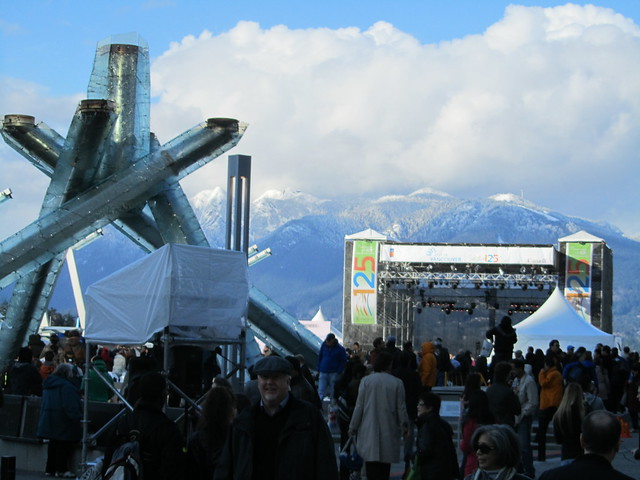
The sky turned blue with occasional clouds, with lots of sunshine for the Vancouver 125 Celebrations, marking the 125th birthday of the City of Vancouver. Fresh snow decorated the local mountains, yet the Jack Poole Plaza was a warmish 9 degrees in the sunshine. The concert stage opened at 4pm with Uzume Taiko, followed by Mmm-HoP, and Leela Gilday. The 6pm ceremonies featured a birthday singalong by the Vancouver Bach Choir, of which city councilor Heather Deal is a singer.
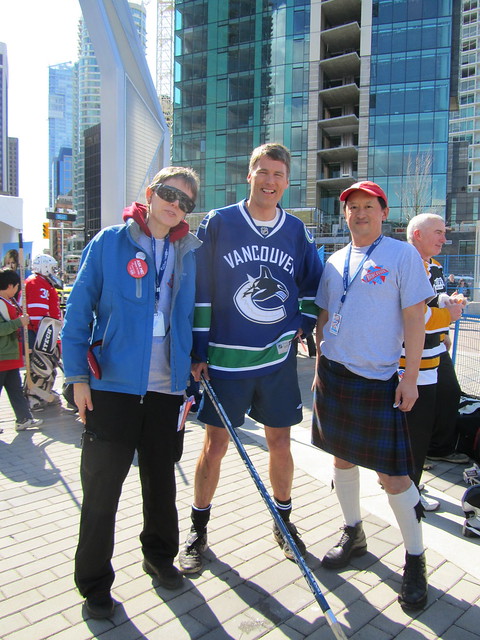 – photo Deb Martin
My role for the Vancouver 125 Team was to help out with the ball hockey games. During my breaks, I walked around the Jack Poole Plaza and saw the music performances that featured some of my friends. Bonnie Mah is part of Uzume Taiko. Ndidi Cascade was one of the performers of Mm-HoP: Hop Jump Jive.
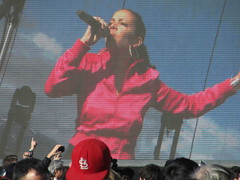
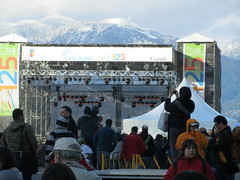
It was a picturesque day with fresh snow on the mountains, and all the people creating a happy crowd.
 |
Playwright Marty Chan (Mom, Dad, I'm Living With A White Girl) is coming to Historic Joy Kogawa House.
This is a special reception, hosted by Kogawa House Society. Marty is coming, and so is the costume designer. They will talk about this new exciting play about the Chinese immigration to Canada, and how Monkey King is involved.
The evening is moderated by Todd Wong, creator of Gung Haggis Fat Choy, and who is active on the executive boards of Asian Canadian Writers' Workshop, Historic Joy Kogawa House Society and The Land Conservancy of BC. Todd loves is a 5th generation Chinese Canadian, and loves Monkey King stories and Asian Canadian history.
Wednesday, March 30th. 7:30 to 9pm
Bonus: Meet the playwright this Wednesday, March 30, 7:30 to
9pm,
at Historic Joy Kogawa House, 1450 West 64th Avenue, Vancouver.
Cost:
$25 = Tax-deductible one-year membership in Historic Joy Kogawa House
Society
$39 = One ticket to any production of The Forbidden Phoenix,
running April 7 to 23 at the Gateway Theatre in Richmond
$64 total
This event is a fundraiser for our writer-in-residence program at
Historic Joy Kogawa House, which September 15, 2011, to April 15, 2012.
For tickets, email email kogawahouse@yahoo.ca
About the play
The Forbidden Phoenix, combines adventure and martial arts to
present an eye-popping musical that tells the story of a father who
comes to Canada looking for a better life. High drama and visual
spectacle combine for a unique evening of family entertainment.
Performed in English with Chinese surtitles. The play runs April 7 to 23
at the Gateway Theatre in Richmond.
About the event
On Wednesday, March 30, please join us in the living room of Historic
Joy Kogawa House, childhood home of the author Joy Kogawa, for a rare
opportunity to sit with this master author, hear him read from the
playscript, and discuss the issues of history and mythology he raises in
his work.
About the playwright
Marty Chan explores the tensions between opposing forces of assimilation
and the search for heritage and cultural roots.
Marty Chan is an award-winning playwright. His Mom, Dad, I’m Living
with a White Girl won the Sterling Award for Best New Play and Best
Sound Design, and Harvard University’s A.C.T. Award. The Forbidden
Phoenix won the Alberta Literary Awards Gwen Pharis Ringwood Award
for Drama in 2004.
For tickets, email email kogawahouse@yahoo.ca
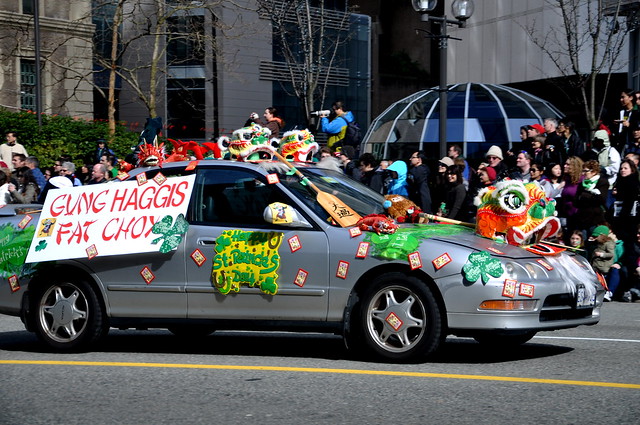
Here is a picture of us with our parade dragon. Jennifer is carrying the head of the dragon, Todd is wearing the yellow Macleod kilt, Carolyn in a blue Fraser Hunting kilt, and Evan in green and purple “Pride of Scotland” kilt.
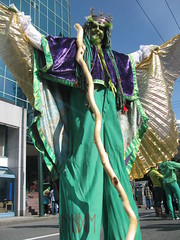
Da Danaan Irish School of Dance
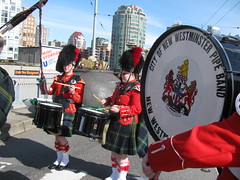

The North Shore Celtic Ensemble
The Vancouver Police Lion Dance team was in the
parade…. Gung Haggis Fat Choy had a 5 person dragon…. Falun Dafa
had a “lotus float” + drummers…. BC Lions Cheerleaders had some
Asians, as did 93.7JR Country Radio (driving the truck)…. Koreans were
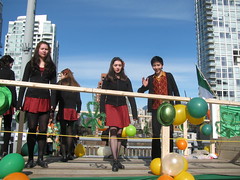
in the parade… but did you see the Hapa-Asian-Canadians in the Da
Danaan Irish Dancers… and the Stave Scottish Dancers?
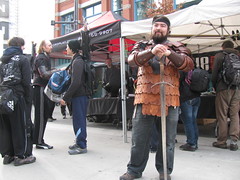
Then off to the Celtic Village,
Every year the Vancouver Cherry Blossom Festival blooms!
I first met VCBF founder Linda Poole in 2005 at the planting of a Kogawa House cherry tree grafting at the City of Vancouver. Since then the VCBF has grown with its events and partners. It was wonderful to see Linda at the yarn bombing event of the Kogawa House cherry tree on Sunday.
Ricepaper Magazine publishes the winner of the Haiku Invitational poetry contest. Personally, I have always thought it would be cool to have a haiku contest with a dragonboat theme, for all the paddlers in the city. But until then… VCBF has a contest that attracts submissions from around the world.

|
Linda |
Visit our website at vcbf.ca
“Celebrate
Vancouver's 125th birthday and order your Birthday Blossom Cherry Tree
at: http://www.vcbf.ca/birthdayblossom/birthday-blossoms.
Gung Haggis Fat Choy Seattle V was amazing!
Feb 20th @ China Harbour Restaurant
Lake Union
Seattle Washington
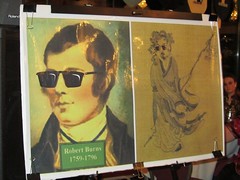
The Seattle version of Gung Haggis Fat Choy Robbie Burns Chinese New Year Dinner has an edgy feel, which pushes the boundaries of both traditional Robbie Burns and Chinese New Year dinners. Scotland's favorite son Robbie Burns is compared to China's most famous poet Lao Tzu.

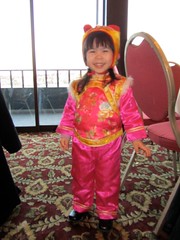
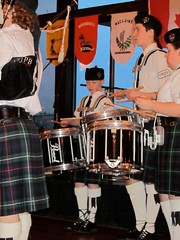
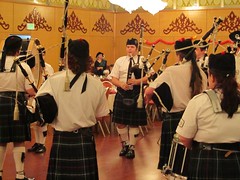
A young drummer keeps up with the older drummers around him. This cultural fusion event opened with the North West Junior Pipe Band.
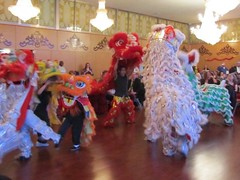
The dance floor was soon invaded by 6 Chinese lions – two were lion cubs.
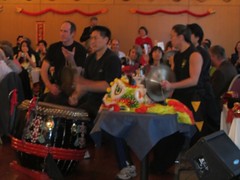
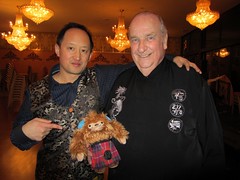
Bell Town Martial Arts is led by Sifu David Leung, who once studied with Bruce Lee.
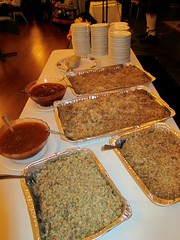
Haggis is served out of their casings… and heated in aluminum
casserole plates. But thankfully, a traditional haggis in it's casing
was used for my Address To The Haggis.
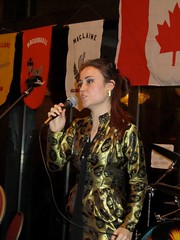
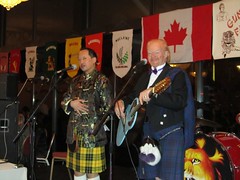
Todd Wong and Red McWilliams, hosting and singing + comic relief. We led an interesting diversion of kilt tartan identification.
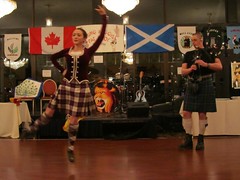
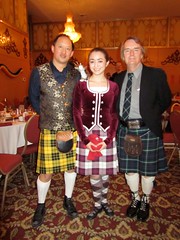
Lauren Black, premier Highland Dancer, from Toronto. What was she doing in Seattle? She specifically came out to perform at the Seattle Gung Haggis Fat Choy Dinner because her mother is 2nd generation Chinese-Canadian, and her Scottish-Canadian father plays bagpipes, and it was a good excuse to come visit relatives. Last year she found out some of her friends, who live in Seattle had danced, and she decided she wanted to, too!
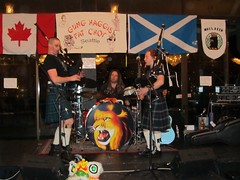
Rock & Roll bagpipes from Don Scobie's band “Nae Regrets”



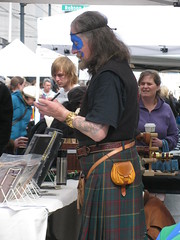 a maker of leather sporrans
 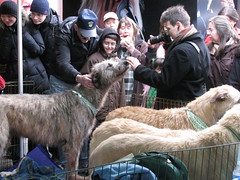 Irish Wolf Hounds
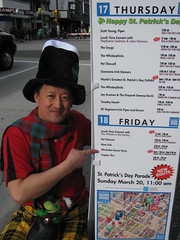 The program for Celtic Fest
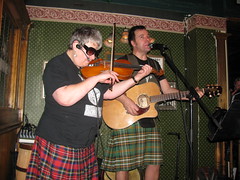 Roolya Boolya- Mark Downey on lead vocals and guitar with the amazing Mary on fiddle.
 Japanese-Celtic-Canadian