
Todd Wong interviewed by Halya Kuchmij for CBC Generations documentary
at Dr. Sun Yat Sen Gardens in Vancouver – photo Rick Zimmerman

Todd Wong interviewed by Halya Kuchmij for CBC Generations documentary
at Dr. Sun Yat Sen Gardens in Vancouver – photo Rick Zimmerman
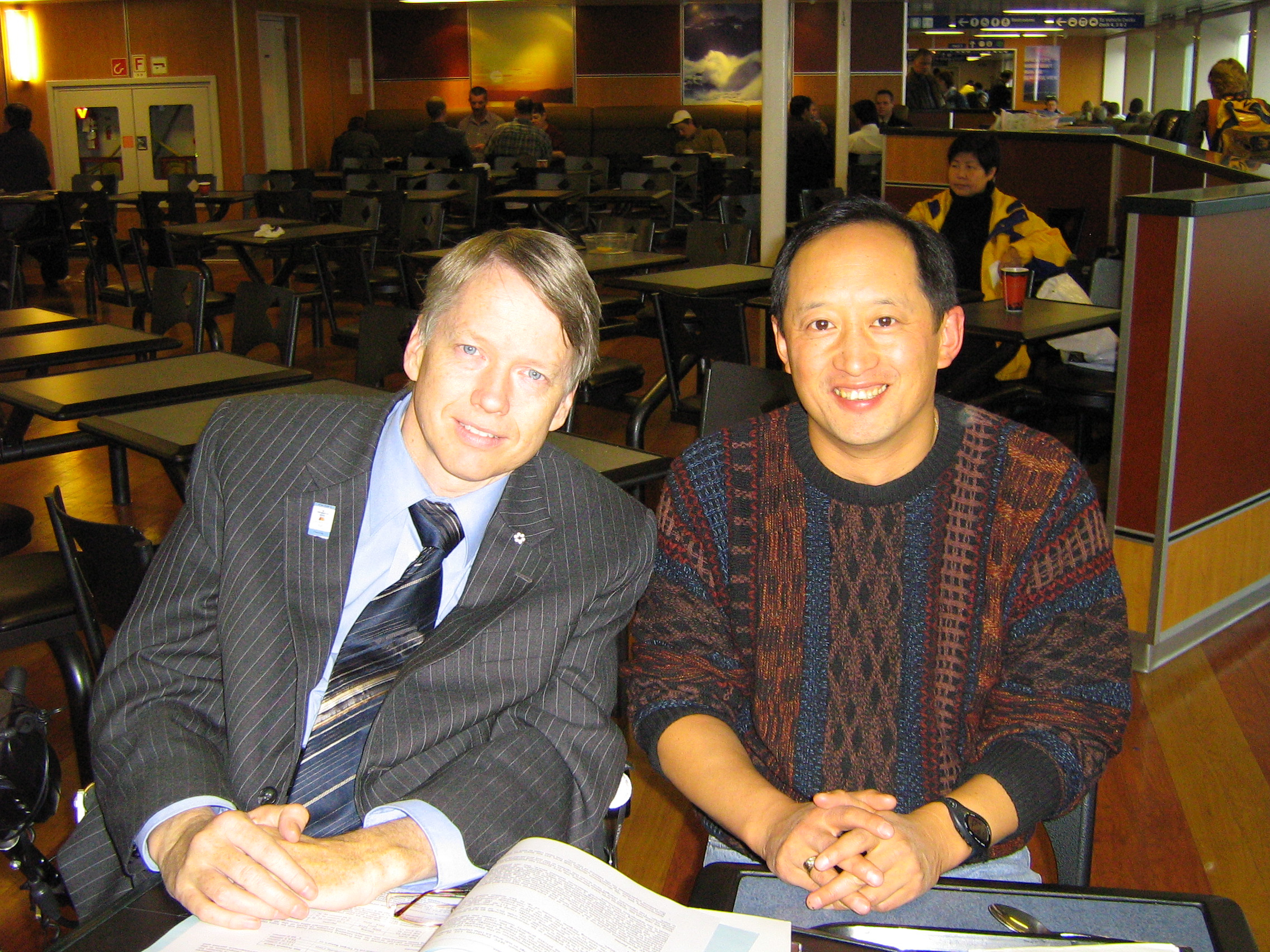
Vancouver mayor Sam Sullivan and Todd Wong on board the Queen of Oak Bay enroute to Victoria – photo Todd Wong
Mayor Sam Sullivan and me, on board the Queen of Oak Bay

Vancouver Mayor Sam Sullivan and Todd Wong – just two boys who grew up in Vancouver's East End. – photo Todd Wong
I bumped into Vancouver Mayor Sam Sullivan on the 9am sailing to
Victoria on the Queen of Oak Bay. Sam was travelling to Victoria for a
BC Munincipalities conference. I was travelling with a CBC documentary
film crew because we were going to Vancouver Island to interview my
family elders.
Family history is a bit of a theme between Sam and me. The first
time we met was a
few years ago, at a history fair at the Vancouver Public Library.
I
had a display of the Rev. Chan family photos, and he stopped to share
stories about his family. We discovered that we both grew up in
the
same East Vancouver neighborhoods, our fathers had shops in the same
area – his on Hastings and mine on Venables. And we briefly
attended Vancouver Technical highschool together for one year.
In the years since, Sam has attended many events that I have hosted for
Asian Canadian Writers' Workshop or Gung Haggis Fat Choy dinners.
Last year, we featured Mayor Sam reading a Chinese poem as part of the
GHFC dinner festivities.
What do you talk about when you meet the Vancouver mayor on a ferry to Victoria?
Well… first of all, you have to appreciate that wherever Sam Sullivan
travels, he is approached by strangers who want to say hello.
Sam's appearance at the Torino Olympics closing ceremony made an
incredible impact, as he waved the Olympic flag from his
wheelchair. As a quadripelic mayor he has raised the profile for
wheel chair atheletes and physically challenged people globally.
During our chat, a young boy came up to ask to say hello and ask to
take a picture with the Mayor. Another traveller going to the BC
Munincipalities conference brought his daughter who uses a
wheelchair, to say hello to Sam Sullivan.

Todd Wong and Vancouver mayor Sam
Sullivan at Gung Haggis Fat Choy 2006 dinner. Sam read a poem in
Chinese. Maybe for 2007 we can find him a plaid neck tie with the
Sullivan tartan or a Chinese jacket. Maybe we can find a Robbie
Burns poem to draw on his Scottish heritage of the Sullivan clan… –
photo Ray Shum.
Okay… we definitely chatted about the next Gung Haggis Fat Choy
dinner. Mayor Sam will be pleased to attend. I just have to
go through his City of Vancouver protocol department now. I also
informed him about some of the latest issues in the Asian Canadian
community, and told him about a recent Head Tax Redress recognition day
at the City of Toronto.
“Do you think this is something we should do in Vancouver?” Sam asked.
“Oh yes… the head tax reress campaign started in Vancouver back in
the 1980's,” I said. “We have many key figures here in Vancouver,
and the first redress payment was to Charlie Quan here in
Vancouver. Vancouver city councillors Raymond Louie and George
Chow are also head tax descendants.”
CBC Generations filming: Searching for Rev. Chan on Vancouver Island

Rev Chan Yu Tan is 4th from the left, standing beside his elder and taller brother Rev. Chan Sing Kai at the 50th Anniversary of the Chinese United Church in Victoria, 1935. Rev Chan Sing Kai first came to Canada in 1888 to help found the Chinese Methodist Church which later became the Chinese United Church. Photo from family archives.
My great-great-grandfather Rev. Chan Yu Tan was a United Church
minister on Vancouver Island in Victoria and Nanaimo. He first
arrived in Victoria in 1896, 110 years ago. He then came to
Vancouver to work at the Chinese Methodist Church which was founded by
his older brother Rev.Chan Sing Kai, in 1888. He also ministered in
New Westminster, then moved to Nanaimo in the 1920's before returning to New
Westminister where he retired. I have a picture of my mother as a child at
the Rev. & Mrs. Chan's 65th wedding anniversary party back around 1943.
The CBC film crew went to Vancouver Island yesterday to interview my grandmother's cousin
Victor Wong and my grandmother's younger sister Auntie Helen Lee for a CBC Generations documentary. They were Rev. Chan's
grandchildren who both remember attending their grandfather's services
in Nanaimo during the 1920's. “Auntie” Helen and her younger brother Daniel, lived with Rev. Chan
and his wife for a time in Nanaimo.
I travelled with producer Halya Kuchmij, cameraman Doug, and sound guy Rick. We
caught a 9am ferry to Victoria, arriving at Uncle Victor's place just
after 11am. Auntie Roberta Lum was also there to greet us.
She
brought some pictures that were scanned for use in the
documentary.
Uncle Victor talked about visiting his grandfather Rev. Chan Yu Tan,
about becoming a Canadian soldier and going to India. Uncle
Victor is the president of the Chinese Canadian veterans association in
Victoria, and he was filmed two weekends ago when they hosted a reunion
in Victoria. Uncle Victor gave a speech about how the
Chinese-Canadian veterans played a major role in bringing
enfranchisement to Chiense Canadians, helping us gain the vote in
1947. Halya was very
pleased with the interview.
“I loved my grandfather,” beamed Uncle Victor, as his face lit up and
he recalled happy times playing in Victoria. He was a very kind
man.”

Here I am with my Grandmother's
cousins Roberta Lum andVictor Wong in Victoria. Their mother was
Rose Chan Wong, a daughter of Rev. Yu Tan Chan. My
great-grandmother Kate was the eldest child of Rev. Chan – photo
Halya Kuchmij
We finished after 2pm then went for lunch. It was a 2+ hour drive
to Nanaimo. We arrived at Auntie Helen's just after 6pm. We
were also greeted by Helen's daughters Donna and Judy. Auntie
Helen
talked about growing up in Nanaimo, and attending services with her
grandfather Rev. Yu Tan Chan. She shared that she sometimes
accompanied Rev. Chan on his visits to Ladysmith, Duncan and Cumberland
where there was a large group of miners. Rev. Chan held evening services for the miners.
She also talked about her grandmother
Mrs. Shee Wong Chan, whom I learned could be a very stern woman as well
as loving. Mrs. Chan was also very active in the community,
knowledgable about Chinese herbal medicines and midwifery. A
highlight of the interview was when Auntie
Helen sang “Jesus Loves Me,” and talked about the hymns that Rev. Chan
played on his pump organ at Church.

My favorite Grand-Aunt… Auntie
Helen is my grandmother's younger sister, at 91 years old. She
has attended the Gung Haggis Fat Choy dinners and she LOVES to eat
Haggis – photo Halya Kuchmij
We caught the 9pm ferry back to Vancouver/Horseshoe Bay. It was a
long day travelling from the 9am ferry in Tsawassen to a 10:45 arrival
at Horseshoe Bay. But we captured some great interviews on
film. Halya keeps saying “This is going to be a great
film.” She is excited and it's great to be part of history in the
making!
On Thursday morning we
filmed my 15 year old 2nd cousin Tracy Hinder at West Vancouver
Secondary School
during her
mandarin chinese language class. She next did an interview and
talked
about what she has learned of her family history and her plans for the
future. Tracy really represents the future history of the
family. At her young age, sh is already a newsmaker. For
the film she also shared her experience winning the 2005 Canspell
contest in
Vancouver, and going to Ottawa for the National competition.
Tracy remembers being at the Rev. Chan family reunions that her mother
helped to organize in 1999 and 2000. Of course she was very young
but remembers that “there were lots of people.”
Filming continues this weekend. Generations: Rev Chan is expected to air in Febrary 2007.

Auntie Helen Lee and Todd Wong – photo Halya Kuchmij

Rev. Chan family descendants: Todd Wong, Roberta Lum and Victor Wong – photo Halya Kuchmij

Dan Seto holds the book “Finding Memories, Tracing Routes” in which he authored a story about his family – photo Todd Wong

CHSBC writing workshop: My cousin Hayne Wai, Dan Seto, Todd Wong (me)
“Finding Memories, Tracing Routes:”
CCHSBC book launch BIG SUCCESS
for Chinese Canadian Family Stories
Wednesday, October 25, 2006
7:30pm
Vancouver Public Library
350 West Georgia Street.

Author Dan Seto
holding a copy of the CCHSBC book Finding Memories, Tracing
Routes” Dan's story includes a beaver… how Canadian is that? –
photo Todd Wong
Almost two hundred people attended the book launch of the Chinese Canadian
Historical Society of BC's book launch for “Finding Memories, Tracing
Routes: Chinese Canadian Family Stories.”
Family
and friends + interested listeners all crowded into the Alice Mackay
Room at the Vancouver Public Library to hear about how self-confessed
non-writers helped create the most significant new book about Chinese
Canadian stories. CCHSBC executive members described how the 6
week writing project took place and what its' significance means to how
history will be understood.
Dr.
Henry Yu, UBC professor of History said “Many people think that history
is defined by the historians, but it's not – it's really defined by the
people who tell the stories. The authors in this book have
changed how history is being told.”
Editor Brandy Liên
Worrall, who was a former editor for the Amerasia Journal
in Los Angeles, led the 6 week workshop. With simple exercises,
the 8 first-time writers were able to discover their topics, and flesh
out their stories with details, sights, sounds and emotional
experiences. Worrall was credited by each of the writers as being
very
supportive, and able to make their stories really come alive.
Shirley
Chan, one of the writers, said she had always wanted to be able to
share the stories that her mother had told her – but she didn't know
how. The writing workshop with a group setting not only helped her to
write, but she developed lots of new friends, and a sense of community
too!
Writer
Hayne Wai (also my cousin), who is also currently president of the
CCHSBC, said it is important to note that nobody considered themselves
a “writer” before the workshop. They didn't know what a
“metaphor” was. And while they all had different reasons for
wanting to write, they also had different audiences to write for.
Some people wrote for their parents or their ancestors. Some
people wrote for their family and future generations. But many of
the writers each admitted that it was also important for them to write
for themselves.
Dan
Seto was the one writer selected to give a testimonial presentation to how the
workshop helped him to give voice to the stories inside him, as well as
helping to understand his brothers and his parents better. And along
the way, Dan said the writing process helped him to mature. Dan
introduced his family to the audience. And he introduced his
dragon boat team too! He asked the Gung Haggis Fat Choy dragon
boat team and its coach – me… to stand up and credited us with giving
him the support and listening to his stories about his family.
All
of the eight authors attended the book launch, and next took seats near
the stage. They answered questions from the audience, then signed
copies of the books for family, friends and fans.

Author Dan Seto holds a copy of
“Finding Memories” with his dragon boat team buddies, Todd, Jen,
Stephen, Wendy, Jonas, Julie, Grace, Tzhe and Jeremy. – photo courtesy
of Grace.
We
really do love Dan on the dragon boat team. He and many others on
the team regularly exchange ideas about Chinese-Canadian identity and
issues, as well as thoughts about issues that affect us. This
year I openly shared with the team about my activities in the Save
Kogawa House and Head Tax redress campaigns. Others talked with
Dan about where we grew up, and where our ancestors grew up. And
like the writing group our Dragon boat team members provides lots
of social support – the following paddlers came out to support Dan:
Grace, Julie, Jonas, Wendy, Jennifer, Jeremy, Tzhe, Joe, Keng, Gerard,
Stephen, Steven, Christine and myself.

CCHSBC president Hayne Wai (my
cousin!), Dan Seto and Todd Wong (me!), attending the Oct 21st CCHSBC
writing workshop at the Vancouver Museum – photo courtesy of Todd Wong
 The Chinese Canadian
Historical Society of BC proudly presents the first
collection of eight stories demonstrating the power of finding common
history in the lives and deaths of those who came before us. Created
during a six-week community writing workshop, this touching and
evocative book is a must-read for all Canadians who want to understand
the central place of Chinese-Canadians in our shared past.
Authors: Shirley Chan,
Belinda Hung, Roy Mah, Dan Seto, Hayne Wai, Candace Yip, Gail Yip and
Ken Yip.
Editor: Brandy Liên
Worrall
Proceeds from the sales of this
collection will go towards the Edgar Wickberg Scholarship for
Chinese Canadian History.
For additional
information on the book launch, please email
info@cchsbc.ca.
For information on the
collection and/or how to purchase, please go its
dedicated page.
To
find out more information on the upcoming February workshop that will
focus on “Stories about Family and Food” – please go to www.cchsbc.ca/
Federal Govt. to name Vancouver building after noted MP who made racist comments
The latest hot issue in the Asian-Canadian community is the Federal government's attempt to name a Vancouver building after a Conservative MP who served during Diefenbaker's government. Howard Green apparently made the following statements:
“Mr.
Green felt there should be 'no halfway measures about the Japanese
question in Canada.” 'The Japs must never be allowed to return to
British Columbia”
– The Vancouver Sun of May 17, 1945
Many
Japanese-Canadian and Chinese-Canadian community leaders are speaking
out against the naming of the building. My quick perusal of the
internet reveals the Hon. Howard Green to have held cabinet
positions of Public Works, Defense Building, External Affairs.
John Diefenbaker called him “one of the greatest leaders in the
field of disarmament and world peace”as he was a strong advocate of
world peace and the United Nations.
So what is true? Did
this WW1 veteran feel that Canada's existence was really threatened by
Canadian born citizens of Japanese ancestry? Even though
Japanese-Canadian soldiers were accepted in the Canadian Army?
Did he ever recant his racist declarations? Was he a victim of
the times, when Canada was swept up in fear of attack from Japan that
everybody and their dog wanted BC's Westcoast free from anything
Japanese… even though Japanese-Americans were never interned or sent
away from the Hawaiian Islands.
Other possible names were apparently considered, such as Chief Dan George and Terry Fox.
Do
we condone racist comments as the tenor of the times, or do we move
along and say that while it may have been acceptable back then, it is
no longer acceptable now. After having worked on the Save Kogawa
House committee, and the Head Tax Redress campaign it is amazing to
discover the deep-rooted emotions that many Canadians have had towards
these issues. These emotions are valid, and we cannot move
forward as a country until we stop paying lip service to these
issues. This is the reason why we must ensure that all
communities that have vested interests are not only part of the naming
process, but also part of the decision making bodies – such as the
government. Otherwise we have uninformed people going “What's the
fuss?”
Ottawa,
October 24, 2006 – The Honourable Michael M Fortier, Minister of Public
Works and Government Services Canada (PWGSC), today announced that he
will ask the local volunteer committee in British Columbia to review
its recommendation regarding the naming of the Howard Charles Green
Building in Vancouver.
In
keeping with the Policy on Naming Government of Canada Structures, a
volunteer committee comprised of representatives of Vancouver
organizations held public consultations and made a recommendation in
2004 for consideration by the Government on the naming of the federal
building at 401 Burrard St . The organizations included the Downtown
Business Association, the Vancouver Business Improvement Association,
the Vancouver Historical Society, and the Vancouver Heritage Commission.
“Following
concerns expressed by Canadians of Japanese descent regarding the
naming of the Howard Charles Green Building , I will be asking the
volunteer committee to review its recommendation and indicate whether
it continues to stand by this recommendation,” Minister Fortier said.
Mr.
Fortier committed his department to taking immediate action to work
with the volunteer committee to review the recommendation and to report
back to him as soon as possible.
“I will await the results of this review before making any decision regarding the naming of this building,” the Minister added.
-30-
ce texte est également disponible en français.
For further information, please contact:
Jean-Luc Benoît
Director of Communications
Office of Minister Fortie
819-997-5421
Media Relations
Public Works and Government Services Canada
819-956-2315
PWGSC news releases are also available on our Internet site at www.pwgsc.gc.ca/text/generic/media-e.html
End
For Immediate Release
October 25, 2006
CCNC to Ottawa : Name Building After Heroes Who Survived Racism
TORONTO:
The Chinese Canadian National Council (CCNC) is calling on Ottawa to
reverse a decision to name a federal building after the late Howard
Charles Green, a former Conservative MP who served in Prime Minister
John Diefenbaker's government.
The
Globe and Mail published a story on October 24, 2006 bringing attention
to some of the racist comments made by Mr. Green, when he was a Member
of Parliament:
“A Vancouver News-Herald front-page story on July 25, 1939, had Mr.
Green
demanding 'Orientals be excluded from Canada .' The Vancouver Sun of
May 17, 1945, states: “Mr. Green felt there should be 'no halfway
measures about the Japanese question in Canada .
” 'The Japs must never be allowed to return to British Columbia ,' he said.””
“We
are dismayed to learn that the Conservative Government chose last month
to name a building after someone who advocated so forcefully for
exclusion of Asians in general and internment and repatriation of
Japanese Canadians in particular,” Colleen Hua, CCNC National President
said today. “The irony is that we just completed a ceremony to restore
dignity to our few living Head Tax payers including 99 year-old Charlie
Quan and WWII veteran Gim Wong who both who lived through the Chinese
Exclusion Act era.”
“There are no half-way measures about fighting racism in Canada”
“My
question is how members of the Japanese Canadian community will feel
walking into a building named after someone described as ‘among the
most vocal and unregenerate of the racist politicians,’” Sid Tan, CCNC
National Director added. “Where are the lessons of redress here? This
building should be named after Suzuki, Kogawa, Miki, Shoyama and the
true heroes who survived this vicious racism.”
Chinese
Canadian National Council (CCNC) continues to work with other
redress-seeking groups including the Ontario Coalition of Chinese Head
Tax Payers and Families (Ontario Coalition) and Head Tax Families of
Canada Society (formerly the B.C. Coalition of Head Tax Payers, Spouses
and Descendants) in the campaign for inclusive redress of the Chinese
Head Tax and Chinese Exclusion Act.
– 30-
For more information, please contact:
Sid Tan, CCNC National Director, (604) 783-1853 ( Vancouver )
Victor Wong, CCNC Executive Director, (416) 977-9871 ( Toronto )