Category Archives: Vancouver Heritage and History

125 Places That Matter in Vancouver, includes Hastings Park Livestock building that housed detained Japanese-Canadians during WW2

Vancouver Heritage Foundation had a ceremony on Dec 1 to recognize the Livestock Building at Hastings Park, an important part of Japanese Canadian Internment History, as one of Vancouver’s Places that Matter.
At 1pm, everybody met in the Hastings Room, and MC Lorene Oikawa, told people the order of events.  We would do a walk to the Livestock Building for an unveiling, followed by a walk to Momoji Gardens for a Parks Canada unveiling.  Finally we would return to the Hastings Room for formal speeches, personal stories, and presentations in appreciation.
Marta Farevaag, Chair of the Vancouver Heritage Foundation, watches as Mary Kitagawa steps back from unveiling the plaque for the Livestock Building at Hastings Park.
Mary had recently pushed for the University of British Columbia to recognize the Japanese Canadian students that were not allowed to finish their degrees at UBC because they were interned during WW2.  It was an emotional ceremony when 76 students were honoured with degrees at a special tribute 70 years later.  http://japanese-canadian-student-tribute.ubc.ca/
Watch this video of Mary Kitagawa speaking about the detainment and internment of Japanese Canadians during WW2.  Roy Miki, Japanese-Canadian Redress co-leader and author stands at the top of the stairs in long dark coat and white hair.  Chinese-Canadian historian/author Larry Wong stands on the stairs in rust coloured jacket.  Lorene Oikawa, union leader and human rights activist stands on the right in red coat.
The Parks Canada plaque at Momoji Gardens was re-located for better public viewing, and unveiled.

One of the event attendees shares a personal moment, as she stands beside the plaque with photos of family members.

Naomi Yamamoto MLA, is the first Japanese-Canadian to be elected to the BC Legislature.  She shared a story how her father had spent 5 months living as a detainee at the Livestock Building.  Naomi explained that because her father was an older teen-aged boy, he was separated from his mother.  His father had already been separated from their family and sent to a labour work camp.  Unfortunately, her father could not attend the ceremonies on Saturday, due to not feeling up to it.
My friend Ann-Marie Metten was deeply touched by some of the personal stories.  She wrote:
“Mary Ohara’s story resounded. She told of her incarceration in March 1942 in the livestock barns at Hastings Park, still reeking with manure and infested with bugs. Birds flew overhead and fouled their blankets. Bedbugs bit at night, and the administrators brought in DDT and sprayed the bedding, including the blankets under which the children would sleep at night.

“At age twelve, Mary developed mumps and had to be isolated from others so as not to sprea the highly communicable disease. She and other children were moved to the coal-storage area under the livestock barns, where only a small hole high in one of the walls let in daylight. In the darkness, other young children cried for their families. She was held there for ten days.”
My friends: Ellen Crowe-Swords, Ann-Marie Metten (executive director of Historic Joy Kogawa House), and Joy Kogawa – author of Obasan, the first novel to address the issues of the internment of Japanese Canadians.  Roy Miki, Simon Fraser University Professor Emeritus and 2003 Governor General’s Award Winner for Poetry, had called Obasan, “A novel that I believe is the most important literary work of the past 30 years for understanding Canadian history.”
My friend Inger Iwaasa and my accordion.  Inger married a Japanese Canadian, and her daughter is pianist Rachel Iwaasa, who performed at Kogawa House for the presentation when Joy Kogawa was named recipient of the George Woodcock Lifetime Achievement Award.  Inger said she recognized each of the songs that I performed: Sakura, Mo Li Hua (Jasmine Flower), O Solo Mio, Neil Gow’s Lament, Hungarian Dance No.5, Dark Eyes.  I wanted to perform a mixed repertoire that would represent many of the ethnic groups that had come to settle in Vancouver: Japanese, Chinese, Italian, Irish, Hungarian and Russian.
Todd Wong, Judy Hanazawa, Jessica Quan – special projects coordinator VHF, Mary Kitagawa, Lorene Oikawa, Tosh Kitagawa.

Charlie Quan, head tax warrior, Rest In Peace, 1907-1912

Charlie Quan stood up for Head Tax Redress in 2005 at age 98

Charlie
Quan was the the first person to receive a head tax redress ex-gratia
payment in 2006.  Charlie came to Canada as a small young child, and had
to pay $500 head tax, at the start of the previous century. In 2005, He
was a brave man calling for a full head tax redress and payment, when
others were feeling too afraid.  It was wonderful to meet and talk with
him, and I discovered he was the grandfather of one of my childhood
friends.


by
Todd
on Fri 20 Oct 2006 03:59 PM PDT

Charlie
Quan. Standing are Victor Wong, Gim Wong and Sid Tan – photo Todd Wong

I met Charlie through renowned head tax activist Sid Tan.  Sid told a story at Charlie's service in his eulogy, about how Charlie came up to him after the Supreme Court of Canada denied leave to appeal in 2003.  “Charlie came up to me,” Sid says, “He said, you and Gim and Victor are doing a good job, but you need some help.”

“You're a head tax payer?” Sid says he thought maybe Charlie was a son or descendant of a head tax payer. But Charlie Quan had come to Canada at a young age, and in 2003, he was only 96 years old.

In the next few years, the head tax redress ramped up to one of the major issues of the 2005-2006 federal election campaign.  The Liberal Government of Paul Martin promised the ACE program of Acknowledgement, Commemoration and Education.  But Charlie wanted an apology and a monetary redress.  He went on record as saying what he thought a fair price would be.  You can see him in this CBC interview. 

Check out my blog posts with Charlie here: http://www.gunghaggis.com/blog?cmd=search&keywords=charlie+quan

Sid Tan, friend of the family sent this message out yesterday evening.

In Memory of
Mr. Charlie Sang Now Quan
February 15, 1907 – February 23, 2012
 
Obituary
It is
with sadness that we announce the passing of Mr. Charlie Sang Now Quan. Charlie
was born in Hoyping, China and passed away peacefully in Vancouver, BC on
February 23, 2012 at the age of 105. He was predeceased by his wife, Own Yee
Lee. He is lovingly survived by his daughter-in-law Chung Yit Quan, his two sons
Gary, Wesley, his six grandchildren and his seven
great-grandchildren.

He will be deeply missed
by his family and friends. The family has asked for privacy until after the service.

by
Todd
on Mon 27 Nov 2006 10:12 PM PST
members: Libby Davies, Charlie Quan, Jack Layton, ??, Gim Wong, Ujjal Dosanjh – photo Todd Wong

by
Todd
on Fri 20 Oct 2006 04:08 PM PDT
Charlie Quan holding cheque, Foon
Chang Ron Mah, Victor Wong and Todd Wong – photo Eric

by
Todd
on Thu 22 Jun 2006 10:38 PM PDT

Charlie Quan with his favorite grandson Terry Quan – my elementary school friend – photo Todd Wong

Chuck Davis' “History of Metropolitan Vancouver” mentions a Robbie Burns Dinner in Vancouver Chinatown

Chuck Davis' “History of Metropolitan Vancouver” mentions a Robbie Burns Dinner in Vancouver Chinatown

I am sorry to say that Chuck Davis never attended a Gung Haggis Fat Choy dinner.

The
following entry in “The Chuck Davis History of Metropolitan Vancouver”,
1935, ISBN 978-1-55017-533-2 (2011 edition) at page 151 states as
follows:  (brought to my attention by David J. Bilinsky)


(entry for 1928)

ALSO
AUGUST 25 A statute of the famed Scottish poet Robert Burns (1759-96)
was unveiled in Stanley Park by the Rt Hon. Ramsay Macdonald, the former
British Prime Minister.  The bronze and granite statute is an exact
replica of one standing  in Burns' birthplace in Ayrshire, Scotland
(Local Scots annually mark Robbie Burns Day on January 25, but it was in
the 1930's that fervour was particularly marked.  Even the Chinatown
Lions' Club organized an annual Burns dinner, complete with haggis
served with a sweet and sour sauce.)

Chuck and I knew each other though… I first encountered him many times at the Vancouver Public Library Central Branch, where he would often come to do research.  Later, I became involved with Chinese Canadian historical events and issues, and our paths would cross.  One time, we had a lengthy chat about the Janet Smith murder case, when a Scottish nanny was killed in Vancouver, and a Chinese house boy, was wrongfully accused of the murder, then later acquitted.

photo – photo Todd Wong
But Chuck did came to speak to the Vancouver Library workers during a historic
1st time ever strike – when I invited him to come out.  He was always very proud
that his book “The Vancouver Book” was the 2nd most stolen book at the
Vancouver Public Library.
photo – photo Todd Wong
I had organized an author's reading series for the CUPE 391 strikeline, inspired by 2 reasons.
1) Victoria author Terry Glavin had wanted to do research at VPL
2) a lot of community groups such as the Vancouver Intercultural Orchestra had booked the
community rooms at VPL, and could no longer have a space to do public programs.

photo
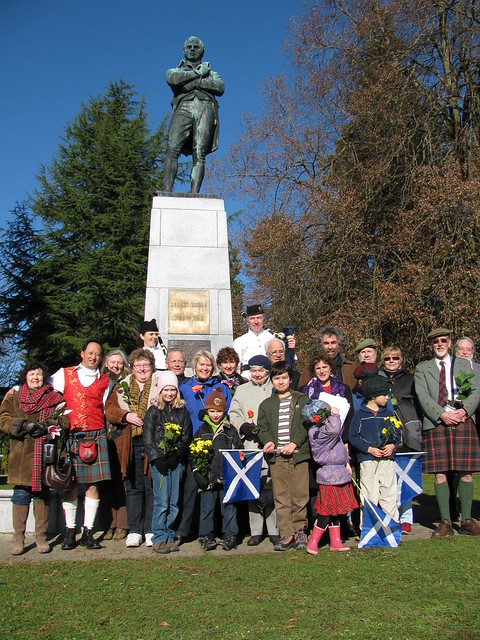
This picture was takenin 2009, to mark the 250th birthday of Robbie
Burns.  We also did a virtual wreath laying in “2nd Life” – organized by
Dr. Leith Davis – director of Centre for Scottish Studies SFU – who had
just flown into Vancouver YVR from Scotland, and came straight to our
ceremony.  That night at the Gung Haggis Fat Choy Dinner – she declared
it the best Burns Dinner she had ever attended – having spent the
previous week in Scotland attending many Burns Suppers.

Read the story of the event here:
250th Anniversary of Robert Burns recognized with poems at statue in Vancouver's Stanley Park

The Chinatown Lion Club dinners began at the Bamboo Terrace Restaurant
just over 50 years ago.  They continued for many years, many of them organized by
Vancouver lawyer Chuck Lew, but dwindled in recent years.  I attended
one of the dinners at Floata – possibly in 2009. We did a one time
merger…  maybe in 2010.  I asked Chuck about creating a 50th
Anniversary Robbie Burns Chinatown dinner for Vancouver Chinatown Lions
Club – but I don't think they ever had one…  He told me that it was
getting harder to organize… and even had asked me about organizing the
dinner for the Chinatown Lions Club – which I declined, in order to focus on Gung Haggis Fat Choy events.

For the record – Chinatown Lions Club always served the haggis
traditional style with sweet and sour sauce (or some kind of Chinese
sauce).  They never ventured into fusion cuisine.  Gung Haggis Fat Choy
dinners have created a number of haggis-fusion-cuisine dishes –
including: deep fried haggis won-tons, deep fried haggis / seafood
dumplings, haggis won ton soup, haggis spring rolls, steamed haggis /
shrimp dumplings, steamed haggis / pork dumplings, haggis lettuce wrap.

Strombo wades in on the plagiarism issue of Ling Zhang's “Gold Mountain Blues”

Plagiarism
and the Arts
George Stromboulopoulos comments on the current lawsuit
by authors Wayson Choy, Sky Lee and Paul Yee against Chinese born author
Ling Zhang – and points out some infamous examples of plagiarism
including George Harrison's song My Sweet Lord vs He's So Fine by The
Chiffons. 


Here are some of the highlight's from the article

Cold Play's “Viva la Vida” VS Joe Satriani's “If I Could Fly”

Strombo points out that unintentional plagiarism still gets you in trouble.  There are videos comparisons of Harrison's “My Sweet Lord” and “He's So Fine”, as well as Cold Play's “Viva la Vida” vs Joe Striani's “If I Could Fly” which was was settled out of court in September, 2009.  Strombo also points out the successful lawsuit by the Isley Brothers against Michael Bolton, who had both released songs titled 'Love is a
Wonderful Thing', only Bolton did it 25 years later.

More interesting are the literary references:

Teenager Kaavya Viswanthan, wrote a hit debut novel, 'How
Opal Mehta Got Kissed, Got Wild and Got a Life' which was found to contain different portions of two young adult novels by Megan McCafferty.

Stephen Ambrose's book 'The Wild Blue: The
Men and Boys Who Flew the B-24s Over Germany 1944-45' was found to have copied full passages from six different books that had not been listed as sources.

The Terminator Movie VS Outer Limits segments

If story “ideas” are proprietary, then Ling Zhang may be in big trouble.  Strombo points out that James Cameron had admitted that the idea of the Terminator movie was based on ideas from “a couple of Outer Limits segments”.  Author of the segments was author Harlan Ellison who settled out of court and had his name added to the end credits of the film.

Disappearing Moon Cafe

Can it also be a coincidence that Paul Yee's Saltwater City, Sky Lee's Disappearing Moon Cafe, Denise Chong's The Concubine's Children, and Wayson Choy's Jade Peony, were the 1989, 1990, 1994 and 1996 winners for the City of Vancouver Book Awards

 
The Jade Peony by Wayson Choy
  

Check out the listed examples of plot and character similarities that have been printed in news stories, from the Federal Court Statement of Claim

Sky Lee's Disappearing Moon Cafe (1990), pg. 3

In
grave danger, a young Chinese man is rescued and then cared for by a
beautiful girl, Kelora, of rare Chinese/ Native heritage.

Zhang Ling's Gold Mountain Blues (2011), pp. 256-285

In
grave danger, a young Chinese man is rescued and then cared for by a
beautiful girl, Sundance, of rare Chinese/Native heritage.


Sky Lee's Disappearing Moon Cafe (1990), pg. 237

The Chinese man is old now. Full of regret for his long lost love, Kelora, he dies after a visit from her.

Zhang Ling's Gold Mountain Blues (2011), pp. 511-513

The Chinese man is old now. Full of regret for his long lost love, Sundance, he dies after a visit from her.

Wayson Choy's The Jade Peony (1995), pp. 52-56

Wong
Suk is disfigured after working on the railway. He rescues a white
foreman who becomes gratefully indebted as well as a good friend. When
the foreman dies, his son passes along a precious piece of gold.

Zhang Ling's Gold Mountain Blues (2011), pp. 70-72, 145-147, 377

Ah
Fat is disfigured in a fight while working on the railway. He saves the
life of his white foreman. They become good friends over the years.
When the foreman's wife dies, her will leaves money to Ah Fat's son.

Paul Yee's The Bone Collector's Son (2003), pp. 62, 72-73, 79-80, 140-141

Fourteen-year-old
Bing works as a houseboy for a white couple in Vancouver. He becomes a
target of white bullies, but his employer Mrs. Bentley rescues him.

Zhang Ling's Gold Mountain Blues (2011), pp. 309-326

Fifteen-year-old
Kam Ho works as a houseboy for a white couple in Vancouver. He becomes a
target of white bullies, but his employer Mrs. Henderson rescues him.

Paul Yee's Dead Man's Gold and Other Stories (2002), pp. 73-78

Hard-working
Shek buys a farm while younger brother Ping hates farm work and goes to
the city to gamble. Shek pays everyone but Ping. Ping is unhappy. Ping
kills Shek.

Zhang Ling's Gold Mountain Blues (2011), pp. 235-236, 241, 243, 246, 247, 249, 328

Hard-working
Ah Fat buys a farm while his son Kam Shan hates farm work and goes to
the city to gamble. Ah Fat pays others but not Kam Shan. Kam Shan is
unhappy. He disappears.


Heart of the City Festival features concert & dinner at Ukranian Hall

Lots of cultural mix at Ukranian Hall
for concert & dinner event

Nov 6th, 3pm concert 6pm dinner
Ukranian Hall, 805 East Pender St.
Heart of the City Festival


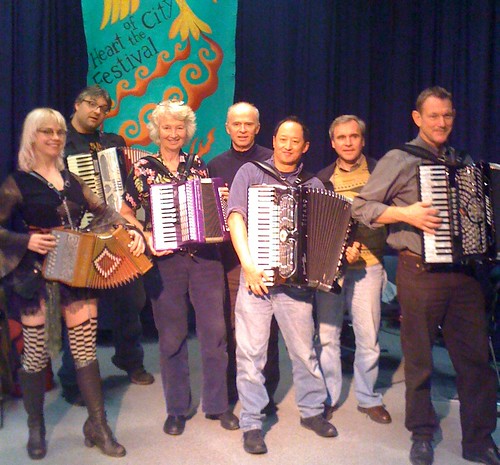
First Nations, Chinese, Hawaiian, Ukranian, and British ethnicities and cultures mix together at Heart of the City Festival.  David Nahanee's First Nations family gave the opening welcome and drumming to open the festival.  Savannah Walling and Terry Hunter (back row) are the festival's founders and artistic directors.  Todd Wong (right) was guest accordionist.

William Nahanee explained to me that his family name is of Hawaiian origin, as Hawaiians had come to BC with traders, and settled into the Squamish Nation.  It is now a common name, he explained to me when I told him I had a friend named Nahanee in grade 8. 

I played solo accordion in the second half of the program.  I started out with the Chinese folk song Mo Li Hua (Jasmine Flower), then a version of Scotland the Brave.  Terry Hunter had give me an introduction to the audience mentioning how I am the creator of the Gung Haggis Fat Choy Robbie Burns Chinese New Year Dinner, so I explained that I wanted to acknowledge that Chinese and Scottish pioneers were the founding pioneer cultures of British Columbia – not English and French as in Eastern Canada.  I explained that my great great grandfather had come to Canada and ministered at the Chinese United Church, just up Pender St. It has been a pleasure to participate in the Heart of the City Festival, and I wanted to acknowledge the immigrant groups that have settled in Strathcona and the Downtown Eastside.  The next songs I played were J.S. Bach's Toccata in D Minor and the St. Louis Blues, to acknowledge German and American pioneers to Vancouver, and especially Jelly Roll Morton who had lived at the Patricia Hotel over on Hastings St.


The Ukranian Folk Orchestra played a number of songs for the concert.  Conducted by David Ho, who is Chinese, most of the members are of Ukranian ancestry, and all share an appreciation for Ukranian folk music.  Instruments included flute, violin, lute, mandolin, guitar, drum & percussion.  Sadly, they no longer have an accordion player, which prompted one of the band members asked me to join them.

2011_Ukranian 003

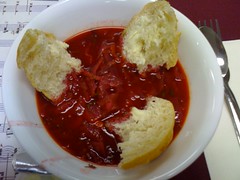
Bortsch soup, made from beets – a Ukranian staple, that I first had many many years ago made by a high school friend.

2011_Ukranian 007

Cabbage rolls!

2011_Ukranian 010

No Ukranian dinner would be complete without perogies.  One of my favorite foods I like to keep stored in the freezer, and smother them with cream cheese.

2011_Ukranian 012

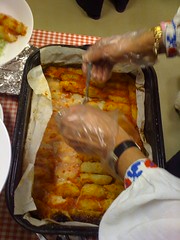
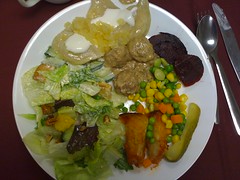
Here is the completed dinner with salad, meat balls, beets, cucumbers, cabbage rolls and perogies!

Accordions at Heart of the City Festival

Accordions took over Carnegie Centre
for the Heart of the City Festival event
“Accordion To Immigrants”


Vancouver Squeezebox Circle performed Nov 5th at Carnegie Centre – l-r special guest Renee de la Prade of  “Accordion Babes” from California, Rowan Lipkowits, Ans, Glen, Todd Wong, Franz Gerber, Halke Kingma, (missing from photo is Alan Zisman) - photo Deb Martin

Fantastic accordion concert at Carnegie Centre…. with Vancouver Squeezebox Circle. We alternated solos and group songs. 

The inspiration for the event was to tell the story of 125 years of immigrants to Vancouver's Strathcona and Downtown East Side neighborhoods.

My solos were: St. Louis Blues and JS Bach's Tocatta in D Minor – +
Hungarian Dance #5 (turned into a duet with Halke Kingma whom I had never played
with before, and who hadn't played the song in 15 years.

Best unexpected moment was when Renee de la Prade joined us on stage to sit in – and I asked her if she would like a solo spot.  She stood up to play and sing an Irish whiskey song, then followed up with a Celtic Reel.

“How do you follow that?” I asked the audience, and performed JS Bach's Tocatta in D Minor, which the sound tech added some reverb through the microphone and sound systems to make the performance sound like we were in a big church.  Renee later complimented me on the performance, saying she really liked it.

2nd Best unexpected moment – was acknowledging that Jimi Hendrix had lived in Strathcona / Hogan's Alley at his grandmother Nona Hendrix's home, then having Rowan performing “Purple Haze” with a surprise bridge excerpt of “Star Spangled Banner”

Vancouver Squeezebox Circle performs 1:30pm Saturday Nov 5 @ Carnegie Centre

Accordion and Vancouver's 125 year History of Immigrants
2009_Sept_Accordion_Noir_Festival 044 by you.
Accordions
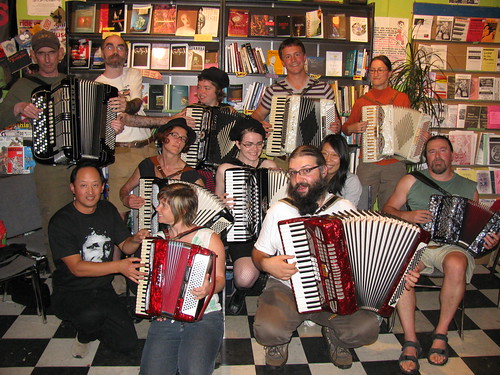
“Squeeze Box Circle” is led by Rowan Lipkovits (front right with big
red accordion) at Spartacus Books.  I am in the front row kneeling wearing a black Terry Fox t-shirt, with my hand on Elena's beautiful red accordion! Usually the 1st Thursday of the
month – this session was Sept 10th 2009 as a special part of the Accordion
Noir Festival.

Come see the Vancouver Squeezebox Circle perform at Heart of the City
Festival.  We have been practicing for a month to create group
performances to represent songs from Italian, Chinese, Japanese,
Russian, Irish, Ukranian communities that have settled into Strathcona
and DTES neighborhoods over 125 years.  Plus we have some great solo
pieces to represent German, Italian, Jewish, Dutch communities and
more!!!

Spoiler Alert !  I am playing solo versions of JS Bach's Tocatta in D Minor + St. Louis Blues
http://www.heartofthecityfestival.com/saturday-november-5/

Group Songs are:

Mo Li Hua (Chinese)
O Solo Mio (Italian)
Freylach (Jewish)
Dark Eyes / Ochi Chyornye (Russian Song)
Bandura (Ukranian song)
Buddy Bowden's Blues (American)
Can Can (we will do as a group accordion march – outdoor to four
corners of Main & Hastings Street and into the Carnegie Theatre for
1pm)
Neil Gow's Lament (Scottish)
Sakura – (Japanese)
La Bastringue / Reel des Ouvrieres (Quebec)

We had a preview in the Georgia Straight by Alex Varty

Cultures tangle in the Heart of the City Festival's Trisurgence


Straight.comAlexander Varty - 27 Oct 2011

The brainchild of fifth-generation Vancouverite Todd Wong and members of Vancouver's burgeoning Squeezebox Circle, this free event uses the humble accordion

Hapa-Palooza literary event with Fred Wah, Joanne Arnott and Tanya Evanson

Hapa-Palooza poets helps celebrate Vancouver 125

The largest meeting room at the downtown Vancouver Public Library was full.  Anna Kaye Ling was moderating questions from the audience to poets Fred Wah, Joanne Arnott and Tanya Evanson.  Ling is one of the co-founders of the brand new Hapa-Palooza Festival, and is also a director for Asian Canadian Writers' Workshop – the sponsoring organization, that helped submit the grants to Vancouver 125.

Each of the poets grew up from mixed race ethnic backgrounds.  Wah is Swedish/Chinese/Scottish/Irish, Evanson is Black/Mixed Caucasian and Arnott is Metis/Mixed.  I've known Fred Wah since 2003, when Asian Canadian Writers' Workshop presented him with the ACWW Community Builder Award.  A few years later, I invited Wah to be the featured poet at the 2005 Gung Haggis Fat Choy Robbie Burns Chinese New Year Dinner.

It would be simple if as the last person from the audience to ask a question, suggest that we forego all labels of race or ethnicity and simply “recognize each other as human beings.”  But poetry and experience that addresses growing up mixed-race isn't that simple.  Humankind has always created a sense of “otherness” to shun those “not like us.”  Wah's award winning poetry books “Diamond Grill” and “is a door” both address the joys and pitfalls of “looking different”.

While the topic of racism, and not fitting in on both your mother's side, and your father's side, was upsetting to some members of the audience, there was a larger sense that this was community.  It was a community of recognition.  It was a community of meeting other people like themselves.  It was a community that was saying “our time has come,” as Canada's first Festival celebrating Mixed Ancestry kicked off it's first of 4 days.

Hapa is a Hawaiian term meaning Half.  It is historically used to describe somebody as hapa haole (half white), but recently it has been used to describe somebody who is half Asian or Pacific Islander.  But now it being used to describe a new emerging tribe of Hapa-Canadians, and their culture – similar to the use of the word Metis.  Historically, Metis was used to describe anybody of First Nations and European heritage.  These people were not fully accepted in either culture, and thus created their own.  And today Hapa is doing the same.

I looked around the room, and saw many Hapa Canadians that I knew, didn't know, and some who were my friends.  Rema Tavares, founder of www.mixed-me.ca had flown out from Toronto to excitedly attend this festival.  Brandy Lien Worrall was holding her new 4 month old Hapa baby, born of Hapa-Vietnamese-Chinese-Pensylanvian Duth, and Hapa-Filipino parents.  Ricepaper Magazine (published by ACWW) was there with our managing editor Patricia Lim, and intern Cara Kuhane – who is a Hawaiian born Hapa.

And I saw my cousin Tracey.  We are both descended from Rev, Chan Yu Tan, our great-great-grandfather who came to Canada in 1896.  Her father is Anglo-Canadian.  When she graduated from high school, as a present, I took her to see the play Mixie and the Half-Breeds, written by my Hapa friends Adrienne Wong and Julie Tamiko Manning.  Tracey enjoyed it tremendously, as it addressed issues of mixed race identity.  Afterwards we went out to eat with Julie and Adrienne.  It was one of the first times Tracey got to meet Hapa artists who actively developing Hapa culture!  Tonight, my little cousin Tracey, is in 3rd year university, and embracing her Hapa-ness by volunteering as a photographer for the festival. 

I introduced Tracey to poet Fred Wah, then in the audience we said hello to poets Roy Miki and Daphne Marlatt.  I introduced her to the co-founders of the Hapa-Palooza, my Hapa friends Jeff Chiba Stearns, Zarah Martz and Anna Kaye Ling.  This is my community, which recognized and embraced her as Hapa.  They commented how wonderful it was that Gung Haggis Fat Choy was one of the inspirations for Hapa-Palooza, and how my Hapa cousin was possibly one of the inspirations for me creating Gung Haggis Fat Choy, as I had wanted to create an event that was inclusive for my family members who were Scottish and Chinese and Hapa.

If more families had members who were of diverse ethnic ancestry, and had more Hapa children – then hopefully there would be less racism.  Because if everybody is related and inclusive to every other race, then it would be harder for politicians to pass laws and legislation such as the Chinese head tax, the Chinese Exclusion Act, the Potlatch Law, the internment of Japanese Canadians, and excluding First Nations from voting until 1960… as Canada did in the 19th and 20th Centuries – because you're gonna hear it from your in-laws!

http://hapapalooza.ca/wednesday/

Vancouver Sun story about architect Joe Wai and Dr. Sun Yat Sen Gardens

Fantastic
recognition for my role model and “biu-goh” (older cousin) – architect Joe Wai.
Now you can see where I get all this East West fusion stuff – It's in
the family. Our grandfather Wong Wah came to Canada in 1882, at age 16, in Victoria.

East is East and West is West, and 25 years ago the twain met


To
celebrate its 25th anniversary, the Dr. Sun Yatsen Classical Chinese
Garden held a Founders reception Friday afternoon, and in attendance
were old friends Joe Wai and Marwyn Samuels. Samuels flew in from his
home in China for the event. Wai flew in from his office on Homer
Street.


To
celebrate its 25th anniversary, the Dr. Sun Yatsen Classical Chinese
Garden held a Founders reception Friday afternoon, and in attendance
were old friends Joe Wai and Marwyn Samuels. Samuels flew in from his
home in China for the event. Wai flew in from his office on Homer
Street.

Two people could not be less alike. Wai is an architect.
Samuels, at present, is a movie producer. Wai was born in Hong Kong and
grew up in Vancouver. Samuels, a Jew who was born in New York, got his
PhD in Chinese Studies at the U. of Washington and came to Vancouver as a
UBC professor in 1974. Wai speaks Cantonese. Samuels speaks Mandarin.
Wai's wife is white. Samuels, in his two marriages, married a Filipina
and a Chinese national. They appear to inhabit two different sides of a
cultural divide, but what those sides are is difficult to say. East and
West are not as twain as they used to be.

In the late 1970s,
events brought Wai and Samuels together. The City of Vancouver had
vacant land at the edge of Chinatown, and wanted to build a park for the
Chinese community. Complicating matters was a bitter political divide
within the Chinese community itself -between a pro-Taiwanese faction and
a pro-mainland China faction.

Samuels was thrust in between the
two. The idea of building a Chinese garden had been suggested, so the
City appointed a three-man advisory committee with one representative
from each faction, and Samuels, who acted as intermediary.

Samuels,
as it turned out, may have been the only person in town to have seen a
classical Chinese garden in situ. He had visited China in 1973 and 1975
on study grants, just as the country was beginning to open up to North
Americans. He made important political contacts while he was there -he
met Premier Zhou Enlai, for one -and it was his idea to have Chinese
artisans build a replica of a Ming Dynasty-era garden here.

“Most
of the existing classical gardens [in China] were built in the 16th
century,” Samuels said, “when China was then part of the global economy.
And most of the gardens were built by very wealthy merchants.”

In
time, Wai, who was vicechairman of the Chinese Cultural Centre, would
be brought on as architect for the park surrounding the garden, and
would also be responsible for adapting the garden's ancient techniques
to modern building codes.

But first they had to get the money to
build it. And it would be built as a symbol between the city's two
communities. “Joe and I,” Samuels said, “decided that this should not be
a Chinese community project, but that it should be a whole community
project, that the Chinese community and non-Chinese community should act
together for the first time on a major project like this, and also that
the city's corporate elite get involved.

“I was always conscious of this cultural mix.”

They needed about $6.7 million. A garden society was formed and a fundraising drive was started.

Then the recession of 1981 hit. The donations dried up.

“But
we weren't about to give up,” Samuels said, “and Joe and I became
allies in this. You know the Yiddish word 'macher'? It's like a fixer.
Essentially, Joe, who had good political connections to the city
government and elite, was the local macher, and I was the China macher.”

At
one point, money was so tight that Li Ka-shing, who was developing land
around the garden, offered to buy it as a centrepiece to his
development. The offer was turned down. At another point, they had to
resort to barter. One corporate donor, a forestry company, sent off a
shipment of raw logs and pulp to China as payment.

They needed
more than just donations from the Chinese community, so Wai worked his
contacts within the non-Chinese community, among them Anne Cherniavsky,
wife of Peter Cherniavsky, head of BC Sugar. Wai and Samuels showed her a
design of the garden, and she brought her friends on board. And Wai won
an important donor in David Lam, former B.C. lieutenant-governor.

Lam
donated $1 million, but only on the condition that it would be the last
million donated. Wai and Samuels first had to prove they could get the
garden built.

“We were really desperate for money at the time,”
Samuels said, “and Joe set up two meetings with Lam. When Lam donated
his own money, his commitment to do that was sufficient to get other
people to come in.”

The society -and both Samuels and Wai stressed
that the garden was due to the hard work of many people -finally raised
most of the money. Fiftythree Chinese master craftsmen flew to
Vancouver and built the garden using traditional methods -no glue, no
screws, no power tools.

Wai would resume his architectural work.
Samuels would move to China in 1994 and marry his second wife, a former
movie actress. They now finance and produce movies together.

Oddly,
both men made a similar observation about the garden and its
relationship to Vancouver's Chinese community. It was the first major
cross-cultural project that the Chinese and non-Chinese communities
endeavoured to build, and as such, had a potent symbolism attached to
it. But in the intervening years, the Chinese community has grown so
different and so quickly that Wai and Samuels wondered at the garden's
relevance to it.

“It seems to me,” Wai said, “that the newer
members of the Chinese community aren't as involved in the garden. As a
community, I don't think we know where we're going.”

“That issue
is quite common in China,” Samuels said. “So much has changed so quickly
there that there is this crisis of identity -who are we and where are
we?” It was wealthy Chinese merchants that built the last classical
Chinese gardens in the 16th century. Now, the wealthy Chinese merchants
of the 21st century were moving here.

A classical Chinese garden
to them, Samuels said, was ancient history. Why, having left it behind,
would they necessarily be interested in it when they came here?

pmcmartin@vancouversun.com

Vancouver Sun: 10 Legendary Vancouverites

Do you know these 10 legendary Vancouverites?
Vancouver Sun article includes Yip Sang, Mary Lee Chan, Wong Foon Sien

Check it out at: Vancouver Sun: 10 Legendary Vancouverites
: http://www.vancouversun.com/legendary+Vancouverites/4567105/story.html


Here are my personal connections to Joe Fortes, Mary Lee Chan, Yip Sang, and Dal Richards.

I learned the story about Joe Fortes when I first worked at the Joe Fortes Library when I started as a teenager.  I can answer trivia questions that his baptized name was “Seraphim”, and he was one of Vancouver's most beloved life guards of English Bay.  Here's a great video of Joe Fortes by Global TV's Mike McCardell.
Mary Lee Chan
I am friends with the children of Mary Lee Chan, and descendants of Yip Sang.  Mary Lee Chan's story about saving Strathcona neighborhood from Free way Destruction is wonderfully captured in the film documentary “Mary Lee Chan Takes On City Hall“.   There is a current campaign to name the newly proposed library in Strathcona neighborhood after Mary Lee Chan: http://buildingopportunities.org/blog/index.php/tag/mary-lee-chan/
Here's a link from historia Chuck Davis' Metropolitan Vancouver http://www.vancouverhistory.ca/archives_strathconaSaved.htm.

Yip Sang was an important figure for the building of CPR Railroad, and Vancouver Chinatown development.  The Yip Sang family reunion is also legendary.  I contacted descendant Hoy Yip when I started organizing a family reunion for the Rev. Chan family descendants for 99 and 2000.  Descendant Steven Wong (on his mother's side) paddles on the Gung Haggis Fat Choy dragon boat team. Vancouver Archives has the Yip Sang project online: http://vancouver.ca/ctyclerk/archives/digitized/Yip_Sang/index.htm

Wong Foon Sien was a pioneer in fighting for the repeal of the Chinese
Excusion Act in 1947, and asking for redress for the Chinese Head Tax. 
Here's a good story about Wong Foon Sien, by my friend Larry Wong
http://www.vancouverhistory.ca/archives_foon_sien.htm

Dal Richards at the 2010 Canada Day celebrations at Kitsilano Showboat stage – photo T. Wong

I have known Vancouver-born Dal Richards for the past few years from our roles on Canadian Club Vancouver.  I had the honour of being included with Dal for the BC Royal Museum's “The Party”centrepiece display for the 150th anniversary
exhibition – titled Free Spirit: Stories of You, Me and BC – The Party featured 150 British Columbians who’ve helped shape the province. http://www.royalbcmuseum.bc.ca/Content_Files/Files/Press%20Room/stories/RBCMNewsletterAugv6.pdf

Nobody born in Scotland?

Lachlan Hamilton, CPR surveyor and alderman might have been of Scottish ancestry, as were many of Vancouver's pioneers, but a google search isn't revealing anything so far.  Sam Greer is listed as born in Ireland.  Major Skitt Matthews, who started the Vancouver Archives, was born in Wales.

A google search on Alfred Larwill reveals more about the history of Larwill Park, formerly the Cambie street Grounds, and now a parking lot, and the proposed site of a new Vancouver Art Gallery, where the Olympics hosted the Live City Downtown site.

Interesting how 3 of the 10, were evicted (or almost) from their homes: Larwill from the Cambie Street Grounds, Greer from the CPR lands, and Fortes nearly from his shack on English Bay – if not for a blockade of 100 people.  His house was moved to the present location of the English Bay bandstand, where a plaque now commemorates Joe Fortes.