Category Archives: Main Page

Gung Haggis Fat Choy dragon boat team development – as of May 21

Gung Haggis Fat Choy dragon boat team development – as of May 21


We have now done 8 weeks of training leading up
to full race pieces at Lotus Sports Club's “Bill Alley Memorial
regatta,” at Barnet Marine Park.


Yes, the May 20 regatta was a
test drive.  We have a lot of rookie paddlers with enthusiasm, but
didn't yet know what a race was all about.  Now they do, and they don't
want to finish last…


This early in the season, we are racing
against experienced teams.  We will more beginner and novice team competition in all the
next races.  BUT…  we want to improve.  A Lot!


ENDURANCE


Last week we moved into the “strength and endurance” phase of our
program, with our first full 3 minute race piece. We will be doing race
pieces every practice from now on.  Build your endurance by doing cross
training exercises, such as running, swimming or bicycling.  Last week
I tried a stationary wheel chair for the paralympics and Olympics
display at the Vancouver Art Gallery front lawn.  It was challenging
going 3 minutes, but I used my mental training exercises to break it
down into counts of 10, then another. Key words and number counts
really help to keep a focus during endurance races.  Sports Psychology
really helps!


STRENGTH & POWER


Starts are all about strength.  We began “starts” training 2 weeks
ago.  People know how good starts feel, and what they need to do.  Leg
Drive, Bums up, Lean out, Grunt and Yell!


Push ups will build
the deltoid muscles for top arm drive.  Crunches will help build the
lower back and abdominal muscles for hip drive.  To build quadricep
(thigh) muscles – try plyometrics – jumping… as well as running start
sprints and bicycle sprints uphill – uphill increases the resistance
and makes you work harder.


For weight training, asking Dan and
Jonas to help create a training program or a dryland workshop is a good
idea.  Especially try a weight machine – use the “rowing” functions
with a straight arm to emphasize your hip.
  For top arm drive – use the “pull down bar”, as well as “arm flys” to
work your deltoids.  Use the “leg press” for quadriceps. 


TECHNIQUE


We are now past the “technique” phase of our training. Practices from
now on will NOT emphasize technique drills – but may incorporate them
when needed.  Practices from now on focus on RACE TRAINING.  We will be
doing race pieces, and race strategies. 


But… for the
large numbers of beginners – we can start up a technique practice for
Fridays 6pm.  But I might have to train some assistant coaches for
relieve me for “Friday night dates with my girlfriend” – especially
when I have to review or attend an event.  Coaching 3 X week can be
hard on a social life.  Maybe Friday nights will become our “social
night” where we can do movies and bowling, as team members have
suggested.  It's also an excellent way to invite your friends to join
us.


TEAM DEVELOPMENT


I am really pleased at how the “team” is developing and integrating. 
Thank you again to Dan for bringing smokies to the regatta, Joe for
bringing the tent and hosting the after-bbq.  The tent was excellent
for storing bags, and there were even two paddlers napping in the tent
while we took team pictures on the beach.


The best teams
always recognize that everybody is important.  Everybody offers
something: Power, strength, wisdom, experience, as well as cookies,
drink, fun, humor and friendship.


Please ensure that you get
to know all the new paddlers, and the veteran paddlers.  If you see
somebody on their own – please check on them, sometimes they are just
shy.  Good teams are like extended families.  “Ohana” is hawaiian for
“family spirit”.  It is the team motto for the Portland race team Kai
I'kaika, and also a theme from the movie Lolo and Stitch.  “Ohana
means, no-one gets left behind.”  “Lolo & Stitch” would be a good
video night suggestion.  It fulfils the multicultural component with
Hawaiian culture. 


ENDURANCE


Last week we moved into the “strength and endurance” phase of our
program, with our first full 3 minute race piece. We will be doing race
pieces every practice from now on.  Build your endurance by doing cross
training exercises, such as running, swimming or bicycling.  Last week
I tried a stationary wheel chair for the paralympics and Olympics
display at the Vancouver Art Gallery front lawn.  It was challenging
going 3 minutes, but I used my mental training exercises to break it
down into counts of 10, then another. Key words and number counts
really help to keep a focus during endurance races.  Sports Psychology
really helps!


STRENGTH & POWER


Starts are all about strength.  We began “starts” training 2 weeks
ago.  People know how good starts feel, and what they need to do.  Leg
Drive, Bums up, Lean out, Grunt and Yell!


Push ups will build
the deltoid muscles for top arm drive.  Crunches will help build the
lower back and abdominal muscles for hip drive.  To build quadricep
(thigh) muscles – try plyometrics – jumping… as well as running start
sprints and bicycle sprints uphill – uphill increases the resistance
and makes you work harder.


For weight training, asking Dan and
Jonas to help create a training program or a dryland workshop is a good
idea.  Especially try a weight machine – use the “rowing” functions
with a straight arm to emphasize your hip.
  For top arm drive – use the “pull down bar”, as well as “arm flys” to
work your deltoids.  Use the “leg press” for quadriceps. 


TECHNIQUE


We are now past the “technique” phase of our training. Practices from
now on will NOT emphasize technique drills – but may incorporate them
when needed.  Practices from now on focus on RACE TRAINING.  We will be
doing race pieces, and race strategies. 


But… for the
large numbers of beginners – we can start up a technique practice for
Fridays 6pm.  But I might have to train some assistant coaches for
relieve me for “Friday night dates with my girlfriend” – especially
when I have to review or attend an event.  Coaching 3 X week can be
hard on a social life.  Maybe Friday nights will become our “social
night” where we can do movies and bowling, as team members have
suggested.  It's also an excellent way to invite your friends to join
us.


TEAM DEVELOPMENT


I am really pleased at how the “team” is developing and integrating. 
Thank you again to Dan for bringing smokies to the regatta, Joe for
bringing the tent and hosting the after-bbq.  The tent was excellent
for storing bags, and there were even two paddlers napping in the tent
while we took team pictures on the beach.


The best teams
always recognize that everybody is important.  Everybody offers
something: Power, strength, wisdom, experience, as well as cookies,
drink, fun, humor and friendship.


Please ensure that you get
to know all the new paddlers, and the veteran paddlers.  If you see
somebody on their own – please check on them, sometimes they are just
shy.  Good teams are like extended families.  “Ohana” is hawaiian for
“family spirit”.  It is the team motto for the Portland race team Kai
I'kaika, and also a theme from the movie Lolo and Stitch.  “Ohana
means, no-one gets left behind.”  “Lolo & Stitch” would be a good
video night suggestion.  It fulfils the multicultural component with
Hawaiian cultur


Hmmm…. what would a Gung Haggis Fat Choy Hawaiian luau party look
like?  Can anybody volunteer a backyard party?  We can have kalua pig,
roasted by hot rocks and buried in the ground.  Julie can teach us
polynesian dancing, and we can learn to play ukelele and Hawaiian slack
key guitar.  I can play “Hawaiian Wedding Song” and “Lovely Hula Hands”
on my accordion.  We can trade in the kilts for Hawaiin grass skirts.

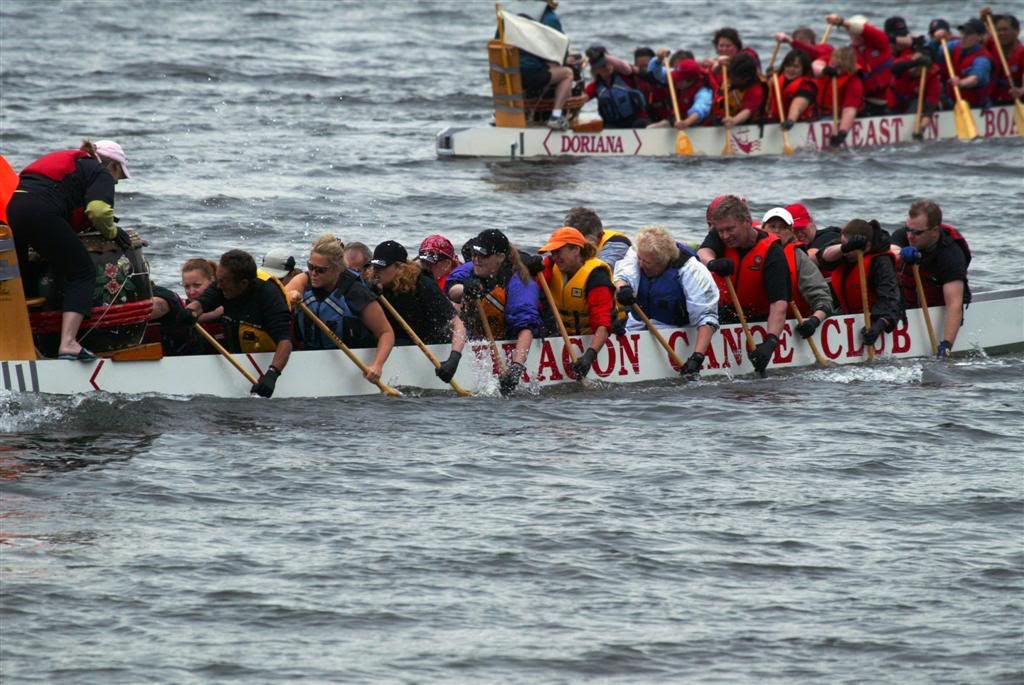
Gung Haggis Fat Choy dragon boat team at Lotus Sports Club's dragon boat regatta at Barnet Marine Park

Gung Haggis Fat Choy dragon boat team at Lotus Sports Club's “Bill Alley Memorial dragon boat regatta” at Barnet Marine Park

The Gung Haggis Fat Choy dragon boat team – front row: Carolyn, Wendy, Rita, Gail and Natalie. 
Standing: Anne-Marie, Julie, Jonas, Steven, Jim, Dave, Daming,
Jennifer, Joe, Sonja, Todd, Stephen, Constance, Deb, and Dan.  – Photo courtesy of Lotus Sports Club

The Lotus Sports Club's Bill Alley Memorial Dragon Boat Regatta
is always a fun friendly race.  Chilliwack and Ft. Langley teams
really support it well.  I have attended many years with different
teams.  Celebration in 98, 99, and 2000, Civil Serpents in 2001,
Spirit of Vancouver in 2004, spectator for 2005, and finally with Gung
Haggis team in 2006.  The Lotus Sports Club
is where I first
learned to paddle a dragon boat in 1993 with the Hamazaki Wong
Headliners team.  Grace Morisette was my first coach, and Lotus
people have all become friends over the years, such as Jim McArthur and
Barb Diggins. Friendly faces include Barb Alley, John Park, Carmella,
Jane, Clyde, Cindy, Dean and many many others.  I can also say I
have known Joyce Yeoh and Elton
Pao, since they were junior paddlers.


Our team
really had a lot of fun.  Our rookies were very excited to be in
their first races, our veterans were calm, cool, collected and shared
information.  Dan brought smokies, Joe brought camp stove and
tent.  Dave brought the large Gung Haggis tent.  Food,
shelter and friends – what more can you ask for?  Okay… we had a
team bbq afterwards at Joe's Burnaby home following the regatta.

There
is a prize raffle draw with proceeds going to the Bill Alley Memorial
scholarship.  Bill Alley was a founding member of Lotus, and dedicated
to the Lotus Sports Club.  Each year I help donate prizes to the raffle
and help promote it as an event during Asian Heritage Month.


Format is
round robin for first 3 races + Finals – so you get to race each of the other
teams + have your own category, for a total of FOUR races.  That's
a lot in a day for brand new rookie paddlers!


For the race finals you are put into one of each category:  Junior, Women's, Mixed or Seniors.  Seeding is decided by cumulative race times.  The Open category is decided by the cumulative race time that is the fastest!


Our
friends “The Pirates” led by left stroke and captain Ian Paul (in
front), leading the Gung Haggis Fat Choy dragon boat team (in
back).  Notice how deep the Pirates paddles are – getting good
water on their blades, while the Gung Haggis paddles are not as deep or
consistent.  We will have to work on that aspect of our paddle
technique. – photo Ben Lee (see more photos at
http://www.dragonboatwest.net


The
rotation of the races is pretty fast, so that would help discount for
other effects such as tide, wind, officiating, start position.
  But
this is meant to be a FUN regatta, so the start positions were not
overly picky, especially with wind causing drift at the start line.


Teams
swapped paddlers here and there.  Gung Haggis loaned about 10
paddlers
at one point for Smoke on the Water's 3rd race – because the beginner
team from Chilliwack had paddlers that needed to leave or for other
reasons.  Gung Haggis raced 18 paddlers for our first two races,
than
added 2 paddlers in race 3, then raced the final  with 19
paddlers.  It was great to have Nadia join us for our 3rd and 4th
race.  She is a good friend of Wendy, and paddles on Concord
Pacific.  She had met our team members Dan, Pam and Kristine, who
joined Concord for their San Francisco races last August.


Put
this event on your calendar for next year.   FOUR races,  Great Fun,
beautiful pebble beach setting, lots of trees for shade or rain
protection, Friendly hosts, and BBQ friendly!   No medals – just awards
for the top finisher in each category + Top 3 finishers in Open
category, AND a team picture already framed to take home!


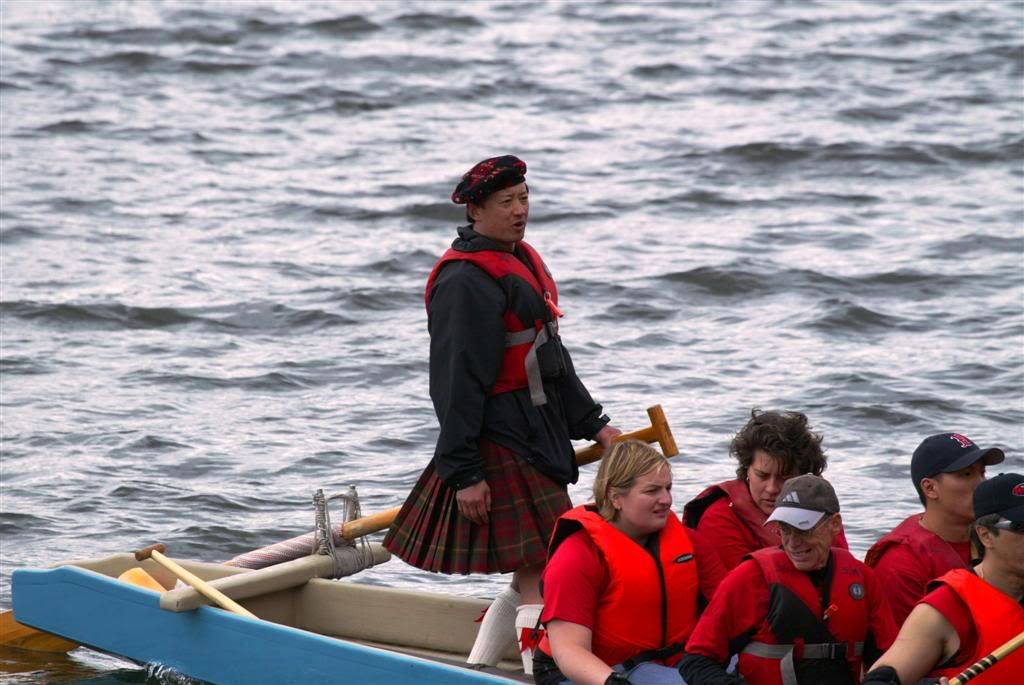
“Toddish
McWong” steering the Gung Haggis Fat Choy dragon boat team.  I only
started wearing the kilt at dragon boat races last year.  It is a Maple
Leaf Tartan made by Bear Kilts.   Sonja and Jennifer (seat 10) in their first dragon boat regatta ever,
and 4th race of the day.  Dave Samis and Jonas in seat 9, Dan Seto in
seat 8.
photo Ben Lee (see more photos at
http://www.dragonboatwest.net/


Officially – there were 16 teams entered

Check out the Lotus Sports Club website

http://www.lotussports.com/page.cfm?PageID=11


Now what were the official results of the FINALS races?   (this is from memory!)


Junior Category –

Lotus Juniors 1 or A  (can't tell the names apart!)

Lotus Juniors A or 1


Women's Category

WOW – Women on Water (Ft. Langley)

Abreast in Barnet


Senior's Division  –


FCRCC Grand Dragons

Dogwood Nothin' Dragons (Coquitlam)

The Eh Team

Dogwood Nothin' Dragons Challengers

FCRCC Grand Dragons (withdrew and did not race finals)


Mixed Adult – 

Sudden Impact

SOAR – Spirit of a renegade (Ft. Langley)

Chilliwack Thunder Strokers (Chilliwack)

Pirates  (Chilliwack)

Lotus Mixed

Gung Haggis Fat Choy

Smoke on the Water (Chiliwack) (withdrew and did not race finals)

Gung Haggis Fat Choy dragon boat team is going to Barnet Marine Park, May 20 for Lotus Sports Club “Bill Alley Memorial dragon boat regatta”

Gung Haggis Fat Choy dragon boat team is going to Barnet Marine Park,
May 20 for Lotus Sports Club “Bill Alley Memorial dragon boat regatta”

Gung Haggis Fat Choy dragon boat team is going to the
Bill Alley Memorial Race.  I did know Bill, and Lotus Sports Club is
where I first learned to paddle, and I have lots of friends there.


This is a fun dragon boat regatta and
perfect to create a festival atmosphere.  The Barnet Marine Park
has lots of trees, a beach, and great views of the water.  We will
set up a tent along the beach or under the trees – for good viewing of
races.


Race Times – REVISED!!!!
 
1st race – 9:40
2nd race – 10:45
3rd race – 12:30
Final Mixed Teams
2:15 or2:30
Award presentations 3:00
… then go to Joe's!

Racers – Remember to bring:
 
1 – sun screen
2 – rain gear
3 – hat
4 – water
5 – extra clothing
6 – extra tent if you have it.
7
– something to eat… (there is a concession stand – but it can be
crowded. – Bring easy to digest foods such as fruits (especially
bananas), snack bars, sandwiches, etc.

 
Where to park?  Where to go?
Here is the Lotus Sports Club website with description
 
Here is a Google Map
 
Here is a description of the event on the website
 
 2006 Bill Alley Memorial Regatta
Join us in our celebration of the 2006 dragon boat season at the ninth annual Bill Alley Memorial Dragon Boat Regatta. This
fun race has become a regular event for many teams. The race schedule is available now! See below for links to the race package and the race schedule.

Regatta Date: Saturday, May 20, 2006 Registration Deadline: May 1, 2006 Early Bird Deadline: April 1, 2006 Regatta Features:
• Every team will participate in a minimum of three races
• Trophies will be awarded to the top 3 overall placements and the winners of each division.
• On-site concession
• Raffle: All proceeds go towards the Bill Alley Memorial Scholarship
Race Contacts:
• Sylvester Lai: rounderz10@hotmail.com
• Jane Yeoh: jyeoh@sfu.ca

Click on the following link to download the Race Package:
2006 Dragon
Boat Regatta Race Package – Revised May 15, 2006
. Please note the changes on the Schedule of Events on pages 3 and 4. (You must have Adobe Acrobat to view this file.)
Click on the following link to download the Race Schedule:
2006 Dragon Boat Regatta Race Schedule – Revised May 15, 2006. (You must have Adobe Acrobat to view this file.)

Joy Kogawa named to Order of BC today!

Joy Kogawa named to Order of BC today!

May 18, 2006
13 People to Receive Order of British Columbia
VICTORIA
– Recipients of the Order of British Columbia for 2006 were announced
today by Lieutenant Governor Iona Campagnolo. Her Honour praised the
recipients as outstanding citizens of B.C. who have contributed to
strengthening the province in a variety of exceptional ways.
Full news release and Backgrounder.

Joy recently e-mailed to me about recieving the award:

I've never received so much attention in my life before.  

It's
got to the point now that one miracle after another after another just
keeps on flowing. I don't know how this blessed life has happened.

Joy recently wrote about what saving Kogawa House means to her:

What the house means to me — these days it's a sense of miracle that surrounds me.
 
The
fact of The Land Conservancy coming along and taking this on, the fact
that it just happened to be that Naomi's Road was made into an opera at
this time, that Vancouver Public Library chose Obasan as the One Book
for Vancouver–these were miracles enough, without it all happening at
this particular time.

 
And
the amazing miracle of the particular people who were drawn to the work
of saving the house — Anton Wagner, Ann-Marie Metten, Todd Wong. So
the house and the cherry tree and all these happenings and people are
signs of miracles and fill me with hope.

 
When
we look at the uncaring in our planet, here is evidence that
relationships can be rehabilitated, the formerly despised can be
embraced.  The dream that writers who are presently among the despised
of the world, can come and write their stories here, fills me with even
more hope.

 
Racism
is a present tragedy in the world, as it has been in the past. Here is
one small way that we can say in Canada, that racism can be overcome.

Latest updates on Kogawa House at www.kogawahouse.com
Donations can be sent to The Land Conservancy at www.conservancy.bc.ca

Todd Wong
Save Kogawa House Committee – Vancouver
604-240-7090

Paul Yee's “Saltwater City” at CBC Radio One Book Club: Important History for a hopeful yet unsettled future

Here are some pictures from Wednesday night's Paul Yee book launch of
Saltwater City for the CBC Radio One Book Club, hosted by Sheryl Mackay
and John Byrnes.

I did write a story… but I hit the button and lost it… time to go to bed now.


Sheryl Mackay, Paul Yee and John Byrnes – taking questions from the audience – photo Todd Wong


Larry Wong hold the page open to a 1987 picture of him taken by Paul Yee.  Marlen Enns sits beside him – photo Todd Wong

Larry Wong, Sheryl Mackay and Wesley Louie, all hold their book copies and smile! – photo Todd Wong


Todd Wong, Paul Yee, and Larry Wong – photo Hayne Wai


Paul Yee holds the new edition cover of Saltwater City next to the old
logo on Walter Quan's t-shirt from the historic 1986 Saltwater City
exhibit, that inspired the book.

Late night dinner in Saltwater City… at Foo's Ho Ho Restaurant in
Vancouver Chinatown, it's the Saltwater City gang + new friends. 
Standing: Gee, Jennifer, Barry Wong, Todd Wong.  Sitting: Rosanne
So, Ramona Mar, Paul Yee, Wesley Lowe, Larry Wong, Walter Quan and
Elizabeth Sheffrin – photo Joanne.

“Music with Marnie”at Vancouver Children's Festival – I meet Marnie!!!

“Music with Marnie”at Vancouver Children's Festival – I meet Marnie!!!


Marnie Grey and Todd Wong – my eyes are closed in bliss! – photo Deb Martin

I went to the Vancouver International Children's
Festiva
l
with my mother and my almost 3 year old nephew.  We went to see “Music with Marnie,” 
Marnie Grey is an incredibly energetic former pre-school worker, who
now headlines her own shows at children's festivals across the country.

Marnie is a friend of my mother's.  They practice Qi Gong together
sometimes.  Marnie and her husband Kevin were caught in the
December 26th Tsunami in Thailand.  Check out her incredible story
of getting hit by the water, running for the hills, and experiencing
the incredible love and support of the Thai people, as well as how
Marnie has found a way to give something back to the Thai community.

Check out Marnie's bio at the Children's Fest.  Better yet – catch her remaining shows on Sunday May 21, or Monday May 22.

The Children's Festival is lots of fun this year.  We also saw
Lolo and
Bob, two fun young women who sing songs about sea animals in a show
called Sea Notes.  We did face painting, and I even bought a large
stuffed animal dragon toy.  One for my nephew… one for me and
the dragon boat team.

Marnie has a wonderful children's album called Groovin' Through the Neighborhood.  It has instantly singable songs perfect for pre-school aged children.  Check out Marnie's album:

My Favorite Marnie Songs are:

1. Marnie and Her Rock and Roll Band
2. Kangaroos
5. Cement Truck Mix
6. Oh the Bump
10. I Yi Yippee Yi Yay
14. Mumbu Where are You?
15. Going to the Moon

Naomi's Road at Seattle Public Library – seen by Joy Kogawa's brother Rev. Timothy Nakayama


Naomi's Road at Seattle PublicLibrary – seen by Joy Kogawa's brother Rev. Timothy Nakayama
 
The following was sent to me by both Joy Kogawa and her brother
Rev. Timothy Nakayama.  He is now a retired minister living in
Seattle.  The story of Obasan is partly autobiographical, and the
character of Steven Kato is a composite character partially based on
Joy's older brother Tim.

Vancouver Opera Touring Ensemble performs “Naomi's Road” composed by Ramona Leungen, libretto by Ann Hodges, and commissioned by Vancouver Opera.

 – Todd
 
“The Rev. Timothy M. Nakayama”  05/15/06 8:52 PM

Monday night, May 15, 2006 8:40 p.m. –
From the Rev. Timothy Makoto Nakayama, Seattle
 
Hi Joy, Todd, and  fellow Seattlelites:
 
My
wife, Keiko, and I returned last Tuesday from our 3-week trip to
Japan.  We are still in jet-lag that keeps us sleepy during the
daylight hours and awake during much of the night and early morning. 
However, our daughter, Tina,  drove us, and brought her son, Taylor,
and we I managed to get to Bainbridge Island by ferry from Seattle
and got to Woodward Middle School after having dinner at a local
Japanese restaurant 0.6 miles from the ferry dock, and then 1.6 miles
to the school  last Friday evening in time to see and hear “Naomi's
Road”.   As a bonus I met and spoke with Mary Woodward in the school
parking lot after we came outside.
 
When
the young performers were confronted with probing questions about the
Japanese-Canadian “camp” experiences and Canadian governmental
attitudes which prompted the “Relocation”,  As one born and raised in
Canada, and an eye witness of the Japanese Canadian “camps”, I couldn't
contain myself and began a response.  After the question period was
concluded the cast took pictures of me with them.  They were somewhat
interested in meeting me as the brother of the author of the little
children's book, Naomi's Road, whose words inspired the development of
this opera.   What they had been describing by singing, acting and
skillfully moving and inter-changing scenic panels on stage, was a
reflection of the past that had occurred!  It stirred my memories!
 
This was my first experience of this opera, and to say the least it was nostalgic.
 
I intend to go tomorrow night to the Seattle Downtown Public Library by 7 p.m. to hear and see it again.
 
Tim.

Joy and Tim Nakayama
as children before internment at 1450 West 64th Ave. in Marpole
neighborhood in Vancouver.  The house will become a writing centre
and writer's retreat known as Joy Kogawa House. photo courtesy of Joy
Kogawa.
 
Sent: Tuesday, May 16, 2006 11:34 PM
Subject: Re: Naomi's Road
Thank
you, Chris, for bringing the mike to me tonight!  I hope my interloping
intervention during the question period was not too inappropriate!  At
least several people came to speak to me afterwards to express their
thanks.  My wife, Keiko, and I didn't stay too long afterwards; I tend
to run out of steam these days, so we try to pick and choose where we
go and what we do! 
 
The operatic
performance was well done.  I noticed the Ninomiya Kinjiro Statue on
the mobile in-set “piano” during the second time I saw this opera, just
as I found myself musing about the vignette about “Roughlock Bill” (a
Canadian Buffalo Bill as it were), about which I commented briefly.  I
found the question about our schooling while in “camp”  an interesting
question.    
 
Best wishes to you, for you and your work!
 

Tim Nakayama.


Rev. Timothy Nakayama and sister Joy Kogawa reunited at the One Book
One Vancouver launch at the Vancouver Public Library Central Branch in
May 2005.  The siblings had not seen each other in 10 years. photo
Todd Wong

 
Wednesday evening, May 17, 2006.  (it's now tomorrow the 18th!)
 
 
Among the questions was one about school during our internment. 
 
I
mentioned that at the beginning there appeared to be no provision for
our education.  Ten women missionaries who came to Slocan City (who had
left Japan for North America because of the war – they had been sent by
missionary organizations from the USA, the UK, and Canada) – now they
were in Slocan City.  They lived in a big house outside the camps but
helped us.  In our gold-mining “ghost town” there was a small St.
Paul's Anglican Church and Parish Hall.  So the women missionaries set
up a school in the Parish Hall for the high school students who were in
their final year whose time in school and opportunity for
graduation was cut off when all of us were sent to “camp”.  So the
women missionaries organized classes in the parish hall to help those
so close to graduation. 
 
The time
went on the war didn't end and we were in the mountain wilderness
without any school.  The authorities must have decided that some things
ought to happen.  The carpenters in the camps were put to work to build
a two storey structure in “Bayfarm”, a camp between the old hotels and
buildings in Slocan City, North of Bayfarm, and “Popoff”, another
camp South of Bayfarm.  The classrooms had green chalkboards in front
with a teacher's desk, and 2-person desks with bench (I remember having
to sit beside a girl at one of those desks). The school in Bayfarm was
given the name of “Pine Crescent School”.  The School Principal was a
young Buddhist Priest, Takashi Tsuji recently returned from Japan where
he had been educated. 
 
In the meantime
high school graduates were rounded up to be trained in a short course
on how to teach by the retired inspector of schools of the Province of
B.C., and recruitment of various persons with skills, such as a
cosmetologist who taught personal cleanliness and hygiene, a
boat-building carpenter who taught us “manual training” (I remember
learning how to draf, and print letters at 60 degrees, how to read
blueprints, how to hammer nails straight, cut straight with a saw, how
to set the blade of a plane and plane wood, how to carve wood, and use
sandpaper, and varnish, etc.).  We had been out of school for about a
year and a half (we didn't know how long we would continue to be in
camp), and many of us wouldn't “apply” ourselves, and the inexperienced
“greenhorn” teachers had a hard time with us, but during the year and
half we continued to be there we did about three year's school work. 
About 10% of us caught up the lost time and got up to the grade level
we had lost. 
 
The
weather was very cold in winter.  There was a stove in each
classroom and I remember seeing the red hot stove pipes.  If we faced
the stove we would feel the heat which was burning hot, but our
backsides remained freezing.  We needed gloves or mits on our hands to
keep them warm, but we couldn't write or print with them on.
 
The
story of “Naomi's Road” ends with our family going to the sugar beet
farming areas of Southern Alberta because we were not allowed to return
to Vancouver.  During the upheaval about 1/6 of our population had been
“repatriated” — “back” to Japan.  These words didn't apply to me so I
resented “repatriation” and “back” to Japan because Japan is not the
land of my birth, and I had never been to Japan in the first place. 
The plan was to close the “camps” as quickly as possible.  Those of us
who had not been repatriated were to be moved “East of the Rockies”. 
At the end of August 1945 we moved to Coaldale, Alberta..
 
Legislsation
in 1949 made sweeping changes in Canada, opening the opportunity of
immigration from all over the world into Canada, no longer with
preferences only from the UK and Europe, but from varous Asian
countries, and we were finally allowed as Japanese Canadians to return
to the 100-mile area along the Pacific Coast that had been designated
as a “protectect area” from 1942 until 1949 (even for 4
additional years after the war had ended.  Also because all our
property had been auctioned off by government order without our
knowledge while we were still in camp, we had no place where we could
go back.  By the time we were allowed to do so, people didn't have the
resources to make such a move, and most were too weary to do so.  Most
stayed where there were now living.  The centre of Japanese Canadian
population by then was Toronto.
 
I
graduated from high school in 1950, so was able to go to Vancouver to
attend the University of B.C.  After graduating I continued at our
theological college adjacent to the UBC campus.  This was the time when
some Japanese Canadians began to return to the Vancouver area so I
assisted the retired Priest, Canon Willam H. Gale who returned to
Vancouver after having helped many people in their resettlement in
Eastern Canada..  We learned by word of mouth about people who were
returning and began to re-group them into a congregation.  Because our
church buildings had also been sold, we were offered the Chapel of the
Blessed Sacrament at St. James' Church in downtown Vancouver East,
where the Japanese work had first begun in 1904.  Fr. Gale led the
Services in Japanese on Sunday afternoons when the church was not being
used by others, and since I couldn't read Japanese just as most of
Canada-born Japanese couldn't,  he gave me a 1926 Ro-maji
(Romanized) Edition of the Japanese Book of Common Prayer so I could
participate in the Services.  We also used St. George's Church in the
Fairview district – one of the areas where the Japanese had once lived
– (near the Vancouver General Hospital) for our work among the young
people.
 
These memories
were aroused by some of the questions after the performance.  These
written recollections are a little fuller than the verbal presentations
I interjected after the performances of the opera at Bainbridge
Island's Woodward Middle School and in the Auditorium of the new
downtown Seattle Public Library. 
 
Tim.


Asian Canadian Culture Online Project: now on video – historic Nov 26 Head Tax redress protest


Asian Canadian Culture Online Project: 
now on video – historic Nov 26 Head Tax redress protest


Check out the ASIAN CANADIAN Culture Online Project.  There is a
whole collection of stories, art projects etc created by Asian Canadian
youth. 

I was really surprised to discover a video of the Nov 26 protest,
against the ACE program proposed by the Liberal Government and the
National Congress of Chinese Canadians – which called for NO APOLOGY
and NO Compensation – only Acknowledgement, Commemoration and Education.

Presently the Conservative government is consulting Chinese Canadians
across the country and promising Apology, Comensation for head tax
payers and spouses.  Hopefully head tax sons and daughters will
not be Excluded from collecting for their predeceased fathers and
mothers who paid the head tax but who did not live long enough for
Apology and Compensation.

Check out this video – if you look and listen carefully, you will see
me holding a megaphone and leading chants of “Apology Now,” “We want
Head Tax Payer Redress”, and even “NCCC – doesn's speak for me!”

Calling for a Just and Honourable Redress


Vancouver, British Columbia

picture:  PM Paul Martin arrives amidst protestors in Vancouver Chinatown

Film Synopsis

On November 26, 2005, government compliant groups met at the Chinese
Cultural Centre in Vancouver to put forward a “no apology, no compensation”
agreement-in-principle between the National Congress of Chinese Canadians
and the Liberal federal government represented by Multiculturalism Minister
Raymond Chan.

Individuals and community groups, representing head-tax payers, their
spouses, descendants and supporters organized a leafletting and information
line at the conference and subsequent photo opportunity attended by Prime
Minister Paul Martin at the SUCCESS complex in Chinatown.

The shorter online version is from a longer report produced by the Saltwater
City Television Collective and broadcast on the Shaw community channel in
Greater Vancouver and Fraser Valley. Thanks to Karin Lee, Donna Lee and Jane
Kokan for use of video footage.


Check more of the great stuff from the Asian Canadian Culture Online Project:

This is a special anthology of written stories by or about Asian Canadian youth.

View Anthologies

This unique short video collection by or about Asian Canadian youth also includes a showcase of talented video artists.

View Youth Videos

These selected short essays about contemporary history and personal experience are reflective of Asian Canadian communities.

View Essays

Toronto Sun: Recalling two who were heroes (story of Kew Dock Yip and Irving Himel who launched appeal of Exclusion Act)

Toronto Sun: Recalling  two who were heroes

(story of Kew Dock Yip and Irving Himel who launched appeal of Exclusion Act)

This
is a good story about how the 1923 Chinese Exclusion Act was repealed
on May 14th, 1947.   This would be a good annual celebration
for Chinese Canadians annually.  I will mark it on my calendar for
next year which will be the 60th anniversary.  Chinese immigration
was still heavily restricted until 1967, but it started the
reunification of families in Chinese Canadian families.


My
brother's older sister was born in Canada, but went to live with
friends in Hong Kong in 1926, because grandfather's business went
through some tough times.  She married a man in Hong Kong, and was
unable to come back to Canada until after the repeal of the Exclusion
Act.  She was then able to bring her 6 children to Canada in the
1950's.  My cousins are great, and  I consider them to be 3rd
generation Canadians like myself because our parents were born in
Canada, and our Grandfather came to Canada when he was 16 years old in
1882.  Some of them have made immeasurable contributions to
Vancouver and Canadian society and I consider them my role models.

Recalling two who were
heroes

Pair helped kill Chinese Exclusion
Act

By BRODIE FENLON, TORONTO
SUN


There was no celebration this week to mark the
59th anniversary of the death of legislation that barred Chinese
immigrants from Canada.

Nor
was there a tribute to the two Toronto lawyers who played a key role
in the repeal of the Chinese Exclusion Act on May 14, 1947.

Yet
every Chinese immigrant in Canada owes a debt of gratitude to Kew Dock
Yip and Irving Himel, two lawyers who fought
and lobbied the Ottawa to amend a law that had all but barred Chinese
immigrants since 1923.

“All the new Chinese who are here today don't
know the history,” said Alfie Yip, 60, an
electrical engineer and son of the late Dock Yip. “Both of them were
social crusaders.”

At
the time, Himel was already a lawyer and a
civil rights crusader. Dock Yip was a law student at Osgoode Hall on his way to becoming
Canada's first lawyer of
Chinese descent. Both had experienced discrimination, Himel as a Jew.

They were also reservists with the Queen's Own
Rifles of Canada and were sharing a tent in Niagara in the early 1940s when the plan to change
the law was hatched, Alfie said.

The
Chinese Immigration Act of 1923 was passed by the Liberal government of
William Lyon Mackenzie King.

It
barred all Chinese immigrants from landing in Canada
except for a few special cases and was enacted on July 1, Dominion Day,
which became known in the Chinese community as “Humiliation Day.”
Instantly, families were divided, some forever.

The
act replaced the hated Chinese head tax, a toll on Chinese immigrants
that began in 1885 at $50 and peaked at $500 in 1904.

Himel and Yip organized a
committee of 20 people from Ontario and B.C. in 1945. They
gathered petitions and travelled to Ottawa to lobby
the government directly. The act was repealed two years later — the
same year Himel helped found the Canadian
Civil Liberties Association.

“It
was an important contribution to a really hideous thing in Canadian
history,” said Toronto lawyer Bert Raphael, a friend
of Himel's until his death in July 2001. He
and Yip died within a week of each other.

“Too often in this country, we forget our
heroes,” Raphael said.

http://torontosun.com/News/Chinese/2006/05/17/pf-1584162.html


//