Category Archives: Multicultural events

ACWW and Ricepaper had a good presence at Word On The Street

Asian Canadian Writer's Workshop had some of their best contributions at Word On The Street Festival
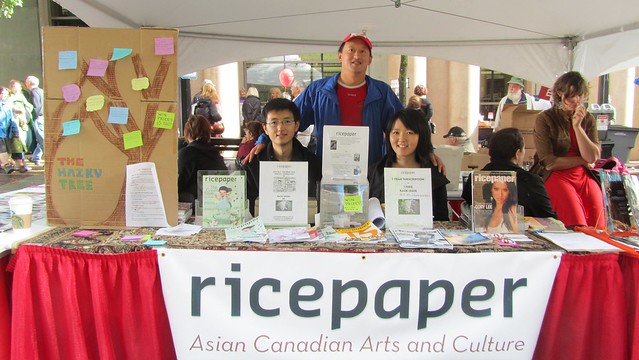
photo

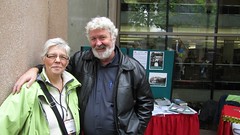
Here I am at the Ricepaper Magazine booth, organized by our managing editor Patricia Lim (right) and assisted by volunteer Jerry Tang (left).  Ricepaper is published by Asian Canadian Writers' Workshop for which I have been a director since 2000-2005 + 2008-2011.

Special
Kudos to director Anna Ling Kaye for moderating on Saturday at Carnegie Centre,
and for managing editor Patricia Lim for organizing and staffing the Ricepaper booth on
Sunday

  • 12:00 :: Ricepaper Magazine with
    Anna Ling Kaye

     Ricepaper’s
    recent Green Issue (16.2) features creative writing and non-fiction
    that revolves around nature, the environment, and landscape. Ricepaper
    magazine is a national quarterly magazine devoted to showcasing Asian
    Canadian artists, writers, performers, and innovators, and is published
    by The Asian Canadian Writers’ Workshop. Writers and poets from Ricepaper will read and share their creative writing.

Usually I will spend some time behind the Ricepaper booth as an ACWW director, but I also helped to staff the booth for Historic Joy Kogawa House where I am president. 

IMG_1173

Joy Kogawa is
currently in town, and made a late surprise appearance at the end of the
day to attend a talk by Susan Crean – the new
writer-in-residence at

Tetsuro attended JJ Lee's reading and gave BIG RAVES!…. I attended
readings by Jen Sookfong Lee, Wayde Compton, and Susan Crean. 
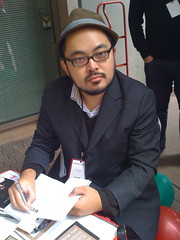
IMG_1698

Kevin Chong signed a copy of his
new book “Beauty and Pity” for me, and I chatted with Evelyn Lau
afterwards (we are having dinner next week, following her reading at
Kogawa House on Sunday).
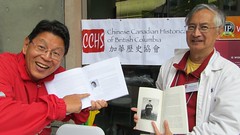
IMG_1084

Bob Sung and Hayne Wai – are both are included in the book
“Chinese Canadian and Aboriginal Pot Luck” (along with ACWW co-president Allan Cho and
myself). Also – I saw local Chinatown historian
Larry Wong, with his new book @ the booth for Chinese Canadian
Historical Society – which I bought from Larry last week.  Larry's book features praise on the back cover, from his childhood and lifetime friend, Wayson Choy.
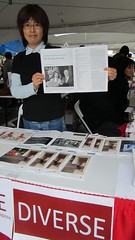
IMG_1124

Myung Lee, publisher of Diverse Magazine, holds up an article about Gung Haggis Fat Choy that I co-wrote with my friend Allan Cho.  Allan also recently submitted
an article about Hapa Palooza, with some quotes from my blog.

IMG_1132

When I saw Anna Ling Kaye, I called her over to introduce Marisa Alps,
an editor at Harbour Publishing.  Marisa is a former long time ACWW
director, and formerly shepherded the ACWW Emerging Writer Award.  She
is also a poet, and contributed to “Swallowing Clouds” the first
Chinese-Canadian poetry anthology, edited by Jim Wong-Chu, that sees its
12th anniversary this year.

Then I introduced Anna to Tradewinds publisher  Michael Katz… Michael
was a driving force behind the young adult anthology “Henry Lee and
Other Stories”.  Michael was immediately taken by Anna's young daughter
Pacific, and he pulled the Paul Yee book “Bamboo” out of my hands to
give to Pacific (saying to me “I'll give you another book”).

My friend Tetsuro Shigematsu (and ACWW board director) was especially affected by JJ Lee's reading today.  Tetsuro wrote on this FB that :
Today at Word on the Street, JJ Lee along with Sheryl MacKay
took a reading and raised it to a new level. The shivering audience
laughed and cried, as JJ spoke entertainingly and insightfully about his
new book, The Measure of a Man, a memoir about his stormy relationship
with his father reconstructed around the rebuilding of his father's
suit. Buy this book. You will love it. I guarantee it. And by
guarantee, I mean I will personally buy the book from you if you don't
love it. (JJ ran out of books to sign afterwards, so I couldn't buy one)
But I know because I read an advance copy!

Word On The Street – is almost swept up by the wind, but prevails!

Great Day at Word On The Street today…
photo

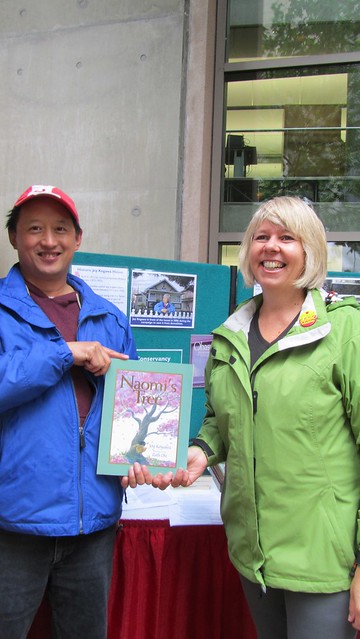
Adrianne Carr, Green Party politician, came by the Historic Joy Kogawa House booth, and told me that her daughter had shared with her Joy's children's book “Naomi's Tree.” “It's a great book” said Carr, as we chatted about the importance of saving historically significant landmarks (such as Kogawa House), and conserving sensitive and important environments – okay, I told her I was a director for The Land Conservancy of BC.

It's always great to see literary friends such as Evelyn Lau, George McWhirter, Renee Saklikar, Brad Cran, Charles Demers, Wayde Compton, Marisa Alps, Kevin Chong, Ariadne Sawyer, Alejandro Mujica + more… Lots of great books and magazines! I did my Christmas shopping to support local book publishers!
IMG_1121

Susan Crean and Hal Wake (Vancouver International Writers Festival) chat in front of the Historic Joy Kogawa House booth – photo T.Wong

Also great to see my friends at the booths such as Historic Joy Kogawa House, Ricepaper Magazine, Chinese Canadian Historical Society of BC, CUPE BC, Tradewind Books, Harbour Publishing, Vancouver Review, BC Book Prizes, VPL Foundation + more!

It was a busy busy Sunday, starting at 10am, because we had moved the dragon boat practice for Gung Haggis Fat Choy dragon boat team one hour early to encourage paddlers to attend events at WOTS.

Deb & I arrived shortly around 1pm to see that the tents for Poetry and Childrens events were flat on the ground.  We later learned that the wind tunnel on Hamilton St had threatened to lift the tents into the air.  After past years of rain, road closures, and a library strike, this will be forever known as the Year of the Wind.

Storyteller Mary Gavan wrote on FB that:

Storytelling in Word in the Street tent. Wind blew. Wind blew and blew; tent flew up; chairs fell down; Persian carpet went into orbit, as per its history.
Storytelling at Word on Street terminated. Area evacuated. All in a
day's story!!!
  First
time in 25 years that anyone can recall the wipe out of part of Word on
the Street (ed. note: tents were taken down for safety and programs moved to other locations). Library staff outstanding in ensuring safety and rehousing
organisations inside with tables to replace their booths. Will write
as a story shortly.

IMG_1706

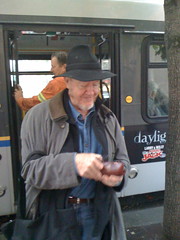
George McWhirters steps off the “Poetry In Transit” bus, where Poetry Tent events were moved to after the tents were “put down” for safety.  George told me that he had arrived at the Poetry Tent 10 minutes before his scheduled event to find the tents flat on the ground!

IMG_1077

Rob Taylor read his poems on the “Poetry In Transit” bus, which didn't have any lights because of a dead battery.  Transit attendants had to herkily-jerkily back up the bus while previously reading poets and host Evelyn Lau were still on the bus chatting with audience.


IMG_1095

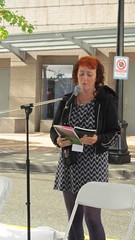
Christine Lowther reads her poems – not on the bus, but in the outdoors –  from her collection “My Nature” at another location instead of the Poetry Tent.

Despite the early morning rain, and the sudden windstorm, this year was lots of fun.  Great programming at WOTS this year.  I was able to help out at the booth for Historic Joy Kogawa House, check in at Ricepaper Magazine, drop in at lots of author readings, chat with friends at the publisher tents, and buy lots of books, as well as scoop up some deals at the silent auction prizes.

I was able to see Jen Sookfong Lee, Wayde Compton, Susan Crean, and many other authors.

IMG_1059

The elegant Jen Sookfong Lee read from her new book “The Better Mother” and also suggested to aspiring writers to never give in to Writers Block, nor interrupt their writing time.  She admitted that she doesn't answer the phone even when she knows her mother is calling.

IMG_1139

Wayde Compton is the current writer-in-residence at Vancouver Public Library.  He spun a particularly captivating story about mixed races.

My friend Tetsuro Shigematsu was especially affected by JJ Lee's reading today.  Tetsuro wrote on this FB that

Today at Word on the Street, JJ Lee along with Sheryl MacKay
took a reading and raised it to a new level. The shivering audience
laughed and cried, as JJ spoke entertainingly and insightfully about his
new book, The Measure of a Man, a memoir about his stormy relationship
with his father reconstructed around the rebuilding of his father's
suit. Buy this book. You will love it. I guarantee it. And by
guarantee, I mean I will personally buy the book from you if you don't
love it. (JJ ran out of books to sign afterwards, so I couldn't buy one)
But I know because I read an advance copy!

Word On The Street Fair features most Asian-Canadian authors yet!

WOTS is featuring the largest number of
Asian-Canadian authors
I have ever seen at this event

Word On The Street – book and magazine Fair
http://www.thewordonthestreet.ca

Friday – come to Kogawa House and meet author Susan Crean
Sunday – join us for Ricepaper booth @ Word On the Street

I always attend WOTS – and can sometimes be found:
1) staffing the ACWW Ricepaper Magazine booth
2) staffing the Historic Joy Kogawa House booth
3) hosting an event
4) listening at an event
5) searching for good book deals
6) searching for good silent auction deals
7) visiting my fellow library co-workers at CUPE 391 and VPL booths
8) one year I played accordion at CUPE 391 booth

Here
is a list of Asian-Canadian writers – + First Nations and Afro-Saxon
(as Wayde Compton describes himself). 
I know each of them – except
Sachiko and Richard.  I have made the list in chronological order, so you can start at 11am with Kevin Chong, and finish at 4:10 with Wayde Compton.

author headshot

Kevin Chong was born in Hong Kong in 1975. He is the author of Baroque-a-Nova, Neil Young Nation, and a forthcoming memoir on horseracing. Beauty Plus Pity is his first novel in ten years.

Kevin Chong is at the Canada Writes at 11:00

author headshot

JJ Lee is the menswear columnist for the Vancouver Sun
and broadcasts a weekly fashion column for CBC Radio in Vancouver. For
years, journalist and amateur tailor JJ Lee tried to ignore the navy
suit that hung at the back of his closet—his late father’s last suit. JJ
Lee will read from The Measure of a Man and…

JJ Lee is at the Authors Tent at 11:30


author headshot

Richard Wagamese is Ojibway but was separated from
his people for 20 years. When they reconnected, elders told him that he
was to be a storyteller. This has led to an award-winning career as a
writer and a journalist.

Richard Wagamese is at the Poetry Tent at 11:30


author headshot

Sachiko Murakami’s first poetry collection, The Invisibility Exhibit,
was a finalist for the Governer General’s Award for Poetry and the
Gerald Lampert Memorial Award. She is a past member of Vancouver’s
Kootenay School of Writing collective and now co-hosts the Pivot Reading
Series.

Sachiko Murakami is at the Poetry Tent at 11:45


author headshot

C. E. Gatchalian is the author of three books of
drama and one book of poetry. His plays have appeared on stages
nationally and internationally, as well as on radio and television. His
most recent undertaking, Crossing and Other Plays contains three plays: Crossing, Diamond and Ticks, that explore themes of sexuality…

C. E. Gatchalian is at the Authors Tent at 12:00


author headshot

Jen Sookfong Lee was born and raised in
Vancouver’s Eastside and is now the voice behind “Westcoast Words,” a
weekly writing column featured on CBC Radio One’s On the Coast and All Points West.

Jen Sookfong Lee is at the Canada Writes at 12:20


author headshot

Evelyn Lau is the author of four volumes of poetry, two works of non-fiction, two short story collections and a novel. Runaway: Diary of a Street Kid was a Canadian bestseller and was made into a CBC movie starring Sandra Oh in her first major role. Living Under Plastic won the 2011 Pat Lowther Memorial Award for Poetry.

Evelyn Lau is at the Carnegie Centre at 1:45


author headshot

Wayde Compton is a Vancouver writer whose books include After Canaan: Essays on Race, Writing, and Region, Performance Bond, Bluesprint: Black British Columbian Literature and Orature and 49th Parallel Psalm. Compton is also a co-founding member of the Hogan’s Alley Memorial Project, an organization…

Wayde Compton is at the Authors Tent at 4:10

Hapa-Palooza literary event with Fred Wah, Joanne Arnott and Tanya Evanson

Hapa-Palooza poets helps celebrate Vancouver 125

The largest meeting room at the downtown Vancouver Public Library was full.  Anna Kaye Ling was moderating questions from the audience to poets Fred Wah, Joanne Arnott and Tanya Evanson.  Ling is one of the co-founders of the brand new Hapa-Palooza Festival, and is also a director for Asian Canadian Writers' Workshop – the sponsoring organization, that helped submit the grants to Vancouver 125.

Each of the poets grew up from mixed race ethnic backgrounds.  Wah is Swedish/Chinese/Scottish/Irish, Evanson is Black/Mixed Caucasian and Arnott is Metis/Mixed.  I've known Fred Wah since 2003, when Asian Canadian Writers' Workshop presented him with the ACWW Community Builder Award.  A few years later, I invited Wah to be the featured poet at the 2005 Gung Haggis Fat Choy Robbie Burns Chinese New Year Dinner.

It would be simple if as the last person from the audience to ask a question, suggest that we forego all labels of race or ethnicity and simply “recognize each other as human beings.”  But poetry and experience that addresses growing up mixed-race isn't that simple.  Humankind has always created a sense of “otherness” to shun those “not like us.”  Wah's award winning poetry books “Diamond Grill” and “is a door” both address the joys and pitfalls of “looking different”.

While the topic of racism, and not fitting in on both your mother's side, and your father's side, was upsetting to some members of the audience, there was a larger sense that this was community.  It was a community of recognition.  It was a community of meeting other people like themselves.  It was a community that was saying “our time has come,” as Canada's first Festival celebrating Mixed Ancestry kicked off it's first of 4 days.

Hapa is a Hawaiian term meaning Half.  It is historically used to describe somebody as hapa haole (half white), but recently it has been used to describe somebody who is half Asian or Pacific Islander.  But now it being used to describe a new emerging tribe of Hapa-Canadians, and their culture – similar to the use of the word Metis.  Historically, Metis was used to describe anybody of First Nations and European heritage.  These people were not fully accepted in either culture, and thus created their own.  And today Hapa is doing the same.

I looked around the room, and saw many Hapa Canadians that I knew, didn't know, and some who were my friends.  Rema Tavares, founder of www.mixed-me.ca had flown out from Toronto to excitedly attend this festival.  Brandy Lien Worrall was holding her new 4 month old Hapa baby, born of Hapa-Vietnamese-Chinese-Pensylanvian Duth, and Hapa-Filipino parents.  Ricepaper Magazine (published by ACWW) was there with our managing editor Patricia Lim, and intern Cara Kuhane – who is a Hawaiian born Hapa.

And I saw my cousin Tracey.  We are both descended from Rev, Chan Yu Tan, our great-great-grandfather who came to Canada in 1896.  Her father is Anglo-Canadian.  When she graduated from high school, as a present, I took her to see the play Mixie and the Half-Breeds, written by my Hapa friends Adrienne Wong and Julie Tamiko Manning.  Tracey enjoyed it tremendously, as it addressed issues of mixed race identity.  Afterwards we went out to eat with Julie and Adrienne.  It was one of the first times Tracey got to meet Hapa artists who actively developing Hapa culture!  Tonight, my little cousin Tracey, is in 3rd year university, and embracing her Hapa-ness by volunteering as a photographer for the festival. 

I introduced Tracey to poet Fred Wah, then in the audience we said hello to poets Roy Miki and Daphne Marlatt.  I introduced her to the co-founders of the Hapa-Palooza, my Hapa friends Jeff Chiba Stearns, Zarah Martz and Anna Kaye Ling.  This is my community, which recognized and embraced her as Hapa.  They commented how wonderful it was that Gung Haggis Fat Choy was one of the inspirations for Hapa-Palooza, and how my Hapa cousin was possibly one of the inspirations for me creating Gung Haggis Fat Choy, as I had wanted to create an event that was inclusive for my family members who were Scottish and Chinese and Hapa.

If more families had members who were of diverse ethnic ancestry, and had more Hapa children – then hopefully there would be less racism.  Because if everybody is related and inclusive to every other race, then it would be harder for politicians to pass laws and legislation such as the Chinese head tax, the Chinese Exclusion Act, the Potlatch Law, the internment of Japanese Canadians, and excluding First Nations from voting until 1960… as Canada did in the 19th and 20th Centuries – because you're gonna hear it from your in-laws!

http://hapapalooza.ca/wednesday/

Early media stories on Hapa Palooza – we got a buzz!

Early media stories on Hapa Palooza

– we got a buzz!

Hapa-Palooza challenges mixed-race stereotypes

Vancouver Sun – Vivian Luk – ‎Sep 7, 2011
The nickname Super Nip – partly derived from a Second World War term to
describe Japanese people – and racial jokes followed Jeff Chiba Stearns
everywhere when he was growing up in Kelowna.

Hapa-Palooza showcases Vancouver's 125 years of cultural passion

The Province – Tom Harrison – ‎Sep 7, 2011‎
This is especially true of Vancouver, where just boarding a SkyTrain is
a multi-cultural experience, or walking the streets can be an
eye-opening exercise in cultural diversity and acceptance.

Hapa-Palooza revels in fest of ethnic mashups

Straight.com – Jessica Werb – ‎14 hours ago‎
Here's to mixed heritage: circus artist Chris Murdoch will be among the
performers at the Hapa-Palooza event's wildly diverse Friday cabaret
night. Growing up, Zarah Martz never felt like she fully belonged.

Hapa-palooza hype builds, but will it deliver?

Open File – Meghan Mast – ‎Sep 6, 2011‎
It wasn't until this year, at age 56, that Jonina Kirton connected her
story with that of other mixed-race women. “I hadn't really put two and
two together that someone else could have almost the same experience as I
had,” says Kirton, who identifies

The Georgia Straight presents Hapa-Palooza

Straight.com – staff –  ‎Sep 6, 2011‎
Hapa is a Hawaiian word to describe someone of mixed heritage from
islands in the Pacific Ocean. And in recent years, it has gone on to
become a term to describe people of multiple ethnicities from around the
world. The following night in the same room

Interracial identities part of the mix at Hapapalooza Festival's Mixed

Straight.com – Craig Takeuchi – Sep 5, 2011

Interracial identities part of the mix at Hapa-palooza Festival's Mixed Flicks Anyways?” are part of the Mixed Flicks program at Hapa-palooza.

Check out the Hapa-Palooza Festival – featuring Mixed Race artists

Hapa-palooza Festival: September 7-10, 2011
A Vancouver Celebration of Mixed-Roots Arts + Ideas

http://hapapalooza.ca/

This is an exciting idea whose time has come.  The seeds were planted at the 2011 Gung Haggis Fat Choy Robbie Burns Chinese New Year Dinner – which featured Hapa-Canadians Jeff Chiba Stearns, Jocelyn Pettit, Patrick Gallagher, and Jenna Chow as artists and co-hosts.

Following the end of the last singalong to Auld Lang Syne, some of our performers and organizers met and discussed the idea of a Hapa-oriented festival or event.   ACWW directors Anna Ling Kaye and Tetsuro Shigematsu (co-host for the evening) were very enthusiastic. 

It was Anna who followed up on the idea and quickly arranged a meeting with Jeff Chiba Stearns.  Zarah helped her as they made an application for Vancouver 125 funding.  I am very pleased that many of the performers featured have also been featured at past Gung Haggis Fat Choy events such as poet Fred Wah, fiddler Jocelyn Pettit and film makers Jeff Chiba Stearns and Ann Marie Fleming.


Wednesday, September 7th, 7:00 –
8:30pm
Location: Alice McKay Room
Vancouver Public Library Central Branch

MIXED VOICES RAISED

Writers, poets and spoken-word artists in dialogue!
FREE EVENT


Thursday, September 8th, 7:00 –
9:00pm
Location: Alice McKay Room
Vancouver Public Library Central Branch
MIXED FLICKS

Explorations of mixed identity in film with mixed actors panel and film
screenings with Q&A from the filmmakers!
FREE EVENT


Friday, September 9th, 7:00 –
10:00pm
Location: Roundhouse Performance Space
THE SIR JAMES DOUGLAS MIX-A-LOT CABARET

A delightful evening of mixed entertainment and celebration!
TICKETED EVENT
* tickets available at hapapalooza.com


Saturday, September 10th
Location: Robson Square
HAPA-PALOOZA IN THE SQUARE

FREE EVENT

12:30-7pm
ART EXHIBITION and COMMUNITY FAIR
Installations by mixed artists and booths from community partners and
related causes.

12:30 to 2:45pm
YOUTH STAGE

Amazing performances by mixed talent of the future!

3:30pm to 7:00pm
GRAND FINALE STAGE

Prepare to be blown away by Vancouver’s incredible mixed talent!

Upcoming Japanese-Canadian Festivals for July

Check out these upcoming events at the National Nikkei Museum
& Heritage Centre.
view image of Nikkei Place

Tanabata
Japanese Star Festival

July 7, 11am-9pm
Celebrate this traditional summer festival by making paper decorations
and writing your wish onto a colourful paper streamer, and then hang the
decoration on bamboo. A fun activity for all ages!

Yukata kitsuke workshop
Saturday, July 16, 2pm

Would you like to wear your Yukata more often to the summer fireworks
and festivals? This is your chance to learn step by step how to put on
your Yukata and look good.
Please bring a yukata, obi, 2 or 3 koshihimo, and wear a t-shirt or tank
top with shorts.
Minimum 3 people, maximum 10.
Parents can learn how to dress their kids. Children over 10 years old
can learn how to dress themself.
Registration fee $10. Tel 604.777.7000

National Nikkei Museum & Heritage Centre
6688 Southoaks Crescent, Burnaby, BC
604.777.7000
www.nikkeiplace.org

Joy Kogawa is giving a reading on Saltspring Island May 14

JOY KOGAWA MAY 14 AT ARTSPRING

Esteemed
Canadian poet and novelist, Joy Kogawa, CM, OBC, will read from her
lifetime of award-winning creative work. Born in Vancouver, her
best-known book is Obasan, a semi-autobiographical novel featuring her
family’s experience of being taken from their normal lives to an
internment camp during WW 2. Joy Kogawa’s first literary reading on Salt
Spring is presented by the Land Conservancy of B.C. to support the
preservation of  Ms. Kogawa’s childhood home
as a heritage site that is also functioning as a writers’ retreat.
Refreshments will be served. Saturday, May 14 at 7pm

Vancouver Sun story about architect Joe Wai and Dr. Sun Yat Sen Gardens

Fantastic
recognition for my role model and “biu-goh” (older cousin) – architect Joe Wai.
Now you can see where I get all this East West fusion stuff – It's in
the family. Our grandfather Wong Wah came to Canada in 1882, at age 16, in Victoria.

East is East and West is West, and 25 years ago the twain met


To
celebrate its 25th anniversary, the Dr. Sun Yatsen Classical Chinese
Garden held a Founders reception Friday afternoon, and in attendance
were old friends Joe Wai and Marwyn Samuels. Samuels flew in from his
home in China for the event. Wai flew in from his office on Homer
Street.


To
celebrate its 25th anniversary, the Dr. Sun Yatsen Classical Chinese
Garden held a Founders reception Friday afternoon, and in attendance
were old friends Joe Wai and Marwyn Samuels. Samuels flew in from his
home in China for the event. Wai flew in from his office on Homer
Street.

Two people could not be less alike. Wai is an architect.
Samuels, at present, is a movie producer. Wai was born in Hong Kong and
grew up in Vancouver. Samuels, a Jew who was born in New York, got his
PhD in Chinese Studies at the U. of Washington and came to Vancouver as a
UBC professor in 1974. Wai speaks Cantonese. Samuels speaks Mandarin.
Wai's wife is white. Samuels, in his two marriages, married a Filipina
and a Chinese national. They appear to inhabit two different sides of a
cultural divide, but what those sides are is difficult to say. East and
West are not as twain as they used to be.

In the late 1970s,
events brought Wai and Samuels together. The City of Vancouver had
vacant land at the edge of Chinatown, and wanted to build a park for the
Chinese community. Complicating matters was a bitter political divide
within the Chinese community itself -between a pro-Taiwanese faction and
a pro-mainland China faction.

Samuels was thrust in between the
two. The idea of building a Chinese garden had been suggested, so the
City appointed a three-man advisory committee with one representative
from each faction, and Samuels, who acted as intermediary.

Samuels,
as it turned out, may have been the only person in town to have seen a
classical Chinese garden in situ. He had visited China in 1973 and 1975
on study grants, just as the country was beginning to open up to North
Americans. He made important political contacts while he was there -he
met Premier Zhou Enlai, for one -and it was his idea to have Chinese
artisans build a replica of a Ming Dynasty-era garden here.

“Most
of the existing classical gardens [in China] were built in the 16th
century,” Samuels said, “when China was then part of the global economy.
And most of the gardens were built by very wealthy merchants.”

In
time, Wai, who was vicechairman of the Chinese Cultural Centre, would
be brought on as architect for the park surrounding the garden, and
would also be responsible for adapting the garden's ancient techniques
to modern building codes.

But first they had to get the money to
build it. And it would be built as a symbol between the city's two
communities. “Joe and I,” Samuels said, “decided that this should not be
a Chinese community project, but that it should be a whole community
project, that the Chinese community and non-Chinese community should act
together for the first time on a major project like this, and also that
the city's corporate elite get involved.

“I was always conscious of this cultural mix.”

They needed about $6.7 million. A garden society was formed and a fundraising drive was started.

Then the recession of 1981 hit. The donations dried up.

“But
we weren't about to give up,” Samuels said, “and Joe and I became
allies in this. You know the Yiddish word 'macher'? It's like a fixer.
Essentially, Joe, who had good political connections to the city
government and elite, was the local macher, and I was the China macher.”

At
one point, money was so tight that Li Ka-shing, who was developing land
around the garden, offered to buy it as a centrepiece to his
development. The offer was turned down. At another point, they had to
resort to barter. One corporate donor, a forestry company, sent off a
shipment of raw logs and pulp to China as payment.

They needed
more than just donations from the Chinese community, so Wai worked his
contacts within the non-Chinese community, among them Anne Cherniavsky,
wife of Peter Cherniavsky, head of BC Sugar. Wai and Samuels showed her a
design of the garden, and she brought her friends on board. And Wai won
an important donor in David Lam, former B.C. lieutenant-governor.

Lam
donated $1 million, but only on the condition that it would be the last
million donated. Wai and Samuels first had to prove they could get the
garden built.

“We were really desperate for money at the time,”
Samuels said, “and Joe set up two meetings with Lam. When Lam donated
his own money, his commitment to do that was sufficient to get other
people to come in.”

The society -and both Samuels and Wai stressed
that the garden was due to the hard work of many people -finally raised
most of the money. Fiftythree Chinese master craftsmen flew to
Vancouver and built the garden using traditional methods -no glue, no
screws, no power tools.

Wai would resume his architectural work.
Samuels would move to China in 1994 and marry his second wife, a former
movie actress. They now finance and produce movies together.

Oddly,
both men made a similar observation about the garden and its
relationship to Vancouver's Chinese community. It was the first major
cross-cultural project that the Chinese and non-Chinese communities
endeavoured to build, and as such, had a potent symbolism attached to
it. But in the intervening years, the Chinese community has grown so
different and so quickly that Wai and Samuels wondered at the garden's
relevance to it.

“It seems to me,” Wai said, “that the newer
members of the Chinese community aren't as involved in the garden. As a
community, I don't think we know where we're going.”

“That issue
is quite common in China,” Samuels said. “So much has changed so quickly
there that there is this crisis of identity -who are we and where are
we?” It was wealthy Chinese merchants that built the last classical
Chinese gardens in the 16th century. Now, the wealthy Chinese merchants
of the 21st century were moving here.

A classical Chinese garden
to them, Samuels said, was ancient history. Why, having left it behind,
would they necessarily be interested in it when they came here?

pmcmartin@vancouversun.com

Kilts Night Tonight for Cinco de Mayo

Kilts Night Tonight for Cinco de Mayo

Did you know that the head
chef at Doolin's Irish Pub is Mexican?

Good social event for
members of the Gung Haggis dragon boat team.  Learn to sing along to
Canadiana and Maritime songs + Scottish and Irish traditional tunes +
dance to celticized folk & rock tunes.

FREE PINT OF GUINNESS BEERif you wear a kilt.
1st thursday of each month


I have a few extra kilts for people to wear… 
so email to reserve – or first come, first choose!


Canucks game start is 5:30 PST today –
so it might be
over just in time for the Halfax Wharf Rats
to take over the
stage at 9pm.

I'll be there for 8:00pm to watch the 3rd
period.

Cheers, Todd